6,153 Popular Culture and Arts Agencies Registered by 2025
Last-Minute Registrations Surge Ahead of Grace Period Deadline
Ministry Plans Investigations into Unregistered Agencies
Anyone Can Become a Representative with Unverified '40-Hour T
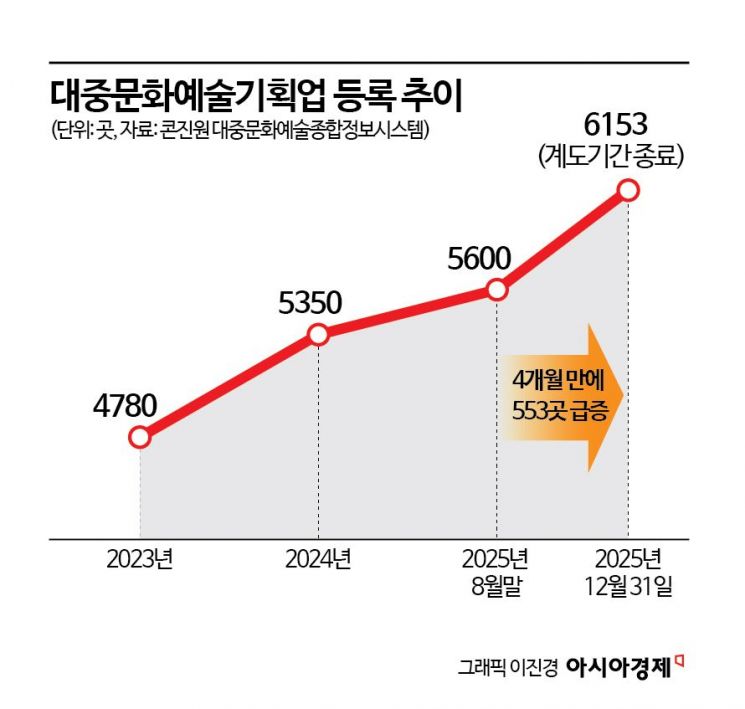
A large number of unregistered one-person agencies, operated by celebrities or their family members, have recently registered as official pop culture and arts planning businesses. This comes about four months after The Asia Business Daily exclusively reported on the illegal business practices of one-person agencies in September of last year. As the voluntary reporting and guidance period set by the Ministry of Culture, Sports and Tourism ended on December 31, hundreds of agencies, concerned about potential crackdowns, rushed to obtain registration certificates belatedly.
According to the Ministry of Culture, Sports and Tourism and the Korea Creative Content Agency, as of December 31, 2025, there were a total of 6,153 officially registered agencies. This marks an increase of over 500 agencies in just four months, from about 5,600 in September of last year. Notably, 177 agencies registered in December alone, just before the end of the guidance period. This means that 70% of the total increase in 2024 (about 570 agencies) occurred within just three to four months.
Top Stars Rush to Register... To Avoid Legal and Tax Risks
Former football player Lee Dongguk registered "Daebak Dreams," which he established in 2021, only on December 30 of last year. Singer Yoon Jongshin also recently reported "Monthly Yoon Jongshin," which he has operated since 2011, and Hong Seokcheon registered "My S Entertainment," founded in 2014, in November of last year. Actors such as Song Kangho, Choi Soojong, Song Yoona, Park Jungmin, Pyo Yejin, Jung Sanghoon, as well as broadcasters Nam Heesuk, Ji Seokjin, and Park Sungkwang, all received registration certificates between October and December of last year. Broadcaster and chef Lee Yeonbok, lecturer Kim Changok, and show host Dong Jihyun also completed their registrations. Many of these individuals operated without registration for several months, or even up to nearly 10 years, but only began the registration process after facing public criticism and the possibility of crackdowns.
 (From left, clockwise) Nam Heesuk, Park Jungmin, Ji Seokjin, Song Kangho, Pyo Yejin, Yoo Ahin, Jung Sanghoon, Yoon Jongshin, Lee Dongguk, Song Yoona. Ninecoms, Sam Company, Esteem, Galaxy Corporation, Secret ENT, UAA, Jam Entertainment, JTBC, Saenggak Entertainment, The Asia Business Daily DB.
Actor Yoo Ahin (real name Eom Hong-sik), who received a suspended sentence for drug use, registered "U Company LLC" in Suseong-gu, Daegu, on December 22, just nine days before the guidance period ended. The legal community views this as a typical case of managing legal risk. If he were to receive a penalty heavier than a fine for unregistered illegal business activities during his probation period, the suspended sentence would be revoked and he would have to serve his prison term.
Cultural critic Kim Heonsik pointed out, "One-person agencies are essentially family-run businesses, making it difficult to implement internal checks and oversight. The fact that they rush to register only after facing legal risks shows that their motivation for joining the official system is not to ensure transparency, but rather to avoid responsibility."
The Ministry of Culture, Sports and Tourism has announced that it will take legal action against unregistered businesses even after the guidance period, including requesting investigations or conducting administrative inspections. Minister Choi Hwi-young emphasized during last year's National Assembly audit, "We will quickly bring unregistered agencies under the management system and conduct a full investigation of the current situation." However, there are criticisms that the ministry lacks direct enforcement authority and has insufficient personnel for investigations, so detection relies heavily on public complaints. The ministry's guidelines are also criticized for being merely administrative recommendations without legal force, thus lacking effectiveness.
Separately, the Korea Entertainment Management Association has announced plans for retroactive prosecution. They intend to hold those responsible for unregistered business activities accountable, regardless of whether they have since registered, as long as the statute of limitations has not expired. A representative from the association stated, "Operating without registration for years is by no means a minor issue. Belated registration does not legitimize illegal profits." He added, "For habitual and intentional unregistered businesses, we will simultaneously file complaints and petition for severe punishment to restore discipline in the market."
Proliferation of 'Home-Based Agencies' Amid Lax Regulations
There are also criticisms regarding the lax registration requirements and ineffective regulations. The current "Act on the Development of the Pop Culture and Arts Industry" stipulates that at least two years of industry experience is required for agency registration, but the Ministry of Culture, Sports and Tourism allows registration after just 40 hours of training. There is no separate evaluation process after completing the training, resulting in merely a formal process. This system has paved the way for family members with no management experience to become corporate representatives, leading to a proliferation of "home-based" agencies. In fact, since the implementation of this system, there has not been a single case of fines imposed for failing to complete the required training.
Bae Seonghee, Deputy Legislative Researcher at the National Assembly Research Service, recently pointed out in a report, "The current registration system focuses only on whether an agency is registered, without evaluating its capabilities or accountability. As a result, the original purpose of protecting artists has been weakened due to the formalization of the system." Entertainment law specialists have also expressed concern that "replacing practical experience with training undermines industry expertise and may lead to increased legal disputes over settlements and contracts."
Tax authorities are also tightening their oversight. The National Tax Service is monitoring the possibility that one-person agencies may be abused as tax evasion channels disguised as tax-saving schemes. While the highest personal income tax rate, including local taxes, reaches up to 49.5%, the maximum corporate tax rate is around 24%, making corporate establishment attractive for high-income celebrities. However, there are concerns about various schemes, such as falsely listing family members as employees to inflate labor costs or diverting corporate funds for personal use.
The National Tax Service plans to provide guidance on types of tax evasion schemes and respond strictly with tax audits. Commissioner Lim Gwanghyun of the National Tax Service has stated, "If tax evasion is detected, we will take thorough measures, including tax audits."
No Jongun, Managing Partner at Jonjae Law Firm, advised, "Ignorance of the law does not exempt one from liability. If you operate a separate one-person agency while already having a management company, you must carefully review the appropriateness of your tax treatment."
© The Asia Business Daily(www.asiae.co.kr). All rights reserved.


















