Final Trial for Rebellion Ringleader Charge Postponed to January 13
Defense Team’s ‘Trial Delay Strategy’ Extends Proceedings Beyond 12 Hours
Court: “We Wanted to Give Everyone Ample Opportunity to Speak”
Sentencing Recommendation and Final Statements to Proceed on January 13
The final trial for former President Yoon Seokyeol, who faces charges as the ringleader of the 12·3 Martial Law Incident, considered the core of the case, has been postponed to January 13. The sentencing hearing was originally scheduled for this day, with the special prosecutor Cho Eunseok’s team set to present their sentencing recommendation and former President Yoon expected to deliver his final statement. However, as the defense team employed a 'trial delay strategy' and the proceedings extended beyond 12 hours, an additional court date was scheduled.
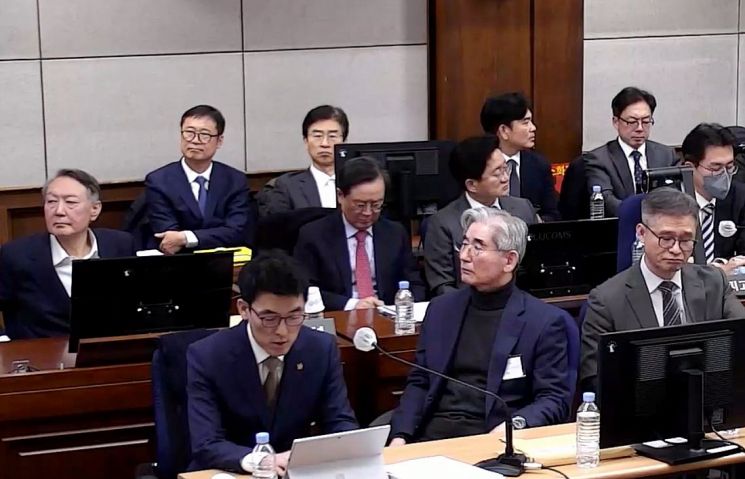
The Criminal Division 25 of the Seoul Central District Court (Presiding Judge Ji Guyoun) convened the final trial at around 9:20 a.m. for former President Yoon Seokyeol’s rebellion ringleader charges, as well as for former Defense Minister Kim Yonghyun and seven other senior military and police officials charged with engaging in key rebellion-related duties, and made this announcement.
The court had planned to conclude arguments during this session, but due to the defense’s so-called 'courtroom filibuster' strategy, the trial continued for about 12 hours. Presiding Judge Ji stated, "It is not the court’s intention to drag out the proceedings, but we wanted to give everyone ample opportunity to speak," adding, "It seems fair and efficient to allow those who have prepared to speak while they still have the energy."
A lawyer for former President Yoon said, "Other attorneys are expected to finish (the documentary evidence review), and we anticipate our turn will come around 1 a.m. However, it is not appropriate for us to make the most important argument for former President Yoon while in a drowsy state." The defense teams for former Minister Kim and the other defendants agreed.
On this day, former President Yoon appeared in court in person at around 9:22 a.m. He wore his hair short and was dressed in a navy suit, holding a document envelope in one hand and sitting in the defendant’s seat with a faint smile. Throughout the proceedings, former President Yoon kept his eyes closed. He was also seen smiling and whispering to his defense team.
Former President Yoon was indicted and detained in January of last year on charges of inciting a riot on December 3, 2024, by declaring martial law and attempting to subvert the constitutional order. He is also accused of attempting to arrest and detain key figures such as President Lee Jaemyung (then leader of the Democratic Party of Korea) and former People Power Party leader Han Donghun, as well as blocking the National Assembly to obstruct a vote to lift martial law.
The statutory penalties for the charge of rebellion ringleader are limited to three options: death, life imprisonment, or life penal servitude. Previously, prosecutors sought the death penalty for former President Chun Doohwan, who was indicted on similar charges. The court of first instance sentenced him to death, but the appellate court commuted the sentence to life imprisonment, which was ultimately upheld by the Supreme Court.
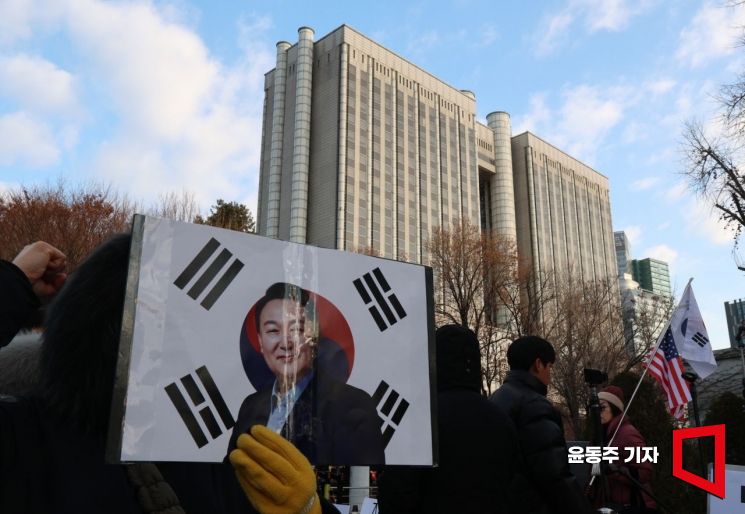 On the 9th, in front of the Seoul Central District Court where the sentencing hearing for former President Yoon Seokyeol, accused of leading a rebellion, was held, a supporter is holding a photo of former President Yoon. 2025.01.09 Photo by Yoon Dongju
The special prosecutor’s team held a six-hour meeting the previous day to determine the sentencing recommendation for former President Yoon. The team concluded there were no mitigating circumstances and is weighing either the death penalty or life imprisonment. During the meeting, some argued that the severity of the crime, Yoon’s consistent evasion of responsibility throughout the trial, and his lack of remorse warranted the death penalty. However, others suggested that, considering the potential social repercussions and the likely actual sentence, recommending life imprisonment would be more appropriate.
The verdict for the first trial is expected no later than mid-February. Even in rebellion cases, if there are extenuating circumstances, the judge may reduce the sentence. The death penalty can be commuted to life imprisonment or 20 to 50 years in prison or penal servitude, while life imprisonment or life penal servitude can be reduced to 10 to 50 years in prison or penal servitude.
© The Asia Business Daily(www.asiae.co.kr). All rights reserved.


















