Cumulative Current Account Surplus Reaches $101.82 Billion from January to November
Annual Record of $105.12 Billion Set in 2015 Nearly Matched
Bank of Korea Forecast of $115 Billion for the Year Likely to Be Surpassed
However, Trade Surplu
Last year, it was virtually confirmed that the current account surplus reached an all-time high. The cumulative current account surplus from January to November already amounted to 101.82 billion dollars, coming very close to the previous annual record of 105.12 billion dollars set in 2015. It is also expected that the Bank of Korea's forecast of a 115 billion dollar surplus, presented in its economic outlook last November, will be easily achieved. To meet this forecast, the required surplus for December is 13.18 billion dollars.
The size of this year's current account surplus is also projected to surpass last year's record high. The Bank of Korea’s forecast for this year is 130 billion dollars. However, it is expected that, as with last year, robust semiconductor exports driven by increased investment in artificial intelligence (AI) will continue to underpin the current account surplus. According to customs clearance data, last year’s trade surplus increased by 21.9% year-on-year, but if semiconductors are excluded, it actually decreased by 1.0%.
 On the 9th, at the Bank of Korea in Jung-gu, Seoul, during the press briefing on the "Preliminary International Balance of Payments for November 2025," (from left) Kim Taeho, Manager of the International Balance of Payments Team, Song Jaechang, Head of the Financial Statistics Department, Park Seonggon, Head of the International Balance of Payments Team, and Kim Junyoung, Manager of the International Balance of Payments Team, are answering questions. Bank of Korea
Semiconductor and Passenger Car Exports Both Strong... Goods Account Surplus Marks Fourth Largest on Record
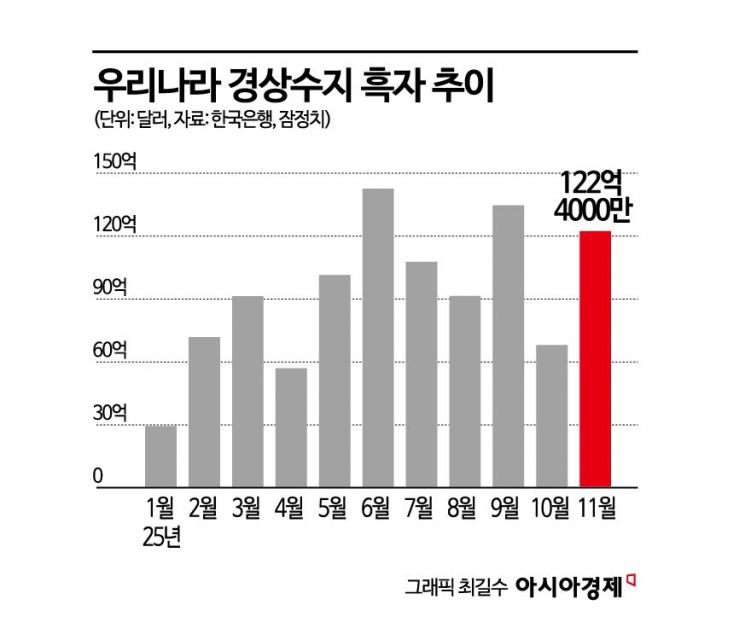
According to the "Preliminary International Balance of Payments for November 2025" released by the Bank of Korea on the 9th, Korea's current account surplus in November last year was 12.24 billion dollars, the highest ever for the month of November. This marks the 31st consecutive month of surplus since May 2023, the second longest streak since the 2000s. The size of the surplus increased compared to both the same period last year (10.05 billion dollars) and the previous month (6.81 billion dollars).
The goods account, which makes up the largest portion of the current account, posted a surplus of 13.31 billion dollars. This is the highest November figure ever and the fourth largest surplus on record. The surplus widened compared to both the same month last year (9.88 billion dollars) and the previous month (7.82 billion dollars). This was due to increased exports of semiconductors and passenger cars, as well as a decrease in imports resulting from falling energy prices.
Exports totaled 60.11 billion dollars, up 5.5% from the same period last year. The increase in IT products, led by semiconductors, expanded significantly, while non-IT products also saw a reduction in the rate of decline, with passenger car exports increasing, resulting in a turnaround to growth for the first time in two months. In November last year, semiconductor exports based on customs clearance amounted to 17.44 billion dollars, a sharp increase of 38.7% year-on-year, driving the overall IT export growth rate (24.3%). Exports of computer peripherals increased by 3.2%, while wireless communication devices fell by 6.1%. Non-IT products (-0.6%) saw declines in steel products (-9.9%), chemical products (-6.3%), and machinery and precision instruments (-1.0%), but the decrease was offset by a 10.9% increase in passenger car exports, which reached 6.05 billion dollars.
Imports stood at 46.8 billion dollars, down 0.7% from the same month last year. Despite increases in passenger car imports and continued growth in gold imports, which drove a 19.9% increase in consumer goods, imports of raw materials decreased for the second consecutive month, mainly due to falling energy prices (-7.9%). In November last year, raw material imports based on customs clearance were 21.85 billion dollars, a decrease of 7.9% year-on-year. Imports of gas (-33.3%), petroleum products (-16.9%), crude oil (-14.4%), and coal (-1.2%) all declined, while chemical products increased by 5.6%. Imports of capital goods rose by 4.7% to 20.06 billion dollars. While imports of semiconductor manufacturing equipment (-7.6%) and semiconductors (-3.2%) decreased, imports of transportation equipment (20.4%) and information and communication devices (16.5%) increased. Consumer goods imports surged by 19.9% to 9.38 billion dollars, with gold imports skyrocketing by 554.7% and durable consumer goods increasing sharply by 51.8%.
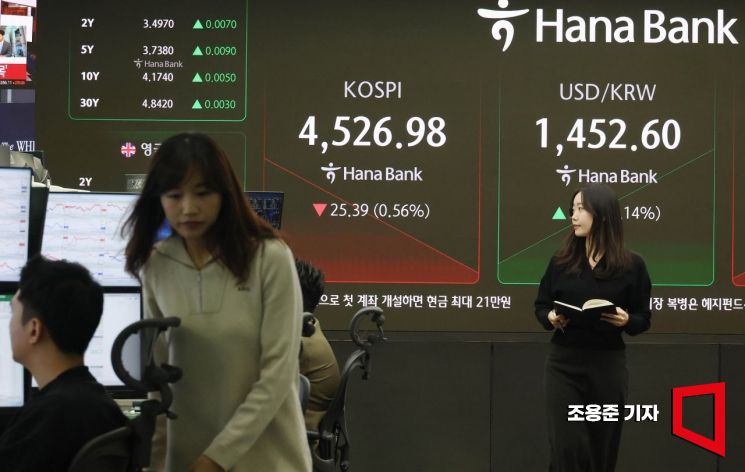 On the 9th, the status board in the dealing room at the Hana Bank headquarters in Jung-gu, Seoul, displayed the KOSPI and the won-dollar exchange rate.
The Number of Outbound Travelers, Which Surged During Chuseok, Declines Again, Reducing the Service Account Deficit
The service account recorded a deficit of 2.73 billion dollars, but the deficit narrowed compared to the previous month (3.75 billion dollars). The decrease in the number of outbound travelers, which had surged during the Chuseok holiday, led to a reduction in the travel account deficit (-960 million dollars). The surplus in the telecommunications, computer, and information services account (460 million dollars) expanded as the temporary increase in computer service payments seen in the previous month dissipated.
The primary income account surplus (1.85 billion dollars) decreased compared to the previous month (2.94 billion dollars). The surplus in the dividend income account (1.25 billion dollars) also narrowed from the previous month due to the impact of quarterly dividend payments from securities investments.
Net external assets in the financial account, calculated as assets minus liabilities, increased by 8.27 billion dollars, expanding from the previous month's increase of 6.81 billion dollars. Direct investment saw overseas investments by domestic residents rise by 4.09 billion dollars, while foreign direct investment in Korea increased by 1.76 billion dollars. In the securities investment account, overseas investment by domestic residents increased by 12.26 billion dollars, mainly in stocks. However, the increase in overseas stock investment by domestic residents (12.54 billion dollars) was smaller than the previous month (18.04 billion dollars). Foreign investment in domestic securities increased by 5.74 billion dollars. While investment in stocks decreased by 9.2 billion dollars due to concerns about overheating in the domestic stock market and weakened investor sentiment, investment in bonds increased significantly by 14.95 billion dollars, mainly in long-term bonds. Derivatives increased by 1.12 billion dollars. In other investments, assets decreased by 220 million dollars, mainly in loans, while liabilities increased by 3.17 billion dollars, mainly in borrowings. Reserve assets increased by 1.7 billion dollars.
If the December Current Account Surplus Exceeds 3.3 Billion Dollars, a New Record Will Be Set... Bank of Korea's Forecast Also Likely to Be Met
As a result, the cumulative current account surplus for January to November last year reached 101.82 billion dollars, the highest ever recorded for the period. On an annual basis, it is highly likely to surpass the previous record of 105.12 billion dollars set in 2015. It is also expected that the Bank of Korea’s annual forecast of 115 billion dollars will be comfortably achieved.
Song Jaechang, Head of the Financial Statistics Department at the Bank of Korea's Economic Statistics Department 1, stated, "The trade surplus based on customs clearance in December last year expanded significantly to 12.18 billion dollars compared to the previous month," adding, "Given how strong the December figures are, we are certain to reach the Bank of Korea's Research Department forecast of 115 billion dollars for the year as a whole."
However, it is assessed that last year's record current account surplus relied heavily on strong semiconductor exports. The trade surplus based on customs clearance increased by 21.9% year-on-year, but excluding semiconductors, it decreased by 1.0%. Song explained, "Due to factors such as a decline in exports to the United States of tariffed items, the trade surplus excluding semiconductors decreased slightly," adding, "Considering the high base of the previous year and the impact of U.S. tariffs, this is a meaningful trend, but it is clear that semiconductors drove the surplus." He predicted, "The robust semiconductor exports driven by expanded AI investment will continue this year as well," forecasting that this year's current account surplus will reach 130 billion dollars.
© The Asia Business Daily(www.asiae.co.kr). All rights reserved.



















