Direct Criticism of Metropolitan Concentration at Transmission Line Rally
"Semiconductors, Energy, and Balanced Development Must Be Completely Reconsidered"
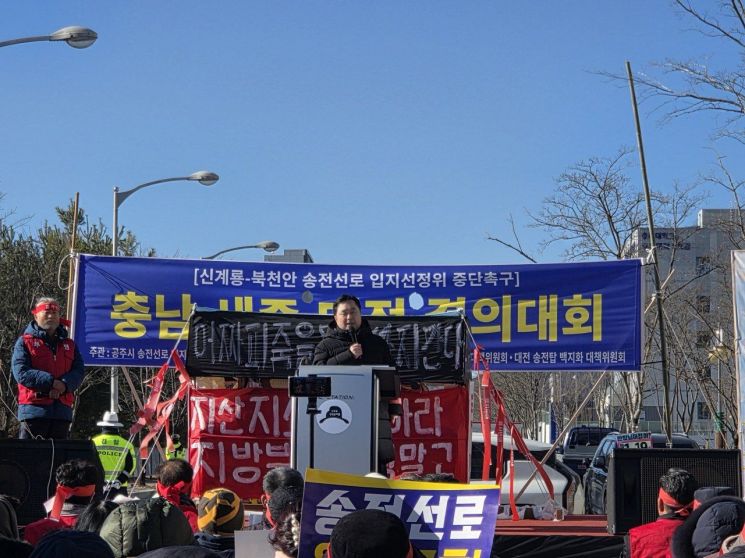 Paek Jongmin, a member of the National Assembly, said at the rally of the Countermeasure Committee for the Cancellation of the Daejeon-Sejong-Chungnam Transmission Line on the 8th, "If 90% of the 620 trillion won investment in advanced industries, which is equivalent to the national budget for one year, is again concentrated in the metropolitan area with 560 trillion won, the future of Korea for the next 100 years will go down the wrong path." / Office of Paek Jongmin
There has been a claim that if the structure in which 90% of the 620 trillion won national advanced industry investment is again concentrated in the metropolitan area becomes entrenched, the next 100 years of Korea's future will be set on the wrong track. Independent Assemblyman Paek Jongmin defined the transmission line issue not as a local complaint, but as a matter of national strategy, and publicly proposed a semiconductor decentralization strategy.
Assemblyman Paek Jongmin (Sejong City Gap, Trade, Industry and Energy Committee) said at the rally of the Countermeasure Committee for the Cancellation of the Daejeon-Sejong-Chungnam Transmission Line on the 8th, "If 560 trillion won, which is 90% of the 620 trillion won advanced industry investment equivalent to the national budget for one year, is again concentrated in the metropolitan area, the next 100 years of Korea's future will be on the wrong path."
According to Assemblyman Paek, following the decision of the National Advanced Strategic Industry Committee in July 2023, 562 trillion won out of the 620 trillion won investment in 'advanced industry and new materials, parts, and equipment specialized complexes' was allocated to the Yongin-Pyeongtaek semiconductor specialized complex.
In addition, in the designation of the bio-specialized complex in June 2024, 25.7 trillion won out of the total 36 trillion won was decided to be invested in the Samsung Bio Mega Cluster in Songdo, Incheon.
Assemblyman Paek stated, "If 90% of the national investment amount is concentrated in the metropolitan area, the disappearance of regional areas will inevitably accelerate," and added, "If things continue this way, Yeongho-nam will become a ghost town."
He particularly emphasized, "TSMC, the world's leading company, is dispersing its semiconductor plants to five locations in consideration of disaster preparedness such as earthquakes, industrial security, and geopolitical risks. The key to competitiveness is not concentration, but decentralization."
Assemblyman Paek also pointed out during the 2024-2025 National Assembly audits of the Ministry of Trade, Industry and Energy that a decentralization strategy should be considered to ensure the sustainable competitiveness of the semiconductor industry.
He asserted, "The transmission line issue is not a problem for just our neighborhood, but a problem for all of Korea. It also becomes an obstacle to RE100 and exports. From the perspectives of semiconductor and energy industry strategies, national balanced development, and these three aspects, it must be thoroughly reviewed."
He went on to suggest, "Semiconductor industrial complexes should be distributed to Honam, which has solar power, and Yeongnam, which has wind power and deep-sea water resources," presenting an alternative for the semiconductor decentralization strategy.
© The Asia Business Daily(www.asiae.co.kr). All rights reserved.

















