Number of Diagnosed Plagiocephaly Cases Increases 25-Fold in 15 Years
99% of Diagnosed Patients Are Infants and Young Children Under Five
When a baby's head appears flat on one side or asymmetrical, it is often dismissed as a simple postural issue. However, since the treatment approach for cranial deformation in infants varies depending on the underlying cause, early assessment is crucial. Recently, as cranial correction helmets have become more common, concerns are also growing about unnecessary treatments and the financial burden they may cause.
On January 7, the Health Insurance Review and Assessment Service announced that the number of patients diagnosed with plagiocephaly reached 10,100 in 2024, marking a 25-fold increase over the past 15 years. In 2010, there were only 409 patients, but as cranial correction helmets and pillows became widely known, the number rose exponentially, surpassing 5,585 in 2018 and exceeding 10,000 for the first time in 2024. Of those diagnosed, 99% were infants and young children under the age of five.
The Most Common Cause of Cranial Deformation: 'Positional Plagiocephaly'
The most common cause of cranial deformation in infants and young children is plagiocephaly. Plagiocephaly occurs when a baby lies in the same position for a long time or prefers a specific direction, resulting in repeated pressure on the same area of the head and causing asymmetry. In particular, it often leads to flattening on one side of the back of the head. Medically, treatment is considered when the diagonal length difference between the left and right sides of the head is 6 to 10 millimeters or more. For brachycephaly, where the entire back of the head is flattened, correction is recommended if the cranial ratio exceeds 85 to 90 percent.
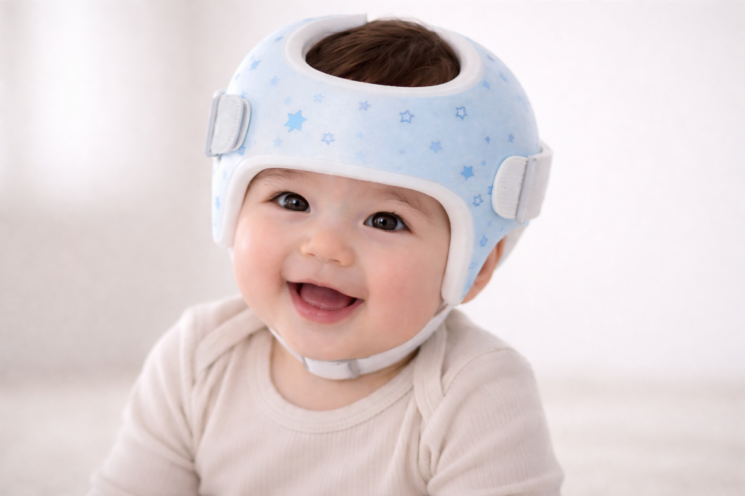
 The most common cause of cranial deformation in infants is plagiocephaly. Plagiocephaly occurs when a baby lies in the same position for a long time or prefers a specific direction, causing repeated pressure on the same area of the head, leading to asymmetry. The photo is not related to the specific content of the article. Pixabay
However, in mild cases, spontaneous improvement without treatment is not uncommon. Plagiocephaly can also be accompanied by torticollis, a condition in which the head tilts to one side due to problems with the neck muscles or nerves, causing the child to look in only one direction and potentially worsening cranial asymmetry.
Although rare, there are also conditions such as craniosynostosis, where the cranial sutures fuse earlier than normal. In these cases, it is not merely a cosmetic issue but can affect brain development, making a specialist's diagnosis essential. Mild cranial deformation can often be sufficiently improved through postural correction alone. The basic principle is to frequently change the direction of the baby's head when lying down and to encourage the protruding area to touch the floor. Increasing 'Tummy Time' while the baby is awake can also be helpful.
When Is Helmet Therapy Necessary?
Helmet therapy for cranial correction may be considered when cranial deformation is pronounced or accompanied by torticollis. The helmet is a medical device that does not reshape the head through pressure, but rather guides the skull to grow in the needed direction during development. Each helmet costs between 2 million and 3 million won. The corrective effect is greatest before three to six months of age, and it is only meaningful if started no later than fifteen months. For the treatment to be effective, the helmet must be worn for more than twenty hours a day on average.
The problem is that even when helmet therapy is not strictly necessary, more parents are opting for it due to cosmetic concerns or marketing that plays on anxiety. In particular, after the children of well-known celebrities were seen wearing helmets, related posts have surged on online parenting communities and social media. However, some experts warn that unless the child has craniosynostosis, which can delay brain development, helmet therapy could actually be harmful. Experts emphasize, "If you are concerned about your child's head shape, you should first consult a pediatrician or neurosurgeon rather than seeking helmet therapy," adding, "Not all cases of plagiocephaly require treatment, and it is most important to tailor the approach to the child's developmental stage and the underlying cause."
© The Asia Business Daily(www.asiae.co.kr). All rights reserved.


















