Luncheon Meeting at the Blue House with Gwangju and Jeonnam Lawmakers on January 9
Kang Gijeong and Kim Youngrok Join to Discuss Key Integration Issues
First Meeting Between the President and Local Political Leaders Since the Joint Declaration
Residents' Briefing to Follow Luncheon, Outlining Future Integration Plans
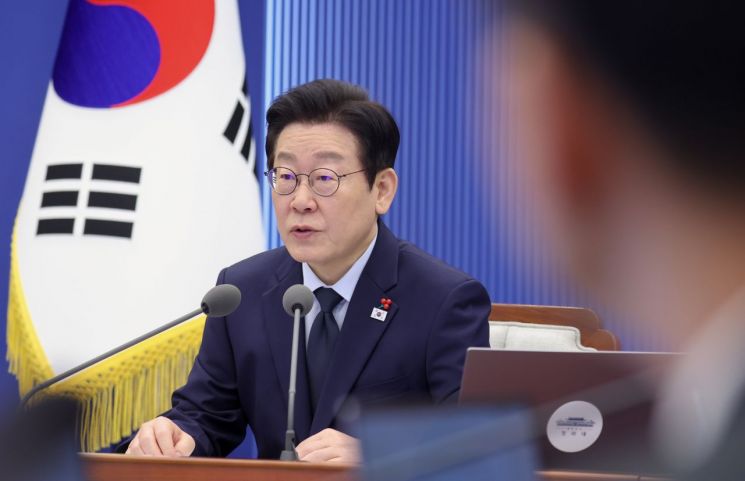 President Lee Jae-myung is speaking at the Senior Secretary Meeting held at the Blue House on the 8th. Photo by Yonhap News
The discussions on the administrative integration of Gwangju and Jeonnam are reaching a critical juncture. As President Lee Jaemyung is set to host a luncheon meeting at the Blue House on January 9 with the mayors and governors of Gwangju and Jeonnam, as well as local National Assembly members, attention is focused on whether the integration talks will move beyond declarations and become more concrete.
According to the presidential office and political circles, President Lee will invite Kang Gijeong, Mayor of Gwangju, Kim Youngrok, Governor of Jeonnam, and 18 National Assembly members from the Gwangju and Jeonnam regions (8 from Gwangju and 10 from Jeonnam) to the Blue House for a luncheon meeting to discuss regional issues, including administrative integration.
This is the first time that the President, mayors, governors, and local legislators will gather in one place to discuss the administrative integration of Gwangju and Jeonnam. With the agenda reportedly including the "discussion of the Gwangju-Jeonnam integration issue," there is a possibility that opinions will be exchanged regarding the method, procedure, and timing of the integration.
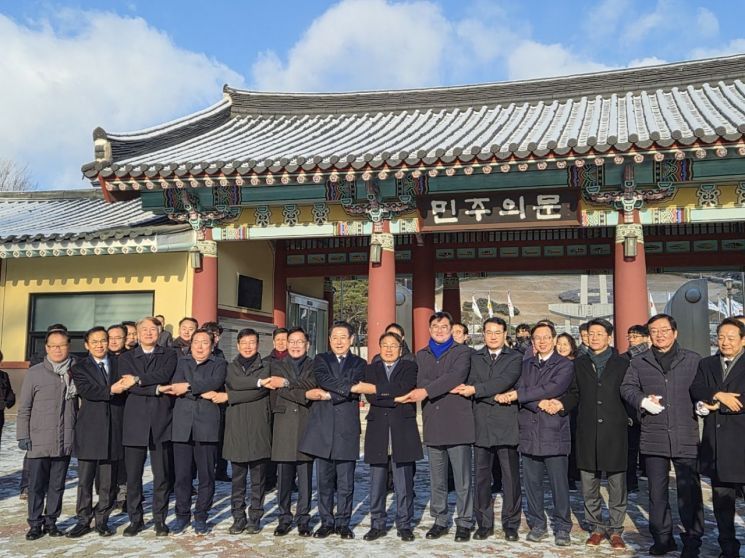 On the morning of the 2nd, prominent figures from Gwangju and Jeonnam are holding hands and taking a commemorative photo in front of the Democracy Gate at the National May 18th Democratic Cemetery in Buk-gu, Gwangju. Photo by Song Bohyun
The momentum for administrative integration between Gwangju and Jeonnam has been accelerating since Mayor Kang and Governor Kim announced a "Joint Declaration for Grand Integration" on January 2. On the same day, President Lee also shared a related article on X (formerly Twitter), stating, "Following Daejeon and Chungnam, the integration of metropolitan governments, which once seemed difficult, is gradually gaining momentum in Gwangju and Jeonnam as well." He added, "It appears that public consensus is forming around the need to overcome the Seoul-centric system and open a new path for region-led growth."
The city of Gwangju and Jeonnam Province both launched administrative integration task forces on January 5 and have begun practical preparations. With the National Assembly's deadline for passing the Gwangju-Jeonnam Integration Special Act set for February 28, both local governments plan to determine whether and how to proceed with integration through public opinion gathering and deliberation processes involving local residents.
Kang Hunsik, Chief Presidential Secretary, recently stated in a radio interview, "I believe we will see the broad outlines of integration emerge." On January 6, Shin Jeonghun, Chairman of the National Assembly's Public Administration and Security Committee, also held a press conference at the Gwangju City Council briefing room, saying, "Let's pave the way for a major transformation into a decentralized state and the renewed leap forward of the Republic of Korea," and added, "I will make a direct proposal when I meet the President on the 9th."
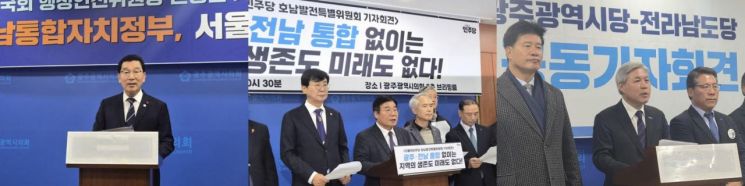 Regarding the administrative integration of Gwangju and Jeonnam, Shin Jeonghoon, Chairman of the National Assembly's Public Administration and Security Committee, the Special Committee for Honam Development, and the National Innovation Party have each expressed the necessity of promoting integration through separate press conferences. Photo by Song Bohyun
Political parties and local political circles are also voicing their positions regarding the administrative integration discussions. On January 8, the Gwangju-Jeonnam branch of the National Innovation Party held a joint press conference at the Gwangju City Council, stating, "The administrative integration of Gwangju and Jeonnam is not merely a matter of adjusting administrative boundaries, but a core task for the national balanced development strategy." They emphasized that a concrete vision encompassing decentralization, industry, and the transition of living areas must also be presented. The National Innovation Party stressed the need for a special law after integration that clearly guarantees autonomy and financial authority equivalent to those of Seoul Metropolitan City.
The Special Committee for Honam Development also held a press conference on the same day, urging the swift promotion of integration. The committee stated, "Gwangju and Jeonnam already function as a single living and economic zone," and added, "Administrative integration is not a matter of choice, but a task that determines the survival and sustainable future of the region." They further argued that the momentum for integration should be maintained by promptly passing the special integration law in the National Assembly and electing a unified head of the integrated local government in the June 3 local elections.
Meanwhile, after meeting with President Lee, Mayor Kang and Governor Kim will immediately travel to Gwangju, where they plan to hold a "Gwangju-Jeonnam Administrative Integration Residents' Briefing" at the Kim Daejung Convention Center in the afternoon to explain the results of their meeting and the future direction of the integration process.
© The Asia Business Daily(www.asiae.co.kr). All rights reserved.



















