Supply Contract Signed with Tesla Last Year
Significant Reduction in Fourth-Quarter Deficit Analyzed
As Samsung Electronics enjoys a semiconductor boom, prospects for improved performance in its foundry (semiconductor contract manufacturing) business-which has struggled in recent years-are growing stronger. Having successfully reversed the mood by securing a series of orders from global companies last year, the company is expected to further boost its performance this year.
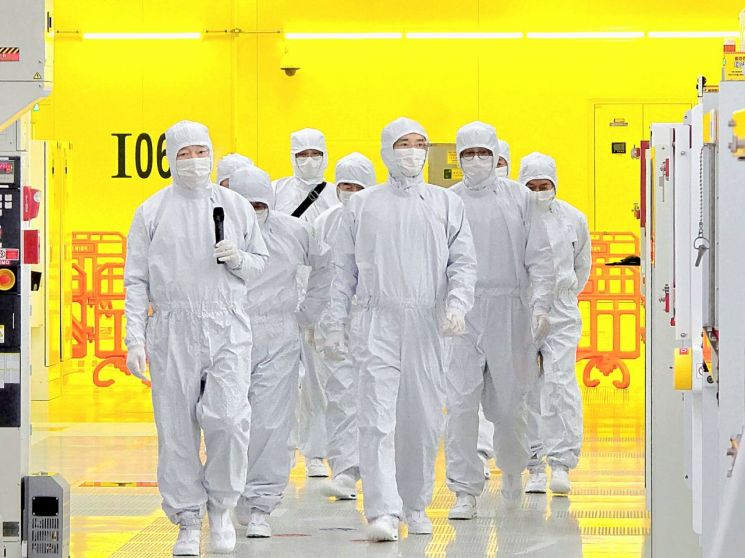 Samsung Electronics Chairman Lee Jae-yong is inspecting the NRD-K cleanroom facility, an advanced integrated semiconductor research and development (R&D) center, at Samsung Electronics' Giheung Campus on the 22nd. Samsung Electronics
According to industry sources on January 8, Samsung Electronics is on the verge of securing a 2-nanometer (nm, one-billionth of a meter) chip order from AMD, and is also expected to partner with Qualcomm, a U.S. mobile application processor (AP) company. Qualcomm is considering entrusting the production of its next-generation APs to Samsung Electronics. Among foundry companies, Samsung Electronics was the first to begin discussions with Qualcomm about contract manufacturing using the latest 2-nanometer process. If the contract is finalized, Samsung will resume production of Qualcomm’s cutting-edge products for the first time in five years, since 2022. Until 2021, Qualcomm had Samsung Foundry produce its most advanced APs, but later shifted its business to Taiwan’s TSMC.
Previously, in July last year, Samsung Electronics signed a supply contract worth approximately 23 trillion won with Tesla in the United States, marking the beginning of a recovery in its foundry business. Although the provisional results did not disclose performance by business segment, analysts believe that the deficit has been significantly reduced. Regarding the fourth quarter results announced last year, Park Yuak, a researcher at Kiwoom Securities, specifically estimated, “The operating loss in the foundry business is expected to shrink to 448 billion won.”
Samsung Foundry is also shaking up the competitive landscape by taking on part of the orders from clients that previously went exclusively to TSMC, which had long held a dominant position in the global market. While many analysts attribute this opportunity to TSMC reaching full capacity and being unable to handle additional orders from many clients, there is also a view that improvements in Samsung’s foundry technology are fundamentally behind this shift.
As a result, competition with TSMC over the 2-nanometer process is expected to intensify. Samsung Foundry is reportedly receiving orders to produce chips using the 2-nanometer process from companies such as AMD, Qualcomm, and Broadcom, while TSMC is also said to have begun mass production of 2-nanometer chips. On January 6, Taiwanese and Chinese media outlets-including Central News Agency, United Daily News, and China Times-reported that TSMC’s Fab 22 plant in the Nanzi Industrial Park in Kaohsiung, southern Taiwan, entered the mass production stage as scheduled in the fourth quarter of 2025. This suggests that TSMC is proceeding with its roadmap for advanced process nodes, following the 3-nanometer process, as planned. The Kaohsiung Fab 22 is an advanced semiconductor plant that TSMC is developing as a key production base in the southern science park.
TSMC will also announce its fourth-quarter results for last year and present its future roadmap on January 15. Attention is focused on what message it will send to competitors such as Samsung Electronics.
© The Asia Business Daily(www.asiae.co.kr). All rights reserved.
![Clutching a Stolen Dior Bag, Saying "I Hate Being Poor but Real"... The Grotesque Con of a "Human Knockoff" [Slate]](https://cwcontent.asiae.co.kr/asiaresize/183/2026021902243444107_1771435474.jpg)
















