Honam Special Committee: "Administrative Integration of Gwangju and Jeonnam Is a 'Matter of Survival'"
Special Integration Law Expected to Pass in February, Unified Regional Head to Be Elected in June
"Authority and Finances Must Be Consolidated to Build a Mega-Regional Growth Governance System"
"A strong region ensures the survival of the Republic of Korea."
It has been argued that the administrative integration of Gwangju and Jeonnam, being promoted in line with the Lee Jaemyung administration's mega-regional policy direction, is not simply a merger of administrative districts. Rather, it is a process of building an integrated governance system in which dispersed authority, finances, and policy capabilities are consolidated into a single framework, enabling the region to proactively design and implement its own future development strategies.
On the morning of January 8, the Gwangju and Jeonnam members of the Honam Development Special Committee held a press conference in the briefing room on the third floor of the Gwangju Metropolitan Council. They urged the swift promotion of administrative integration, stating, "The administrative integration of Gwangju and Jeonnam is no longer a matter of choice, but an essential task that will determine the survival and sustainable future of the region."
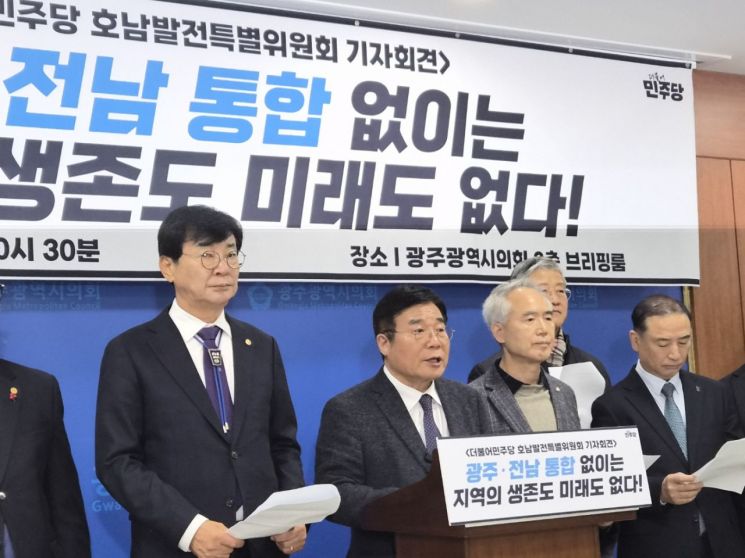 On the morning of the 8th, at the briefing room of the Gwangju Metropolitan Council, Lee Byunghun, Senior Vice Chairman of the Honam Development Special Committee, announced a statement urging the promotion of administrative integration of Gwangju and Jeonnam at a press conference of the Honam Development Special Committee. Photo by Song Bohyun
The Honam Special Committee diagnosed that Gwangju and Jeonnam are facing a complex crisis, including the continued net outflow of young people, population decline, accelerating aging, low income levels, and slowing economic growth. The committee emphasized, "If not now, integration will be difficult." They also stated that the special law for Gwangju-Jeonnam integration should pass the National Assembly in February this year, followed by the election of a unified head of the integrated region in the June local elections, after which specific issues should be addressed step by step.
The Honam Special Committee first presented the fact that Gwangju and Jeonnam already function as a single living and economic zone as the core basis for administrative integration. Despite the organic interconnection between Jeonnam's energy, manufacturing, and agriculture and fisheries base and Gwangju's research and development capabilities, professional workforce, and consumer market, they argued that administrative boundaries have led to repeated overlapping investments and fragmented fiscal management.
The committee further argued that administrative integration is not a political slogan, but a practical solution to improve the quality of life for residents. By operating administration and finances under a unified system and linking policies in industry, transportation, housing, energy, and human resources, policy overlap and inefficiency can be eliminated, which will lead to better living conditions for residents.
In particular, they emphasized that administrative integration is a key task supporting the Lee Jaemyung administration's national balanced growth strategy, known as the "Five Poles, Three Special Zones System." If Jeonnam's potential for renewable energy and energy infrastructure is combined with Gwangju's accumulated capabilities in artificial intelligence (AI), future mobility, and advanced manufacturing industries and research, the integrated Gwangju-Jeonnam region could serve as a new economic axis in the era of AI and energy.
They also stated that, in order to ease the concentration in the Seoul metropolitan area and achieve genuine regional balanced development, institutional and financial support from the central government and the National Assembly is necessary. This includes delegating key authorities to local governments, granting various special exceptions, improving licensing procedures and the preliminary feasibility study system, and applying fast-track measures to create an environment where major policies can be implemented quickly on the ground.
The Honam Special Committee also called for the adjustment of the ratio of national to local taxes, active use of the National Balanced Development Special Account and the Local Extinction Response Fund, and the introduction of an investment incentive package that includes expanded corporate and local tax reductions and research and development (R&D) tax credits.
The Honam Special Committee stated, "The administrative integration of Gwangju and Jeonnam is a turning point that will enable the region to proactively design its future," and added, "In the face of this historic task, we must clearly recognize the region's responsibility and mission of the times and fulfill our role without hesitation."
© The Asia Business Daily(www.asiae.co.kr). All rights reserved.
![Clutching a Stolen Dior Bag, Saying "I Hate Being Poor but Real"... The Grotesque Con of a "Human Knockoff" [Slate]](https://cwcontent.asiae.co.kr/asiaresize/183/2026021902243444107_1771435474.jpg)
















