As Political Discussions Accelerate, Civic Committee Launches
Supporting Special City Initiative with Signature Campaigns and Public Engagement
As discussions on the administrative integration of Gwangju and Jeonnam accelerate, particularly among political circles, citizens in the Gwangju region have officially launched a civic organization supporting the integration of the two regions.
The Gwangju-Jeonnam Special City Promotion Committee, led by Standing Representative Oh Seungyong, held an inaugural ceremony at the Gwangju Metropolitan Council on the morning of January 8, announcing that it will actively pursue the establishment of the "Gwangju-Jeonnam Special City" through administrative integration. The event was attended by over 100 people, including representatives from civic groups and local residents.
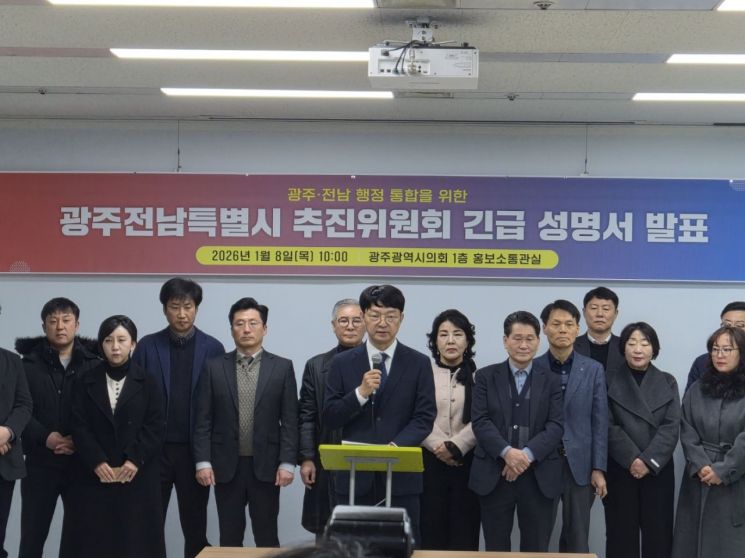 On the morning of the 8th, Oh Seungyong, the standing representative, delivered a statement at the "Emergency Statement Announcement of the Gwangju-Jeonnam Special City Promotion Committee for the Administrative Integration of Gwangju and Jeonnam" held at the Gwangju Metropolitan Council. Photo by Song Bohyun
In a statement released at the inauguration, the committee asserted, "Administrative integration of Gwangju and Jeonnam is an urgent task that cannot be postponed any longer in order to respond to industrial stagnation and the risk of regional extinction." The committee added, "Through administrative integration, we must transform into an ultra-wide economic community and create new opportunities for development."
The committee further diagnosed that the region is facing a complex crisis, citing the outflow of young people, weakened competitiveness of industrial complexes, and worsening business conditions for small business owners. It argued, "Unless we put an end to redundant investments and internal competition caused by administrative boundaries, we cannot guarantee the future of our region."
The committee projected that, if Gwangju and Jeonnam are integrated, a metropolitan economic zone with a population of 3.2 million and a gross regional domestic product (GRDP) of 150 trillion won would be created, enabling competition on equal footing with the Busan-Ulsan-Gyeongnam and Daegu-Gyeongbuk megacities. The committee also emphasized that, by enacting related special legislation, it would be possible to increase the local allocation tax rate and establish a separate account for the National Balanced Development Special Account, thereby expanding fiscal autonomy.
Going forward, the committee plans to launch a province-wide signature campaign urging the swift enactment of the Gwangju-Jeonnam Administrative Integration Special Act, and to broaden public consensus on the necessity of integration through vision briefings and policy forums.
Jung Junho, a Democratic Party lawmaker representing Buk-gu Gap in Gwangju, stated, "Administrative integration is essential for efficient budget execution and revitalizing the stagnant regional economy," adding, "Discussions on integration must not be delayed by political calculations."
© The Asia Business Daily(www.asiae.co.kr). All rights reserved.
![User Who Sold Erroneously Deposited Bitcoins to Repay Debt and Fund Entertainment... What Did the Supreme Court Decide in 2021? [Legal Issue Check]](https://cwcontent.asiae.co.kr/asiaresize/183/2026020910431234020_1770601391.png)















