Foreign Ministers Meet in Paris
Germany: "Greenland's Fate Must Be Decided by Greenland"
Poland: "We Want to Know the Position of the U.S. Congress"
The "Weimar Triangle" of Germany, France, and Poland has publicly criticized the United States for its moves to secure Greenland. As the United States made its ambitions for Greenland explicit, even mentioning military options, major European countries have pushed back, expressing concerns about violations of sovereignty and the international order.
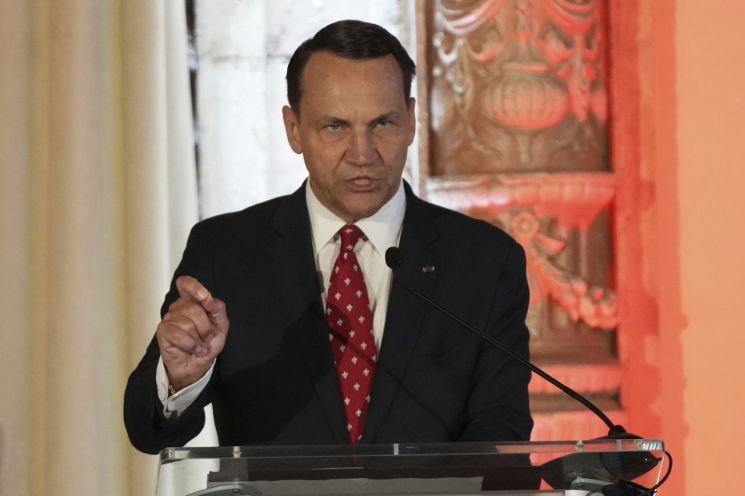
On January 7 (local time), after a meeting in Paris, the foreign ministers of the three countries held a joint press conference, where they voiced concerns and criticism regarding the United States' possible annexation of Greenland. Jean-Noel Barrot, French Minister of Foreign Affairs, stated, "Greenland is not something that can be sold. It is not something that can be taken away." He continued, "The era of buying and selling territories, as with Louisiana, is long over. Such threats must stop." This was a reference to the 1803 sale of Louisiana by France to the United States, which expanded U.S. territory from the Mississippi River to the Rocky Mountains.
Johann Badepuhl, German Minister of Foreign Affairs, also remarked, "The fate of Greenland can only be decided by the people of Greenland and Denmark." He added, "The principles of sovereignty, territorial integrity, and the inviolability of borders, as enshrined in the United Nations Charter, must always be respected. All Arctic security issues should be discussed within the North Atlantic Treaty Organization (NATO)." He further emphasized, "I am confident that this alliance (NATO) will remain the world's foremost defense alliance, as it always has."
Radoslaw Sikorski, Polish Minister of Foreign Affairs, said, "Territorial matters, as well as issues of peace and war, fall within the purview of the United States Congress," adding, "I would like to know the position of the U.S. Congress regarding the Greenland issue." Previously, on January 5, Blake Moore and Steny Hoyer, members of the U.S. House of Representatives and co-chairs of the bipartisan "Friends of Denmark Caucus," issued a statement calling any discussion of annexing Greenland "unnecessary and dangerous," and warned, "This would constitute an attack on NATO."
Recently, U.S. President Donald Trump intervened militarily in Venezuela and arrested President Nicolas Maduro, after which he stated, "We absolutely need Greenland for our defense." White House spokesperson Karoline Leavitt also said in a statement, "Securing Greenland is a national security priority for the United States. It is essential for deterring adversaries in the Arctic region," adding, "The commander-in-chief always has the option of using military force."
As the United States makes its ambitions for Greenland increasingly explicit, concerns are rising that the resulting conflict could go beyond mere diplomatic friction and undermine the very foundation of the transatlantic alliance. Ian Bremmer, president of the U.S. political consulting firm Eurasia Group, said in an interview with CNBC, "European leaders, including those in France and Germany, have been raising concerns about (alliance divisions) for years," adding, "Europe intends to respond not by dismantling itself, but by making itself stronger." He further warned, "If the United States fails to align with these European standards, it will no longer be a trustworthy ally. This poses an existential crisis for the transatlantic alliance."
© The Asia Business Daily(www.asiae.co.kr). All rights reserved.

















