Lunit, a medical artificial intelligence (AI) company, announced on January 8 that it participated as a representative Korean unicorn company at the Korea-China Venture Startup Summit, held as part of President Jae-myung Lee's visit to China.
The summit, hosted by the Ministry of SMEs and Startups, took place at the Shanghai International Exhibition Center in China. More than 400 attendees participated, including President Jae-myung Lee, Kim Yongbeom, Chief of Policy Office at the Presidential Secretariat, Kyunghoon Bae, Deputy Prime Minister and Minister of Science and ICT, Sung Sook Han, Minister of SMEs and Startups, the Chinese Ambassador to Korea, the Korean Ambassador to China, the Vice Mayor of Shanghai, as well as key government officials, representatives from major tech companies from both countries, and members of the investment community.
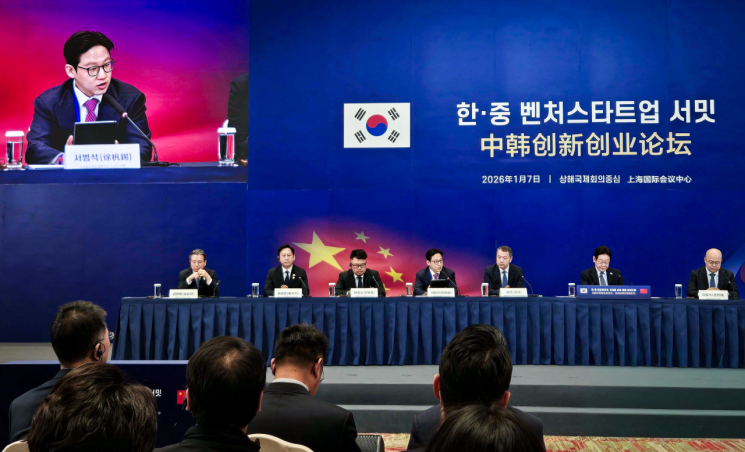 Seobum Seok (center), CEO of Lunit, is presenting as a representative unicorn company of Korea at the 'Korea-China Venture Startup Summit' held on the 7th at the Shanghai International Exhibition Center in China. The event was attended by over 400 government and tech industry officials from both countries, including President Jae-myung Lee (second from right), Kim Yongbeom (left), Chief Policy Officer of the Presidential Office, and Kyunghoon Bae (second from left), Deputy Prime Minister and Minister of Science and ICT. Lunit
Seobum Seok, CEO of Lunit, took part in the “Dialogue with Korea-China Venture Startups” led by the President at the summit, and, alongside BrainCo-a Chinese unicorn company-shared his views on the direction and key initiatives for cooperation between the two countries as representatives of their respective unicorn companies.
During his presentation, CEO Seobum Seok stated, “China’s AI healthcare market is the fastest-growing in the world, expected to expand from 1.6 billion dollars (about 2.3 trillion won) in 2023 to 19 billion dollars (about 27.5 trillion won) by 2030, with an average annual growth rate of 42.5%. We are currently in discussions with global big pharma companies to ensure that our AI biomarker-now under joint research and development with 15 leading pharmaceutical firms worldwide-can be introduced as a companion diagnostic (CDx) in the Chinese market.”
President Jae-myung Lee remarked, “I deeply agree with CEO Seobum Seok’s comment that combining China’s speed and scale with Korea’s reliability and stability will create significant synergy. The purpose of this visit is to establish a new, future-oriented cooperative relationship between our two countries, and the government will provide the utmost support so that companies from both sides can collaborate and achieve shared growth.”
After the summit, CEO Seobum Seok also attended the Korea-China Investment Conference and Global Fund Launch Ceremony, where he held meetings with venture capital and other investors to explore practical investment opportunities. He also met with promising Chinese companies to discuss concrete ways to expand cooperation, such as developing new sales channels.
Lunit first entered the Chinese market in 2020 by establishing its subsidiary, Lunit China, in Shanghai. Since then, the company has supplied its AI products-both directly and indirectly to research and laboratory environments-through global partners with local Chinese branches, including Agilent (a pathology analysis equipment manufacturer), Labcorp (a clinical research organization and diagnostics company), CellCarta, Roche Diagnostics (a diagnostic software platform company), and Indica Labs.
Additionally, Lunit has secured investments from major Chinese and Greater China investors such as Legend Capital and Tybourne Capital, maintaining a long-term, close collaborative relationship with Chinese capital.
© The Asia Business Daily(www.asiae.co.kr). All rights reserved.

















