Ministry of Climate, Energy and Environment Holds Policy Forum on Desirable Energy Mix
Discussing Solutions to Address Intermittency of Renewables and Inflexibility of Nuclear Power
Industry: "Practical LNG Power Generation Needed for Rapid AI Respo
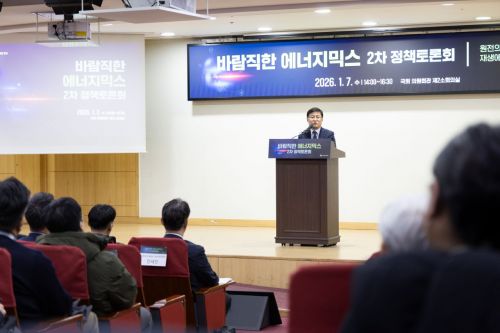 Kim Sung-hwan, Minister of Climate, Energy and Environment, is giving a greeting at the 2nd Policy Forum on Desirable Energy Mix held at the National Assembly Members' Office Building on the 7th. Ministry of Climate, Energy and Environment
"A crucial element is missing from the energy mix discussion. That is the price tag."
At the 2nd Policy Forum on Desirable Energy Mix, hosted by the Ministry of Climate, Energy and Environment and held at the National Assembly Members' Office Building in Yeouido, Seoul, on the afternoon of the 7th, Joo Hankyu, President of the Korea Atomic Energy Research Institute and a panelist, emphasized that generation cost should be a key criterion in discussions about the energy mix of renewables and nuclear power.
Representing the industrial sector, Kim Muhwan, Head of the Energy Solution Business Division at SK Innovation, pointed out that, to realistically address the rapidly increasing power shortages caused by factors such as artificial intelligence (AI) data centers, it is necessary to operate both liquefied natural gas (LNG) power generation and small modular reactors (SMRs) in parallel.
The Desirable Energy Policy Forum was convened to discuss whether to proceed as planned with the construction of two new nuclear power plants, as stipulated in the 11th Basic Plan for Long-term Electricity Supply and Demand. Following a previous forum on December 30, this session presented various strategies to address the intermittency of renewables and the inflexibility of nuclear power. The Ministry of Climate, Energy and Environment plans to finalize the decision on additional nuclear construction in the 12th Basic Plan for Long-term Electricity Supply and Demand later this year, after conducting public opinion surveys and other procedures.
"Both Renewables and Nuclear Must Enhance Flexibility"
Experts at the forum generally agreed that a variety of solutions-not just one or two-should be put on the table and discussed to achieve an effective energy mix of renewables and nuclear power.
Kang Bu-il, Director of System Operations at Korea Power Exchange, explained that, as a prerequisite for achieving eco-friendly energy transition policies, the performance of both renewables and traditional energy sources such as nuclear must be enhanced.
For renewables such as solar and wind to become the main sources of power, flexibility must be strengthened through remote control and integration with energy storage systems (ESS), enabling continuous operation even during transient voltage or frequency changes. Kang stressed that traditional power sources, including nuclear and combined cycle power plants, must also improve their flexibility, such as by adjusting output.
Shin Hocheol, Director of the Central Research Institute at Korea Hydro & Nuclear Power, noted, "Even now, during the spring and autumn daytime hours when the share of solar power is high, we are implementing output reduction operations," adding, "The number of nuclear output reductions, which was seven times in 2024, has risen sharply to 27 times in 2025."
Korea Hydro & Nuclear Power announced that it is developing technologies such as nuclear fuel rod manufacturing, control rod material and manufacturing, online nuclear fuel performance monitoring, output ramp rate guidelines, reactivity control algorithms, core power distribution monitoring, thermal fatigue monitoring systems, operational demonstration, and database (DB) establishment to achieve flexible operation capabilities comparable to those in France. The goal is to achieve daily load-following capability of up to 50% for no more than 100 days per year by 2032.
Son Sungyong, Professor at Gachon University, introduced a variety of technologies to address the intermittency of renewables, including energy storage systems, demand response (DR), pumped storage, V2G (Vehicle-to-Grid), P2H (Power-to-Heat), P2G (Power-to-Gas), virtual power plants (VPP), and output control.
Professor Son pointed out, "Addressing the intermittency of renewables cannot be achieved with a single technology; it must be accomplished through a comprehensive optimization of all available current and future technologies," adding, "It is a complex issue that must also be integrated with national strategic industries."
"ESS Prices for Solar Integration Have Dropped"
In the subsequent panel discussion moderated by Park Jongbae, Professor at Konkuk University, participants included Jeon Younghwan, Professor at the School of Electrical and Electronic Engineering at Hongik University; Han Byungsub, Director of the Nuclear Safety Research Institute; Kim Kangwon, Director of the Renewable Energy Policy Division at Korea Energy Agency; Joo Hankyu, President of the Korea Atomic Energy Research Institute; Lee Jeongik, Professor at the Department of Nuclear and Quantum Engineering at KAIST; Lee Seohye, CEO of E-Consumer; and Kim Muhwan, Head of the Energy Solution Business Division at SK Innovation.
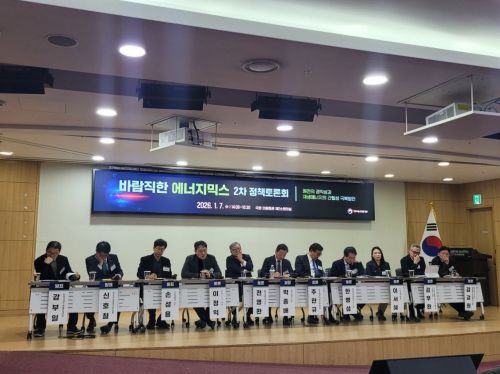 On the afternoon of the 7th, participants are discussing at the Desirable Energy Mix Forum held at the National Assembly Members' Office Building in Yeouido. 2026.1.7 Photo by Kang Hee-jong
President Joo stated, "The load-following role previously handled by LNG power generation must now be taken on by nuclear and renewables," emphasizing, "Renewables can also perform load-following when integrated with ESS."
He explained, "The issue is cost, but as the price of lithium iron phosphate (LFP) batteries has fallen, the generation cost of solar power integrated with ESS can be reduced to about 180 won per kilowatt-hour (kWh)."
President Joo argued that solar-linked ESS should be encouraged, as storing excess electricity in ESS during the day and discharging it at night not only increases solar power revenue but also contributes to grid stability.
Jeon Younghwan, Professor at Hongik University, pointed out that there are many issues to address for flexible operation of nuclear power, such as the need to revise nuclear safety regulations. He asserted, "Nuclear and combined heat and power plants should also participate in the bidding market so that the most cost-effective power sources can survive."
Han Byungsub, Director of the Nuclear Safety Research Institute, explained, "If we adjust the output of nuclear power and utilize renewables' excess electricity elsewhere, many problems can be resolved." He emphasized, "For public acceptance, the release of information is important, and safety issues must be given significant attention."
"Accelerate Flexible Nuclear Operation... LNG's Tactical Role Is Also Key"
Lee Jeongik, Professor at KAIST, said, "The speed of developing output and frequency control technology for domestic nuclear plants can be increased depending on government commitment," adding, "We must add nuclear capacity to maintain competitiveness in manufacturing."
Lee Seohye, CEO of E-Consumer, pointed out, "Consumers support renewables but also want affordable electricity rates," stressing, "The 12th Basic Plan for Long-term Electricity Supply and Demand must also address how to structure electricity rates."
Kim Muhwan, Head of the Energy Solution Business Division at SK Innovation, emphasized, "The global power war triggered by AI and semiconductors is beyond imagination," adding, "We must put every option on the table to cope with rapidly increasing demand."
Kim stressed, "The tactical role of LNG power generation is important," explaining, "In reality, LNG is the only option that can supply the electricity needed for AI data centers in a short time." Regarding the greenhouse gas emissions from LNG power, he emphasized that policies introducing carbon capture, utilization and storage (CCUS) technology, as well as hydrogen-fueled and mixed-fuel power generation, must be implemented in parallel.
He also stated, "SMRs can operate flexibly in parallel," suggesting, "LNG power and SMRs are a realistic portfolio to compensate for the variability of renewables."
Kim Kangwon, Director of the Renewable Energy Policy Division, said, "ESS charge/discharge losses are about 10%," and noted, "We need to consider whether it is more advantageous to store excess renewables or to control their output."
Uljoo Residents Hope for Nuclear Plant... Environmental Groups Call Public Debate 'Nonsense'
During the on-site discussion, a resident from Uljoo, Ulsan, stated, "If additional nuclear construction is decided in the 12th Basic Plan for Long-term Electricity Supply and Demand, Seosaeng-myeon in Uljoo, Ulsan, is the most suitable location."
Meanwhile, environmental group representatives held protests inside and outside the forum venue, holding placards reading, "Stop passing the buck on political responsibility, stop the nonsense public debate." Heated arguments between supporters and opponents of nuclear power also broke out among the audience.
The Ministry of Climate, Energy and Environment plans to decide on additional nuclear construction through public opinion surveys following the two rounds of policy forums. Kim Sung-hwan, Minister of Climate, Energy and Environment, said, "If additional issues are identified, we plan to collect public opinions through various channels, including roundtable discussions."
© The Asia Business Daily(www.asiae.co.kr). All rights reserved.


















