Development of High-Density Large-Particle Single-Crystal Cathode
Paper Published in "Nature Energy"
SK On announced on January 8 that, together with the research team led by Professor Kang Kisuk from the Department of Materials Science and Engineering at Seoul National University, it has developed a high-density single-crystal cathode composed of large particles. This research, published in the world-renowned journal Nature Energy, is recognized for identifying the technical challenges in synthesizing single-crystal cathode materials and proposing a new synthesis pathway, which is expected to significantly advance battery lifespan, safety, and energy density.

Currently, polycrystalline cathode materials used in the industry have a structure where multiple particles are clustered together, which can lead to cracks in the particles during the rolling process or charge-discharge cycles, increasing the possibility of internal gas generation. In contrast, single-crystalline cathode materials consist of a single unit particle with a uniform crystal structure, making them less prone to cracking and thus offering superior safety and lifespan.
However, single-crystal cathode materials have been considered a major challenge in the industry because it is difficult to grow large and uniform particles while simultaneously ensuring structural stability during the material synthesis process. In particular, high-nickel cathode materials require high-temperature and long-duration heat treatment to form single crystals, which can lead to the phenomenon of "cation disorder," where different ions are randomly arranged. This issue has been identified as a cause of reduced battery performance and lifespan. When cation disorder occurs, lithium-ion movement is hindered, leading to decreased battery output and slower charge-discharge rates.
The research teams from SK On and Seoul National University first created sodium-based single crystals, which are structurally stable and easy to grow, and then replaced the sodium with lithium through ion exchange. Using this method, they were able to obtain cathode materials while maintaining a robust single-crystal structure.
Additionally, the researchers focused on large-particle single crystals, which are advantageous for achieving high energy density, and analyzed the optimal synthesis conditions and structural formation mechanisms, including chemical composition, temperature, and time. As a result, they succeeded in developing ultra-high-nickel (with nickel content of 94% or higher) single-crystal cathode materials composed of particles approximately 10 micrometers in size-about twice the size of typical cathode particles-and free from cation disorder.
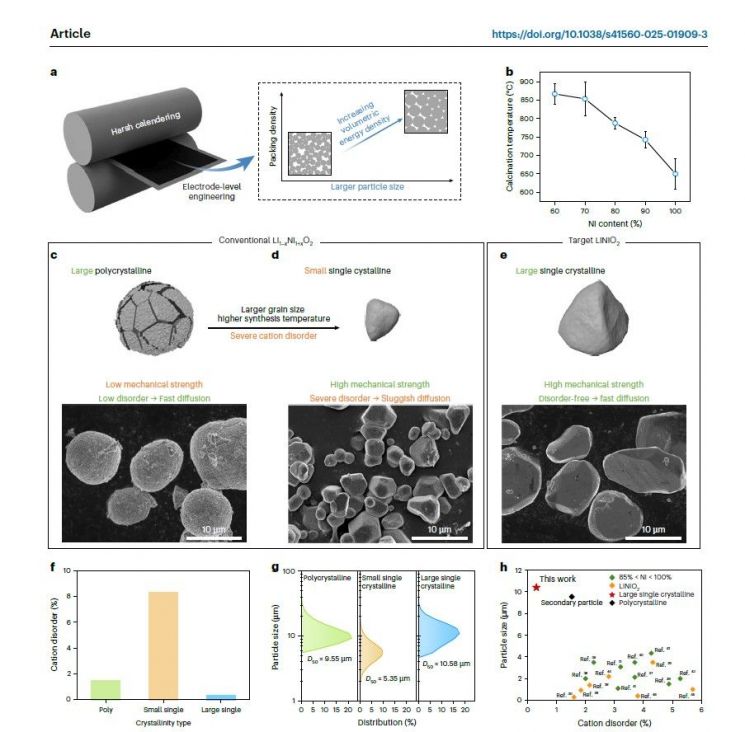 Research paper on high-density single-crystal cathode materials by SK On and Seoul National University published in Nature Energy. Nature Energy
The developed single-crystal cathode material demonstrated excellent mechanical and chemical stability as well as high energy density. The absence of cation disorder led to reduced structural deformation, and the amount of gas generated was found to be 25 times lower compared to polycrystalline cathode materials. The energy density reached up to 77% of the "theoretical crystal density," which is the maximum density assuming a perfect crystal state with no impurities.
Based on these research results, SK On and the Seoul National University research team are also considering studies to further increase energy density by combining single-crystal particles of different sizes in optimal ratios.
Park Kisu, Head of Future Technology Institute at SK On, said, "This research achievement clearly demonstrates the technological competitiveness of SK On in the field of battery materials. We will continue to pursue innovative research and development in collaboration with academia and strengthen our technological leadership going forward."
© The Asia Business Daily(www.asiae.co.kr). All rights reserved.
![Clutching a Stolen Dior Bag, Saying "I Hate Being Poor but Real"... The Grotesque Con of a "Human Knockoff" [Slate]](https://cwcontent.asiae.co.kr/asiaresize/183/2026021902243444107_1771435474.jpg)

















