“2026 Victim-Centered School Violence Policy Forum” Held at the National Assembly on January 7
“Focus Remains on Harsher Punishments, While Healing Victims’ Suffering Is Overlooked”
“The Paradox of Strict Punishment: College Admission Disadvantages Hinder Victim Protection”
The government has been implementing strong measures to address school violence, such as imposing disadvantages on perpetrators in college admissions. However, there have been criticisms that responses focused on healing and recovery for victims are lacking.
On January 7, at the National Assembly Members’ Office Building, the “2026 Victim-Centered School Violence Policy Forum” was hosted by Assemblywoman Ko Minjung of the Democratic Party of Korea. At the forum, victims of school violence and lawyers attended and argued that school violence response policies should shift their focus from “punishing perpetrators” to “healing and recovery for victims.”

Lee Gicheol, the mother of the late Park Juwon, a victim of school violence who gave the main presentation, said, “After losing my daughter, I have participated in forums and policy presentations to prevent such tragic incidents from happening again to anyone else. However, over the past 10 years, the reality of school violence has only become more dire,” adding, “While policies have focused on strengthening punishment for perpetrators, there are no measures to heal the suffering of victims.”
Lee pointed out, “Victims want their children to recover and live healthy lives and get along with their friends, rather than simply seeing perpetrators punished. Although laws and systems related to school violence have been revised multiple times, there are still fundamental questions as to whether these changes are actually leading to victims’ recovery and return to daily life.”
She proposed that the focus of school violence policies should shift from “prevention and countermeasures” to “healing, recovery, and return to daily life” through legal amendments. Regarding protection measures for victims, she argued that the current law, which centers on actions taken ‘after the review process,’ should be revised to include a provision that mandates immediate protective measures for victims as soon as school violence is recognized, even before the facts are fully established.
She also emphasized the need to simplify administrative procedures to prevent victims from being caught in a so-called “endless loop” of bureaucracy. Lee stated, “While victims repeat administrative appeals and lawsuits, they are not finding solutions but are instead driven into isolation or even withdrawing from society.” She called for the creation of integrated support and coordination procedures for administrative processes through legal amendments.
She said, “The key question in school violence response policies should shift from ‘How should we punish?’ to ‘How can we help victims recover?’ While punishment may mark the end of a system, recovery should be the beginning of policy.”
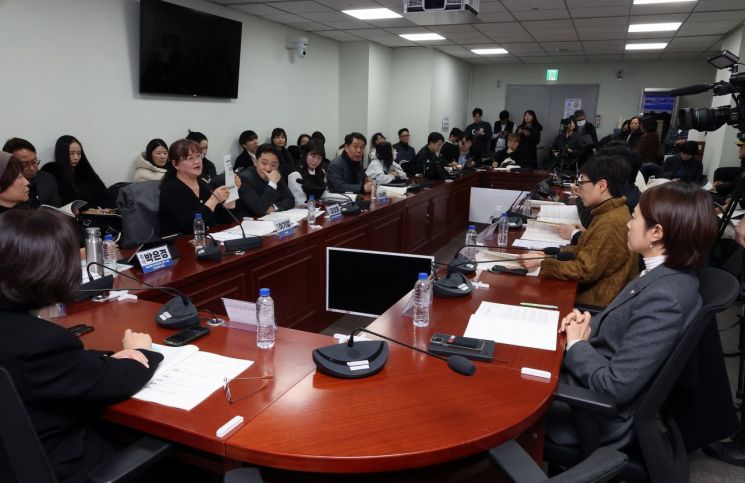
In the subsequent discussion, attorney Lee Jaeseong, a member of the School Violence Countermeasure Deliberation Committee, pointed out the limitations of current laws and systems related to school violence. He stated, “The most urgent measure for victims is physical and spatial separation from the perpetrator, but ironically, the current system makes it very difficult to implement such separation.”
Because the system is directly linked to college admissions, the committee faces the dilemma of whether the incident is serious enough to block a student’s university prospects, making it difficult to enforce a transfer for the perpetrator to separate them from the victim.
Attorney Lee argued, “The strict punishment policies introduced to prevent school violence paradoxically weaken protection for victims. To address this, we need to fundamentally abolish or significantly reduce the linkage between school violence measures and college admissions.”
He added, “Preventing perpetrators from attending university only satisfies the public’s desire for retribution. It does not help the actual recovery of victims and, in fact, exposes them to prolonged conflict.”
He further stated, “If it is difficult to revise the college admissions linkage policy in the short term, at the very least, the law should be amended to allow the committee to implement transfer or class change measures for perpetrators that are not recorded in their school records.”
Meanwhile, since 2024, the Ministry of Education has established Zero Violence Centers within education support offices nationwide to provide integrated support for investigating school violence cases, victim recovery and relationship improvement, and legal services.
An official from the Ministry of Education stated, “The number of dedicated support staff for victims, currently around 1,200, will be doubled to about 2,400 by 2029. Starting with the ‘relationship recovery reflection program’ to be introduced for first and second graders in March this year, we will also develop various relationship recovery programs tailored to different school levels and types.”
© The Asia Business Daily(www.asiae.co.kr). All rights reserved.
![Clutching a Stolen Dior Bag, Saying "I Hate Being Poor but Real"... The Grotesque Con of a "Human Knockoff" [Slate]](https://cwcontent.asiae.co.kr/asiaresize/183/2026021902243444107_1771435474.jpg)












