Three Out of Four Private Incineration Facilities in Cheongju
Sign Contracts with Seoul and Metropolitan Area Governments
Politicians and Civic Groups: "Local Residents Bear the Consequences"
Cheongju City: "Waste Inflow Remains at Normal Levels"
Since the implementation of the ban on direct landfilling of municipal solid waste in the Seoul metropolitan area, household waste generated in Seoul and its surrounding regions has been flowing into private incineration facilities in Cheongju, North Chungcheong Province. This has led to growing concerns among local communities about air pollution and other environmental impacts.
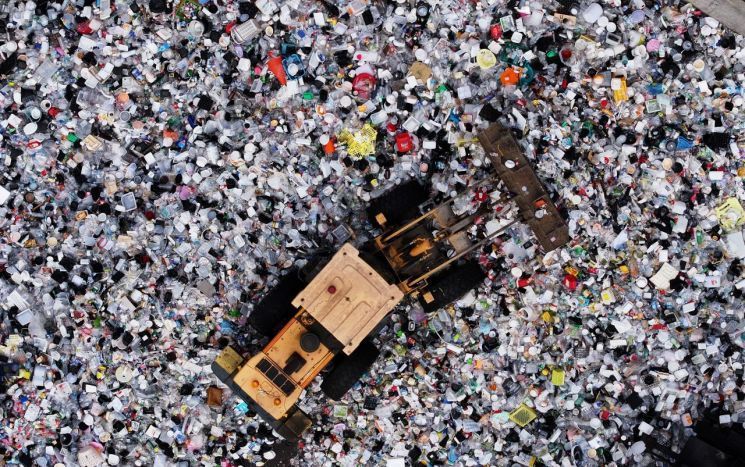 The process of bringing in and taking out plastic recycling waste is underway at the Gyeonggi-do Suwon City Resource Circulation Center. The photo is not related to any specific expression in the article. Photo by Yonhap News.
According to Yonhap News Agency on January 7, three out of four private incineration facilities in Cheongju have either signed or are in the process of signing contracts with local governments in Seoul or the metropolitan area to handle municipal solid waste. It has been reported that these facilities had already been processing household waste under contracts with non-metropolitan local governments even before the ban on direct landfilling in the metropolitan area.
Local politicians and civic groups have voiced opposition, claiming that Cheongju has become an alternative waste disposal site. Park Wanhee, a Cheongju city council member, issued a press release on the same day, stating, "After the Ministry of Environment banned direct landfilling in the metropolitan area, Cheongju, which is easily accessible and has available incineration capacity, was chosen as an 'alternative disposal site' instead of the metropolitan area, where incineration facilities are lacking." She emphasized, "All the negative consequences-including increased air pollutants, emissions of fine dust and greenhouse gases, and traffic risks from long-distance waste transportation-are being borne by local residents."
Former National Assembly member Lee Jangseop also released a statement, saying, "I am firmly opposed to the incineration of metropolitan area waste in Cheongju." He added, "In cooperation with local National Assembly members, I will mobilize every possible means, including amending the Waste Management Act and other relevant laws and pressuring the central government, to block the inflow of waste into Cheongju."
The local civic group Gongjeonghan Saesang in North Chungcheong Province criticized, "Unlike the metropolitan area, which enjoys consumption and convenience, non-metropolitan regions are being reduced to mere waste-consuming areas." The group added, "This will not only hinder balanced regional development, but will also accelerate the decline of local communities."
The city government maintains that the current volume of incoming household waste remains at normal levels, and that only the contracting parties have changed from non-metropolitan to metropolitan local governments.
A city official stated, "So far, the inflow of waste from the metropolitan area is not at a concerning level. The waste volume handled by private incineration companies under city contracts was already finalized at the beginning of the year, so the likelihood of a waste crisis is low." The official added, "The city cannot restrict contracts made by private incineration facilities. We will closely monitor future trends in waste inflow."
© The Asia Business Daily(www.asiae.co.kr). All rights reserved.
!["The Woman Who Threw Herself into the Water Clutching a Stolen Dior Bag"...A Grotesque Success Story That Shakes the Korean Psyche [Slate]](https://cwcontent.asiae.co.kr/asiaresize/183/2026021902243444107_1771435474.jpg)
















