Understanding China's Position Is Also Necessary
"If the stance changes suddenly, it would mean the Hallyu Ban actually existed"
Working-Level Departments to Hold Concrete Consultations
"Spring Does Not Come Suddenly; Time and Process Are Needed"
"China to Remove Some Structures in the West Sea"
"Significant Progress in Korea-China Relations"...Mutual Provocation and Exclusion Should Be Avoided
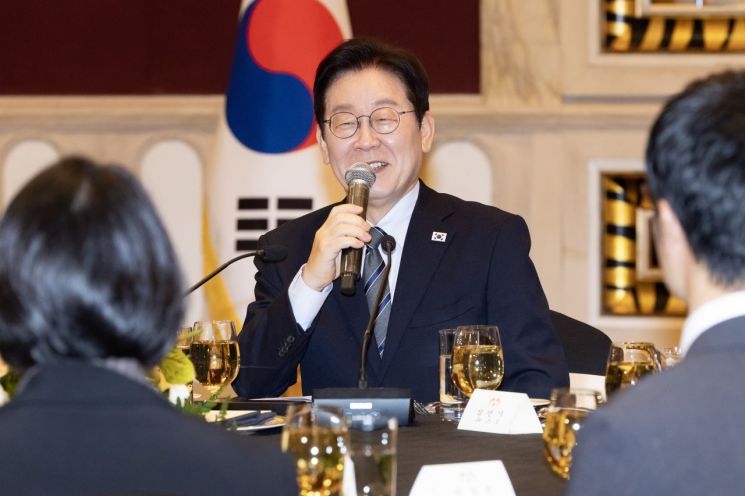
President Lee Jaemyung, who paid a state visit to China and held a summit with Chinese President Xi Jinping, forecast that China's "Hallyu Ban" (Hanhanryeong, a ban on Korean Wave content) would be resolved gradually and in an orderly, step-by-step manner. Meeting President Xi Jinping again just two months after the Gyeongju summit, President Lee noted the change in President Xi's remarks regarding the "Hallyu Ban" and analyzed that it was close to a clear expression of intent to resolve the issue.
Regarding the sensitive issue of structures in the West Sea between South Korea and China, President Lee stated that the Chinese side has agreed to remove some of the structures, and that practical discussions will be held on the proposal to draw a "median line" within the joint waters. He further evaluated that this summit achieved significant progress on various agendas, including economic cooperation, supply chain collaboration, and peace on the Korean Peninsula.
On January 7 (local time), at a press conference held at the press center in Shanghai, China, President Lee said, "The Chinese government has previously stated that there is no Hallyu Ban, but this time, their expression was different." He continued, "President Xi said, 'Three feet of ice does not freeze overnight, so it cannot all melt at once. Fruit ripens and falls when the time comes.' I think that is an accurate description."
He also emphasized the need to understand the situation in which the Chinese side cannot use the expression "lifting the Hallyu Ban." President Lee explained, "If the Chinese side suddenly changes its stance after having said there is no Hallyu Ban, it would mean there was one. That is something both sides need to understand." He added, "Spring does not come suddenly. Time and process are needed," and elaborated, "Since President Xi said that working-level departments should hold concrete consultations, actual discussions will take place."
President Lee further analyzed that President Xi's remarks on the Hallyu Ban were close to a clear expression of intent to resolve the issue. He explained, "According to their expression of resolving the issue gradually and in an orderly manner within the possible scope, the problem will be resolved in an orderly, beneficial, and healthy way. This is not just cautious optimism, but a clear statement of intent."
However, he noted that the timing of easing or lifting the Hallyu Ban may differ depending on the characteristics of each sector. Previously, President Lee had proposed holding exchange events such as Go tournaments or soccer matches with the lifting of the Hallyu Ban in mind. President Xi reportedly responded, "There is no problem." President Lee said, "We must understand the position of the Chinese side, which cannot fully liberalize due to the nature of the socialist system and cannot leave everything unchecked," and added, "Concrete agreements are needed. We have spent many years in a 'zero' state so far, but if we proceed gradually and smoothly without rushing, things will work out."
"China to Remove Some Structures in the West Sea"
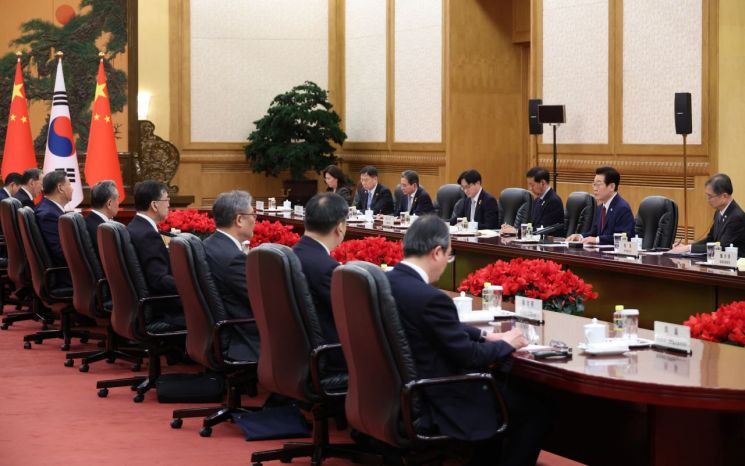
Regarding another sensitive issue between South Korea and China, the matter of structures in the West Sea, President Lee stated that the two countries have agreed to hold working-level talks on the proposal to draw a median line. He said, "There are some who distort the issue and make strange claims, such as that the West Sea has been handed over," and explained the location of the structures: "Each side has its own exclusive waters in the West Sea, and there is a jointly managed area in the middle. The structures are slightly over the boundary on the Chinese side of the joint area, but they are not located on our side of the median line."
President Lee explained that he proposed drawing a "median line" in the joint waters to put the controversy to rest, stating, "The structures are not crossing over to our side of the median line, and since they are located in the joint waters near the Chinese side, I suggested we organize things clearly. To address the root cause of the problem, we agreed to hold practical consultations."
President Lee also described the differing positions of South Korea and China and the visible progress made. He said, "China argues, 'There are no drone fish there; we are actually farming real fish. It's just a fish farm, so what's the issue?'" He continued, "From our perspective, the problem is why they are doing this unilaterally." He added, "The Chinese side says there are two fish farm facilities and another management facility. They stated that the management facility would be withdrawn, so it seems it will be relocated."
"Significant Progress in Korea-China Relations"...Mutual Provocation and Exclusion Should Be Avoided
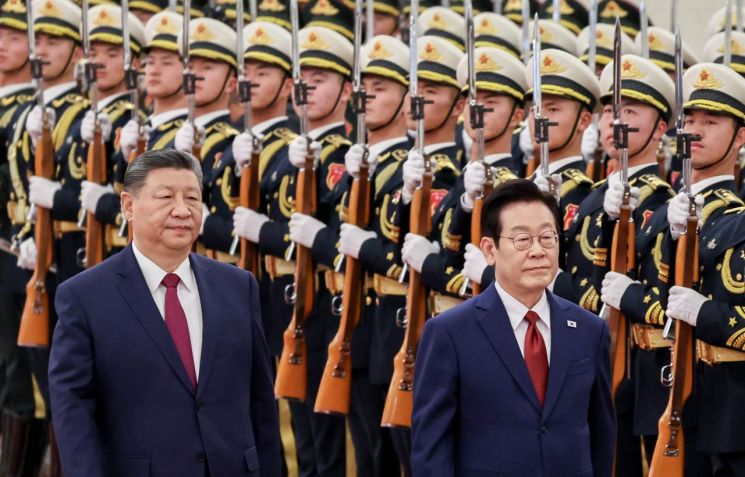
President Lee assessed that the Korea-China summit achieved significant progress on various agendas, including economic cooperation, supply chain collaboration, and peace on the Korean Peninsula. He said, "It seems there was more progress than expected. There was a lot of mutual understanding, and even issues that could have led to confrontation were resolved smoothly."
He particularly noted that the Korea-China relationship now requires both competitive cooperation and cooperative competition, stating, "During the visit, we held serious and responsible discussions on current issues such as supply chain cooperation, peace on the Korean Peninsula, and regional stability."
He emphasized that unnecessary conflict should not be created between the peoples and governments of the two countries. President Lee said, "I do not understand why baseless issues are unnecessarily created to provoke conflict when we could create a better environment. I hope we can move toward a mutually beneficial relationship in the future." He added, "The government of the Republic of Korea will manage Korea-China relations based on mutual respect and the principle of prioritizing national interests, ensuring that the relationship does not become unbalanced or swayed by emotions."
© The Asia Business Daily(www.asiae.co.kr). All rights reserved.
![Clutching a Stolen Dior Bag, Saying "I Hate Being Poor but Real"... The Grotesque Con of a "Human Knockoff" [Slate]](https://cwcontent.asiae.co.kr/asiaresize/183/2026021902243444107_1771435474.jpg)













