BOK Issue Note by the Bank of Korea
An analysis has revealed that the number of private sector employees increased by only 50,000 last year. While the total number of employed persons showed a healthy increase due to the expansion of public sector jobs, private sector employment fell significantly short of the projected figure of 130,000. As a result, the Bank of Korea evaluated that, despite improvements in overall employment indicators, the actual employment situation reflecting domestic economic conditions remained sluggish last year.
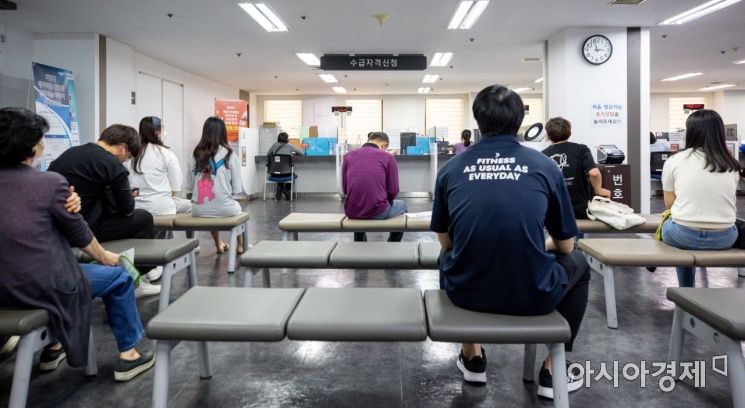 Unemployment benefit recipients are receiving consultations at the Seoul Western Employment Welfare Plus Center in Mapo-gu, Seoul. Photo by Jinhyung Kang aymsdream@
On January 7, the Bank of Korea released a report titled "BOK Issue Note: Assessment of Recent Employment Situation through Private Sector Employment Estimates." The report was authored by Lee Youngho, Head of the Employment Trends Team at the Bank’s Economic Research Department, along with research fellows Jung Kanghee and Song Byungho.
According to the report, the total number of employed persons increased by 9.9%, from a monthly average of 26,178,000 in 2015 to 28,770,000 last year (based on the average for the first to third quarters). Of this, public sector jobs rose by 84.2%, from 1,128,000 to 2,079,000. The proportion of public sector jobs among all employed persons also increased from 4.3% to 7.2% over the same period. In particular, senior citizen jobs increased by approximately 3.7 times (from 270,000 to 990,000), contributing significantly to the overall employment growth. Lee Youngho stated, "It appears that the government has expanded direct job creation in response to recent domestic demand sluggishness."
In contrast, the number of private sector employees increased by only about 6.5%, from 25,050,000 in 2015 to 26,692,000 last year (average for the first to third quarters). Compared to 2024, public sector employment increased by 145,000 year-on-year, while private sector jobs grew by just 48,000.
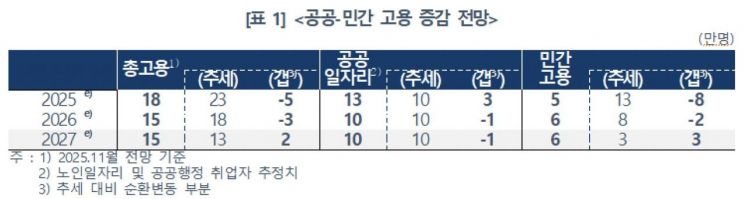
Excluding economic conditions, the structural trend of private sector employment is also rapidly slowing. The private sector employment trend decreased from 237,000 in 2022 to 122,000 in the third quarter of last year. This figure is expected to fall to 80,000 this year and 30,000 next year. The report pointed out that this is due to a declining working-age population, intensified global competition in non-IT sectors, and technological changes, all of which are weakening the private sector’s ability to create jobs.
The problem is that the actual level of private sector employment did not even keep up with the trend. Last year, the actual increase in private sector employment was 48,000, significantly below the trend figure of 122,000. In contrast, public sector jobs exceeded the trend, with the actual increase at 130,000 compared to a trend of 100,000. Scenario analysis showed that public sector jobs are estimated to have reduced the unemployment rate by 0.1 to 0.2 percentage points since 2024. Conversely, without the increase in public sector jobs, the unemployment rate would have been correspondingly higher.
However, the employment situation is expected to gradually improve, supported by a recovery in consumption. This year, the increase in private sector employment is projected to reach only about 60,000, a slight improvement over last year. The trend, calculated by reflecting only structural factors, is 80,000, indicating that actual employment will approach the trend. Next year, the employment increase is also expected to remain at around 60,000, surpassing the trend projection of 30,000.
Private Sector Employment Is a More Accurate Gauge than Total Employment for Assessing Labor Market Conditions... Should Be Used Complementarily
The Bank of Korea assessed that, as public sector jobs expand, total employment figures have limitations in accurately capturing the real employment situation.
Upon reviewing the usefulness of various indicators, it was found that private sector employment reflects domestic economic and price conditions more accurately than total employment.
The correlation with indicators representing domestic economic conditions (such as the coincident index cyclical component, service industry GDP, and consumption GDP) was found to be more accurate when assessed through private sector employment rather than total employment. In particular, the correlation with consumption was 0.76 for private sector employment, noticeably higher than the 0.73 for total employment.
Forecast errors regarding domestic economic conditions were also smaller for private sector employment than for total employment. According to an analysis using the lag distribution model, the predictive power of private sector employment improved by approximately 30.9% to 33.5% compared to total employment. For core inflation, predictive accuracy improved by about 1.1% to 1.6% when using private sector employment figures.
The report stated, "Private sector employment captures short-term and cyclical macroeconomic fluctuations better than total employment, making it more useful for accurately assessing the cyclical aspect of employment conditions. While public sector jobs included in total employment have several positive effects, such as supporting the income of vulnerable groups, they can make it more difficult to assess the cyclical aspect of employment conditions. Therefore, it is necessary to use private sector employment complementarily when evaluating future employment conditions."
© The Asia Business Daily(www.asiae.co.kr). All rights reserved.



















