Six Out of Ten Fatalities in January Involve Trucks
Structural Accidents Triggered by Cold Waves and Drowsy Driving
Highways in January have been identified as the period requiring the highest level of caution throughout the year. The overlap of truck accidents and late-night traffic accidents has led to a sharp increase in the proportion of fatal accidents.
It is analyzed that a combination of cold waves, heavy snowfall, drowsy driving, and vehicle breakdowns has triggered a "red flag" for winter highway safety.
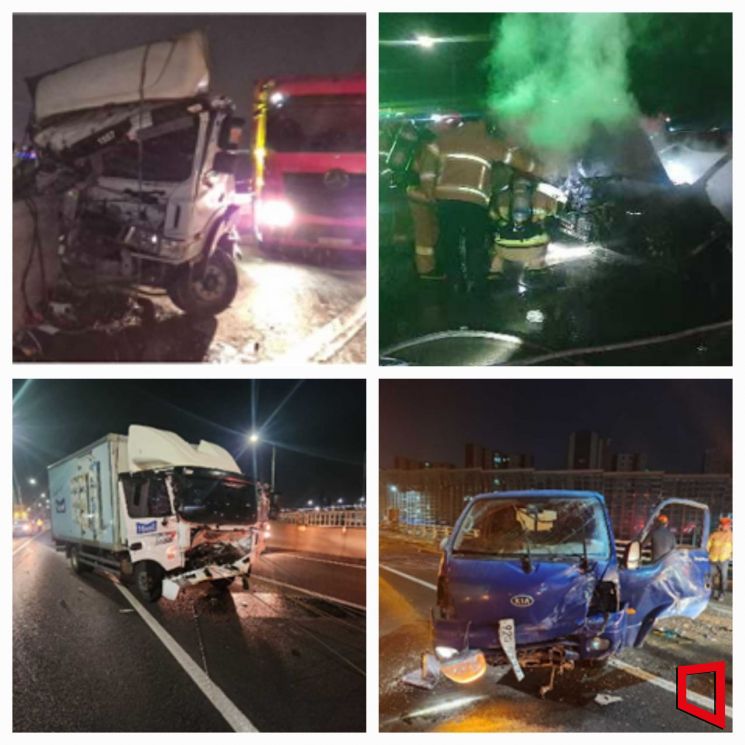 "Winter highway accidents are not simply mistakes but structural risks compounded by 'environment, fatigue, and weight'."
According to the Korea Expressway Corporation's analysis of highway traffic accident statistics for the past three years (2023-2025), there were a total of 28 traffic fatalities in January, of which 61% (17 cases) were related to truck accidents. This is the second highest rate of the year, making January one of the most dangerous months for accidents, following July, the summer vacation season.
All fatal truck accidents were attributed to drowsy driving and failure to pay attention to the road ahead. Notably, 65% of these accidents occurred during long-distance trips of more than 100 kilometers, identifying accumulated fatigue from extended winter driving as a major risk factor.
Actual accident cases clearly illustrate these risks. In January 2023, near the Nooji Junction on the Capital Region First Ring Expressway, a drowsy truck driver rear-ended the vehicle in front and crashed into roadside facilities on the shoulder.
In the same month, near the Namsangju Interchange on the Cheongju-Yeongdeok Expressway, a drowsy driver struck a stationary truck and its driver, who had exited the vehicle due to a breakdown, triggering a chain-reaction collision and a major accident.
Similar serious accidents caused by late-night drowsy driving and secondary collisions continued in the Gyeongbu Expressway area in 2024 and 2025.
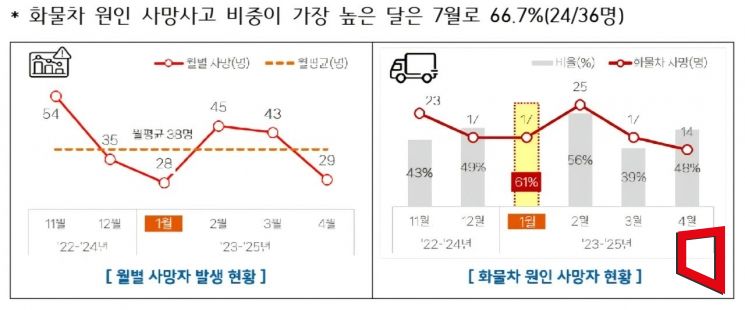
Vehicle breakdowns are another factor that increases accident risk in January. Over the past three years, the average number of daily truck breakdown reports in January was 67, the highest of any month.
This is mainly due to diesel fuel solidifying in the fuel filter and pump during cold waves, or reduced battery performance, which frequently leads to engine stalling or starting failures while driving. The Korea Expressway Corporation emphasized that injecting anti-freeze additives and conducting pre-departure inspections are essential safety rules for diesel vehicles.
Fatal accidents were also concentrated during late-night hours. Twelve fatalities, or 43% of the total, occurred between midnight and 6 a.m. The risk of accidents was heightened by rapidly changing road conditions due to plummeting temperatures and snowfall, limited visibility, and peak driver fatigue during these hours.
In response, the Korea Expressway Corporation is strengthening CCTV-based real-time monitoring and road patrols to prevent winter traffic accidents. During weather advisories such as heavy snowfall, additional safety patrol personnel are deployed, and preemptive spreading of de-icing agents and intensive snow removal operations are carried out in areas where black ice is a concern.
A representative of the Korea Expressway Corporation stated, "January is a period when driving conditions deteriorate rapidly due to cold waves and snowfall, and vehicle breakdowns are frequent. In particular, truck drivers and those driving late at night must take sufficient rest, reduce speed, and maintain a safe following distance."

Winter highway accidents are not simply mistakes but structural risks compounded by "environment, fatigue, and weight."
Winter highway accidents are not merely the result of driver negligence. Decreased vehicle performance due to cold waves, fatigue from long-distance driving, and reduced concentration during early morning hours combine to create an environment where accidents are almost inevitable.
In particular, truck accidents often result in large-scale casualties, making highways in January effectively "danger zones."
© The Asia Business Daily(www.asiae.co.kr). All rights reserved.



















