Announcement of People Power Party Reform Plan
Primary Rules to Be Adjusted by Region and Position
Commitment to Empowering Youth and Experts
Jang Donghyuk, leader of the People Power Party, issued a public apology on January 7 regarding the December 3 Martial Law Incident. He announced a new direction for the party, focusing on expanding its base, and revealed plans to pursue a change of the party name.
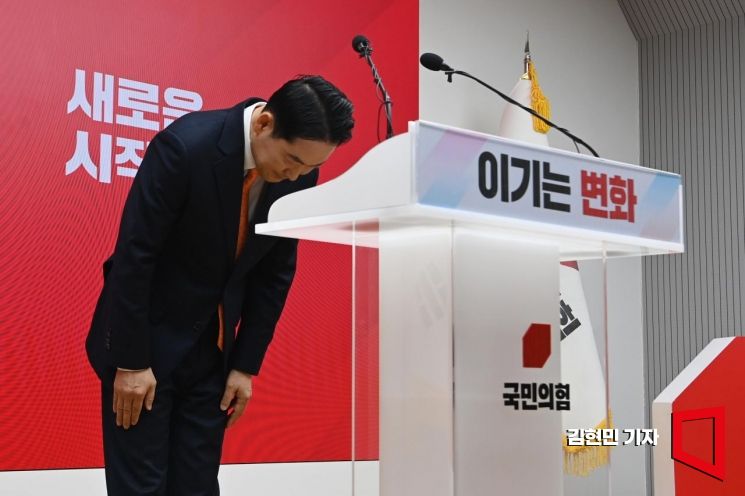 Jang Donghyuk, leader of the People Power Party, is announcing the party reform plan at an emergency press conference held at the central party office in Yeouido, Seoul, on January 7, 2026. Photo by Kim Hyunmin
At 10 a.m. that day, Jang held a press conference at the party headquarters in Yeouido under the theme "Winning Change," where he unveiled the party’s reform measures. He began by addressing the December 3 Martial Law Incident, stating, "We caused great confusion and inconvenience to the public by using inappropriate and misguided means," and added, "As the ruling party, which was one pillar of state administration, we feel a heavy sense of responsibility and sincerely apologize to the people." He continued, "We will leave past events to the judgment of the judiciary and the verdict of history, and move forward into the future, crossing the river of martial law and impeachment." However, he did not explicitly declare a break with former President Yoon Suk Yeol.
Jang also expressed his commitment to reforming the party in line with the expectations of the public. His vision is to expand the party’s base through three main pillars: ▲youth, ▲expert networks, and ▲public empathy. Starting with the local elections in June, the party will introduce a mandatory youth nomination system. Local youth task forces will be established in each city and province, and young talent will be appointed to key party positions through a public audition for recruiting candidates in their 20s and 30s. In addition, the party plans to set up the "Party Alternatives Task Force," an expert network organization. Weekly meetings will be held every Wednesday to review issues related to the people's livelihoods and economy, and the Yeouido Institute will be transformed into a hub for expert networks. A new department will be established to handle policies for labor minorities, and a special labor adviser to the party leader will be appointed. The party will also form a generational integration committee to develop policies that span all generations and seek alliances with opposition parties.
Notably, Jang also announced plans to pursue a change of the party name. He stated, "Through these three pillars, we will transform the People Power Party into a true policy-oriented party. We will redefine the party’s values and direction, and seek the opinions of all party members as we move forward with the party name change."
As part of preparations for the local elections, the party will focus on "eradicating corruption" and "making the party member-centered." From these elections onward, a nomination corruption reporting center will be established to eliminate corruption from the nomination process. Jang explained, "Anyone with a history of bribery or other corruption will be permanently disqualified from nomination. For basic local government heads above a certain size, the central party will directly manage nominations to ensure transparency."
The rules for primary elections will be adjusted to reflect the opinions of party members differently depending on the region and position. The party’s general election planning committee has recommended increasing the proportion of party member input from the current 50% to 70%, and the party has partially accepted opposing views on this matter. For major issues within the party, if a certain number of party members request it, a vote of all party members will be held following a resolution by the Supreme Council.
These reform measures come as pressure mounts on Jang Donghyuk’s leadership to change the party’s direction. The reformist lawmakers’ group "Alternatives and Future" held a forum that day to discuss the path the party should take. Assemblyman Kwon Youngjin said, "The current difficulties and crises the party faces are the result of going against public sentiment, with the most extreme example being the martial law incident." Assemblyman Lee Sungkwon also commented, "The core of the party’s reform plan is how faithfully it reflects the voice of the people." Sixteen lawmakers attended the forum, including Seo Beomsoo, Kwon Youngjin, Park Jungha, Um Taeyoung, Seo Chunho, Ko Dongjin, Kim Gun, Cho Eunhee, Cho Baesook, and Han Jia.
© The Asia Business Daily(www.asiae.co.kr). All rights reserved.

















