Only 2% of Companies Prepared for Compliance
Concerns Raised Over Lack of Specificity and Predictability
With just two weeks remaining before the world’s first Artificial Intelligence (AI) Framework Act comes into effect, concerns have been raised within the industry that preparations are still insufficient.
On the 6th, Startup Alliance, together with Assemblywoman Hwang Jeonga of the Democratic Party of Korea, held the "AI Framework Act Transparency and Accountability Roundtable" at Meeting Room 6 of the National Assembly Members' Office Building to discuss the effectiveness and direction of the AI Framework Act. The discussion reflected the reality that, according to a recent survey of 101 AI companies, only 2% of respondents said they were prepared for the new law.
During the roundtable, participants repeatedly pointed out that the AI Framework Act lacks sufficient specificity to be practically implemented in the industry, making it difficult for companies to prepare in advance. Lim Jungwook, CEO of Startup Alliance, stated, "When designing a new regulatory framework, it is important to consider not only speed, but also effectiveness, predictability, and international alignment."
Choi Jiyeong, Executive Director of the Korea Startup Forum, also remarked, "Startups are often at the forefront of change, but they frequently lack the personnel and resources to respond to regulatory shifts." She added, "For the AI Framework Act to function properly in the field, it must be accompanied by reasonable systems, clear standards and interpretations, and support infrastructure that reduces compliance costs."
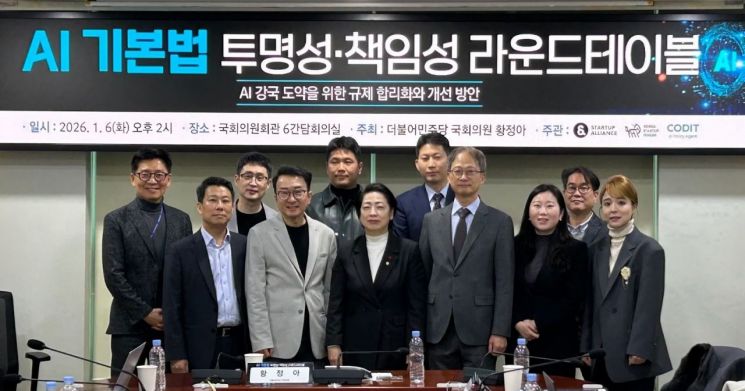 Startup Alliance held the "AI Framework Act Transparency and Accountability Roundtable" on the 6th at Meeting Room 6 of the National Assembly Members' Office Building to discuss the effectiveness and direction of the AI Framework Act. Startup Alliance
There were also concerns that the AI Framework Act could have unintended negative consequences for the industry. Choi Seongjin, CEO of the Startup Growth Research Institute, said, "Individual provisions, such as the designation of high-impact AI, mandatory labeling for generative AI, and the establishment of risk management systems, still lack clear criteria and procedures for practical application." He warned, "As a result, there are concerns that, regardless of the law’s intent, regulatory risks could spread across the entire industry."
During the comprehensive discussion that followed, startup leaders criticized the law as being excessively regulatory. Lee Hoyoung, CEO of Toonsquare, commented, "The current legal framework is not being applied flexibly in educational settings or content production processes, leading to significant confusion and burden." He emphasized, "Given the reality that the boundaries between users, service providers, and developers are unclear, the AI Framework Act must be implemented with greater flexibility."
Jung Jieun, CEO of KODIT, pointed out, "Regarding the obligation to label AI-generated content, the criteria for defining the degree of AI contribution in the production process are unclear, and it is extremely difficult to determine whether only part of the content was edited or the entire work was generated." She added, "Holding AI businesses responsible even for users’ actions such as modifying or removing watermarks is an excessive regulation."
Assemblywoman Hwang, who hosted the roundtable, stated, "The government is continuing its efforts to include only the minimum necessary regulations, but it is true that there are still concerns in the field." She pledged, "As this is the world’s first law of its kind, we will continue to listen to voices from the field after implementation and make improvements as needed."
© The Asia Business Daily(www.asiae.co.kr). All rights reserved.

















