Venezuela Holds 303 Billion Barrels of Oil Reserves, World's Largest
Greenland's Rare Earth Reserves Estimated at 36 Million Tons, Second Only to China
On January 3, U.S. President Donald Trump made a surprise move by arresting the Venezuelan president and his spouse. Analysts suggest that this action signals the beginning of a U.S. 'resource war' aimed at seizing resources, rather than simply attempting a regime change.
According to the Organization of the Petroleum Exporting Countries (OPEC) on January 11, Venezuela's crude oil reserves are estimated at about 303 billion barrels. This is the largest confirmed crude oil reserve in the world. Saudi Arabia ranks second with 297.5 billion barrels, followed by Canada with 168.1 billion barrels.
In simple terms, Venezuela's oil reserves are equivalent to the total amount of crude oil South Korea could import and use for 294 years. As of 2024, South Korea's annual crude oil imports stand at 1.03 billion barrels. This calculation assumes that all imports come exclusively from Venezuela, without considering oil quality or transportation methods.
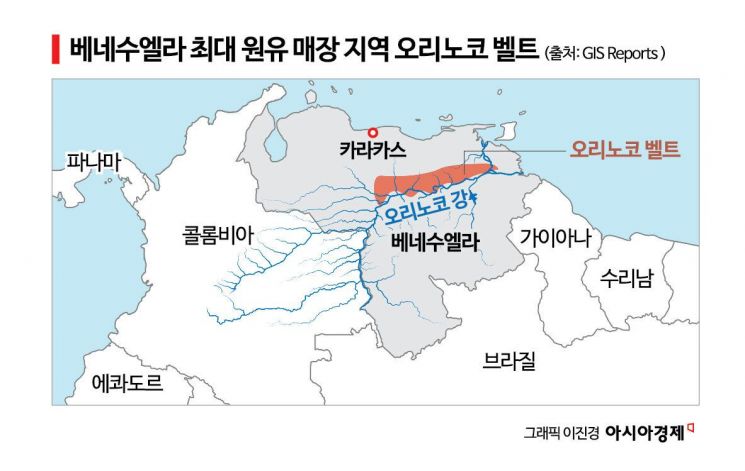
The Orinoco Belt, located in the eastern basin of Venezuela, is the primary area where oil is concentrated. The Orinoco Belt, the world's largest oil deposit, covers more than 55,000 square kilometers, which is about half the size of South Korea. Some analyses estimate that the oil stored here could reach as much as 1.3 trillion barrels. However, Venezuelan crude oil is relatively low-quality heavy oil, requiring a complex refining process before it can be used.
The next region President Trump has set his sights on is Greenland, a territory of Denmark. Even before the start of his second term, President Trump openly expressed interest in purchasing Greenland. While he publicly stated that the motive was to counter Russia and China in the Arctic region, it is already well known that President Trump is keen to secure the rare earth elements buried in Greenland. On January 7 (local time), the Trump administration announced that it was internally reviewing the option of purchasing Greenland from Denmark and would meet with relevant parties next week to discuss the matter.
Rare earth elements in Greenland were not previously considered of much interest. Greenland is covered in ice, and the cost of extraction made such projects economically unfeasible. However, due to global warming, parts of the territory have begun to melt, increasing the potential for rare earth mining and drawing growing attention.
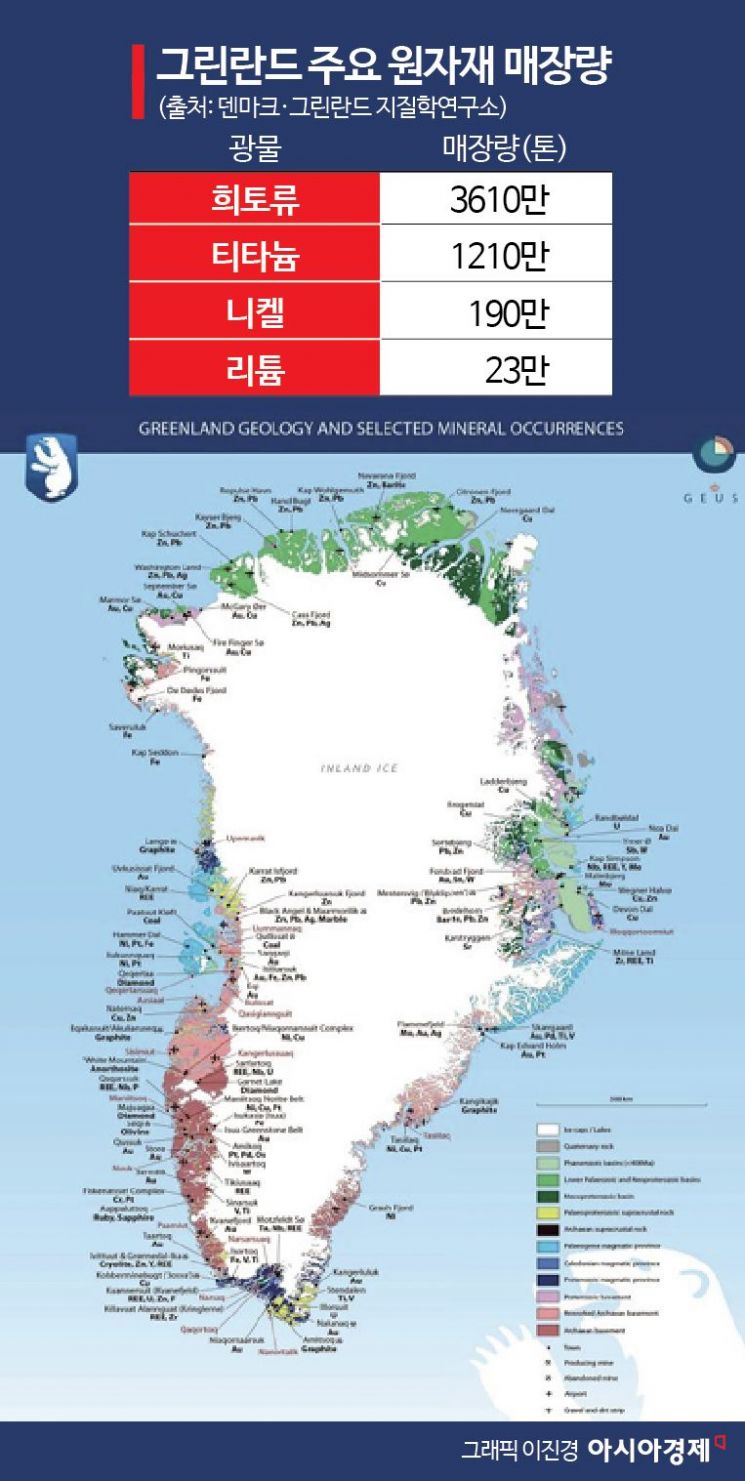
According to the 2023 report "Assessment of the Potential for Critical Raw Materials in Greenland" published by the Geological Survey of Denmark and Greenland (GEUS), Greenland's rare earth reserves are estimated at 36.1 million tons. This is believed to be second only to China, which holds 44 million tons. Currently, Russia and Vietnam are in the second and third positions, with reserves between 21 and 22 million tons. If Greenland's reserves are officially recognized, it would surpass these countries. South Korea imports about 3,000 tons of rare earth elements annually.
Rare earth elements are strategic minerals widely used in electric vehicle motors, wind power turbines, semiconductors, batteries, and the defense industry. The United States relies heavily on imports from China for most of its rare earth supply, making the search for new sources a pressing issue. The U.S. and China were embroiled in a rare earth dispute last year. Early last year, when President Trump imposed high tariffs on China, China retaliated by restricting exports of six types of rare earth elements to the U.S., and later expanded the list to include additional elements such as samarium and dysprosium.
However, since Greenland is a Danish territory, Trump's aggressive approach could undermine the North Atlantic Treaty Organization (NATO) alliance. On January 5, Danish Prime Minister Mette Frederiksen warned in an interview with Danish broadcaster TV2 that "if the United States decides to attack another NATO country militarily, it would lead to the collapse of the entire international order and NATO as we have known them since the end of World War II."
© The Asia Business Daily(www.asiae.co.kr). All rights reserved.


















