Contributing to AI Infrastructure Cost Reduction
with CXL-Based Modular AI Data Center Architecture
Jung Myungsoo, CEO of Panecia and Distinguished Professor at the Department of Electrical and Electronic Engineering at KAIST, has been selected as the January recipient of the Korea Science and Technology Award for leading the application of modular architecture design technology-capable of fundamentally transforming AI data center structures-in domestic and international industries.
 Jung Myungsoo, CEO of Panecia. Photo by Ministry of Science and ICT
The Ministry of Science and ICT and the National Research Foundation of Korea announced on January 7 that CEO Jung Myungsoo has been selected as the recipient of the Korea Science and Technology Award for January 2026.
The Korea Science and Technology Award is presented monthly to one researcher who has made significant contributions to the advancement of science and technology through original research achievements over the past three years. The award includes a Minister of Science and ICT Award and a prize of 10 million won. Starting in 2026, the Ministry of Science and ICT has elevated the status of the "Scientist of the Month Award" to the "Korea Science and Technology Award," reinforcing its position as a national-level science and technology honor.
The Ministry of Science and ICT and the National Research Foundation selected CEO Jung as this month's awardee in January, a period when major events such as CES, next-generation semiconductor and AI technology roadmaps, and global standardization discussions are concentrated. Jung was recognized for his contributions to reducing AI infrastructure costs and improving efficiency through the development of Compute Express Link (CXL)-based modular AI data center architecture design technology.
Recently, large-scale AI services like ChatGPT have required massive computational and memory resources and are operated on ultra-large-scale systems connecting millions of devices. However, existing data center architectures have fixed ratios of central processing units (CPUs), graphics processing units (GPUs), AI accelerators, and memory, making it difficult to respond flexibly to changes in actual demand.
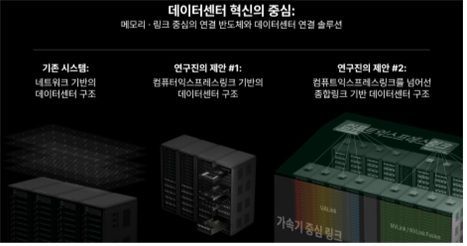 Comprehensive Interconnection and Semiconductor Technology Concept Diagram for Modular AI Data Center Architecture Design. Large-scale AI services require enormous computation and memory, making a data center environment connecting multiple devices essential. However, existing architectures have fixed resource configurations, resulting in low utilization efficiency. The research team led by Chief Researcher Myungsoo Jung proposed a 'Modular AI Data Center Architecture' that allows flexible combination of devices as needed, along with interconnection technologies to realize it. They published a technical white paper on comprehensive interconnection technologies integrating Compute Express Link (CXL), UALink, NVLink, and High Bandwidth Memory (HBM). This technology enhances resource utilization efficiency and contributes to reducing data center operating costs. Provided by the Ministry of Science and ICT
To address these issues, CEO Jung Myungsoo designed a "modular AI data center architecture" that enables the flexible combination and use of necessary devices, and presented a link structure and device topology design guide for efficiently connecting multiple devices.
In particular, by developing a low-power, high-efficiency link technology based on the next-generation connection standard CXL, which separates and manages heterogeneous system devices as individual nodes, he significantly improved both the scalability and operational flexibility of data centers.
He also proposed integrating UALink and NVLink-AI accelerator-centric connection technologies-and high bandwidth memory (HBM) semiconductor technology into the modular data center architecture. By releasing a technical white paper on this link-based system design, he has attracted global industry attention.
CEO Jung is the founder of Panecia, a faculty startup from KAIST, and a researcher inducted into the Hall of Fame of ISCA, the world's most prestigious conference in computer architecture. He has led two basic research projects funded by the Ministry of Science and ICT and has driven innovation in AI infrastructure and semiconductor connection technologies, including winning the CES 2025 Innovation Award (GPU Memory Expansion Kit).
Jung Myungsoo stated, "Recently, we developed the world's first PCIe 6.4/CXL 3.2-based fabric switch, distributed sample chips to partners, and are verifying the feasibility of mass production. I hope to contribute to strengthening national competitiveness in the AI infrastructure sector not only by improving the performance of each device but also through research on link technologies that efficiently connect and utilize them."
The Ministry of Science and ICT plans to continue fostering an ecosystem where researchers can focus on their work in advanced technology fields such as AI and biotechnology, and to continuously strengthen rewards and recognition for outstanding scientists and engineers.
© The Asia Business Daily(www.asiae.co.kr). All rights reserved.
![From Bar Hostess to Organ Seller to High Society... The Grotesque Con of a "Human Counterfeit" [Slate]](https://cwcontent.asiae.co.kr/asiaresize/183/2026021902243444107_1771435474.jpg)
















