Controversy Erupts After 'No Entry for Chinese Customers' Notice
Backlash Grows as Dual Pricing for Foreigners Is Exposed
 The image shows a Japanese ramen shop and is unrelated to the main content. Management Support Homepage
"When I tried to order in Japanese, they told me to order in Korean." "Because the prices seemed strange, I tried to look at the Japanese menu, but the staff stopped me."
A famous ramen restaurant in Osaka, Japan, is facing a strong backlash after posting a notice banning Chinese customers. As the controversy over the "entry ban" spread, it was revealed that the restaurant had been charging foreign customers up to twice as much as Japanese customers. In particular, evidence has emerged that this "dual pricing" was also applied to Korean customers, leading to criticism in Korea as well.
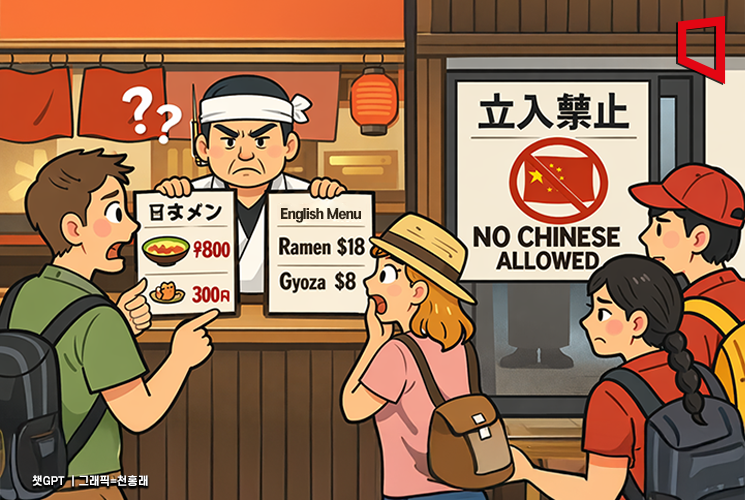
The Beginning of the Controversy: 'No Entry for Chinese Customers' Notice
The controversy began with the so-called "No Entry for Chinese Customers" notice. Located near Namba Station in Osaka, the ramen shop posted on social media on January 4 that "Chinese customers have caused problems in the restaurant, and we have had to call the police," adding, "Since about 90% of the problems caused by foreigners are attributed to Chinese customers, we will ban Chinese customers from entering in the future." The post surpassed 26 million views in just one day, sparking criticism not only in Japan but also abroad.
'Dual Pricing' Exposed Amid Controversy
During this process, the controversy took an unexpected turn. Online users raised suspicions that the restaurant had been charging foreign customers higher prices. They shared photos of the store's kiosk screen, highlighting the reality of the "dual pricing" system.
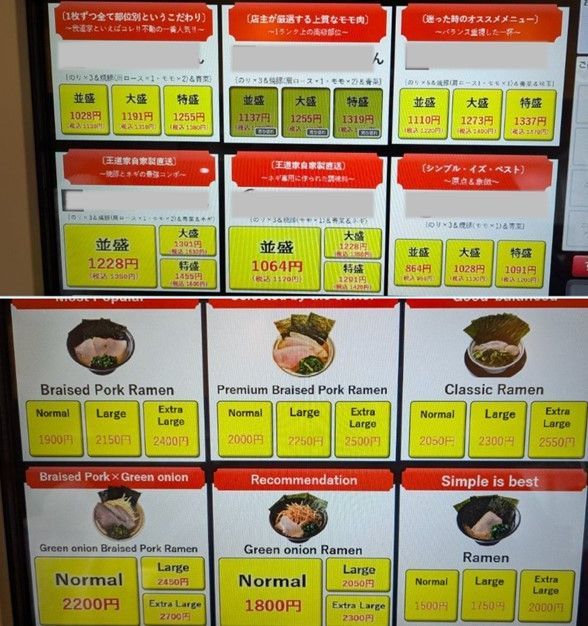 Photo of a store kiosk screen. The prices for the Japanese menu and foreign language menus such as English are set differently. X
The released photos show that the prices for the Japanese menu and foreign language menus, such as English, are set differently. For the Japanese menu, the basic ramen is 950 yen (about 9,000 won) including tax, and the most expensive ramen is 1,350 yen (about 12,500 won). However, when ordering from the English menu, the basic ramen is 1,500 yen (about 13,900 won), and the most expensive menu item is 2,200 yen (about 20,400 won), a significant increase. This means that if you order in a language other than Japanese, you may have to pay nearly twice as much for the same menu item.
Koreans Also Affected: "When I Tried to Order in Japanese, They Told Me to Order in Korean"
It has been confirmed that many reviews raising this issue were already posted on platforms like Google Reviews. In particular, comments from Korean users stand out. One user wrote, "Because the prices seemed strange, I tried to look at the Japanese menu, but the staff stopped me," while another commented, "When I tried to order in Japanese, they told me to order in Korean." Japanese customers also criticized the practice, saying, "As a fellow Japanese, I am ashamed," and "We should not go to a restaurant that engages in such blatant discrimination."
Some are offering new interpretations regarding the background of the notice banning Chinese customers. There is speculation that a conflict arose between Chinese customers and the restaurant during protests against the dual pricing, which may have escalated to the point where the police were called. In this case, the notice blaming a specific nationality for the "cause of the problem" is seen as an attempt to shift responsibility and avoid further controversy.
© The Asia Business Daily(www.asiae.co.kr). All rights reserved.



















