 (From left) Professor Jinho Yoon of GIST, Postdoctoral Researcher Jihoon Ryu of Utah State University, and Master's student Heesu Kim of GIST.
The Gwangju Institute of Science and Technology (GIST) announced on January 7 that an international joint research team led by Professor Jinho Yoon of the Department of Environmental and Energy Engineering has developed a new method using artificial intelligence (AI) technology that enables much more detailed and accurate weather forecasting for the western United States up to one month in advance compared to existing methods.
The fact that the model's performance has been validated in the western United States-a region with complex mountainous, coastal, and inland terrain that makes forecasting particularly challenging-has opened up new possibilities for high-resolution forecasting technology in the era of climate crisis.
The research team focused on addressing the limitations of existing numerical weather prediction (NWP) models used by organizations such as the National Weather Service and the European Centre for Medium-Range Weather Forecasts (ECMWF), which provide information in forecast zones divided at wide intervals of about 120 km (1.5 degrees), failing to sufficiently reflect local characteristics.
In particular, the western United States is known for its significant elevation differences and active exchange of air masses between the ocean and inland areas, resulting in weather that varies greatly depending on the terrain and making accurate forecasting especially difficult.
To address this, the team developed a "three-dimensional (3D) U-Net-based AI post-processing model" designed to learn how weather patterns evolve and change over time. This model analyzes the time interval from today to the target forecast date (lead time) as a continuous flow, allowing it to naturally extend the accuracy of relatively reliable short- and medium-range forecasts (1-10 days) into the extended medium-range period (10-32 days).
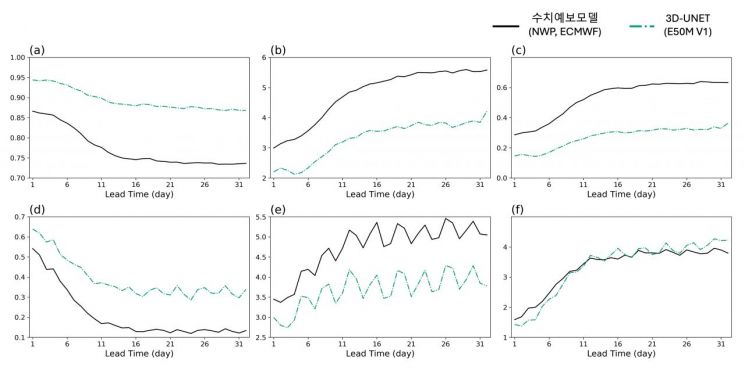
In other words, the model goes beyond simply calibrating information provided by existing numerical forecasts, incorporating temporal, spatial, and topographical characteristics simultaneously to produce more realistic results.
The AI model developed by the research team was trained to generate high-resolution information at approximately 23 km (0.25 degrees) intervals based on forecast data from the European Centre for Medium-Range Weather Forecasts (ECMWF), and it is also equipped with a function to correct structural errors that repeatedly appear in numerical forecasts.
This technology subdivides the forecast zones, which were previously separated at about 120 km intervals, into much finer zones of about 23 km, enabling predictions for much smaller areas and more precisely reflecting weather changes due to mountainous, coastal, and inland terrain. Rather than simply increasing resolution, this advanced method finely adjusts forecast errors to minimize discrepancies with actual weather patterns.
Performance evaluations showed that the new model achieved a significantly higher correlation with actual weather changes. For temperature, the correlation coefficient-which indicates how well the model matches observed weather patterns-increased by 0.12 compared to existing models, and for precipitation, it increased by 0.18. The correlation coefficient is a metric that approaches 1 as the model's predictions align more closely with real weather changes. In addition, the root mean square error (RMSE) was reduced by about 31% for temperature and about 22% for precipitation, demonstrating a substantial improvement in accuracy over conventional numerical forecasts.
The research team further analyzed the case of record-breaking rainfall in California in 2023. The results showed that while the new model more accurately captured the location and distribution of rainfall, it tended to underestimate the actual amount of precipitation (absolute precipitation).
This limitation is known to be common among the latest AI-based weather prediction models developed overseas, indicating that accurately forecasting the magnitude (amount) of precipitation remains an unresolved challenge.
It is noteworthy that this study achieved high predictive performance without adding dozens of complex input variables or exhaustively utilizing the results of multiple models, but rather by averaging multiple forecast results and using only the most important pieces of information.
Thanks to this approach, the model requires less memory and significantly reduces computation time, making it possible to operate reliably even in standard GPU environments rather than on expensive equipment. In other words, it is considered a practical and efficient alternative for improving forecasting capabilities before deploying large-scale AI weather forecasting systems.
Professor Jinho Yoon emphasized, "As the importance of forecasting grows with climate change, post-processing technology that uses AI to further calibrate the results produced by existing models to improve accuracy will be a powerful solution to the limitations of numerical weather prediction. As demonstrated in the case of the complex western United States, AI can play a decisive role in realizing high-resolution regional forecasts."
He added, "Because this technology improves forecasting accuracy while reducing computational burden and enhancing operational efficiency, it will also be highly beneficial for responding to climate disasters such as wildfires, floods, and droughts."
© The Asia Business Daily(www.asiae.co.kr). All rights reserved.
![From Bar Hostess to Organ Seller to High Society... The Grotesque Con of a "Human Counterfeit" [Slate]](https://cwcontent.asiae.co.kr/asiaresize/183/2026021902243444107_1771435474.jpg)

















