This Year’s MRV Solution Distribution Budget Set at 1 Billion Won
More Than Halved From Last Year’s 2.4 Billion Won
No Separate Budget for Consulting Program
"Support for Carbon Emissions Calculation Must Be Expanded"
With the European Union’s Carbon Border Adjustment Mechanism (CBAM) coming into full effect this year, it is expected that small and medium-sized enterprises (SMEs) will inevitably face both direct and indirect burdens. However, government support programs to address these challenges have actually been reduced. Concerns are growing, as domestic SMEs have low awareness of CBAM and lack the capacity to bear additional administrative costs.
According to industry sources on January 7, the budget for the “Digital-Based Automated MRV (Measurement, Reporting, and Verification) Solution Distribution Project”-implemented by the Ministry of SMEs and Startups to help domestic SMEs respond to CBAM-has been cut by more than half, from 2.4 billion won last year to 1 billion won this year. The “Carbon Emissions Calculation Consulting Project,” which had a budget of 1.7 billion won and was operated by the ministry until last year, has also been discontinued. This year, the consulting project, previously carried out jointly by the Ministry of SMEs and Startups and the Ministry of Climate, Energy, and Environment, will be implemented solely by the climate ministry with an annual budget of 1.2 billion won.
This change is reportedly due to the Ministry of Economy and Finance’s assessment that the impact of CBAM on domestic SMEs will not be as significant as initially expected. For now, the Ministry of SMEs and Startups plans to focus on encouraging facility improvements among SMEs through a 5 billion won support program for the development of carbon reduction technologies.
CBAM, which took effect on January 1, 2026, is a system that imposes additional costs on six categories of products-including steel, aluminum, and fertilizers-imported into EU countries, based on the amount of carbon emitted during production. In 2024, during the CBAM transition period, the Ministry of SMEs and Startups launched the “SME CBAM Response Infrastructure Development Project,” distributing MRV solutions and providing carbon emissions calculation consulting. However, just two years after these initiatives began, the core programs have been scaled back ahead of the full implementation.
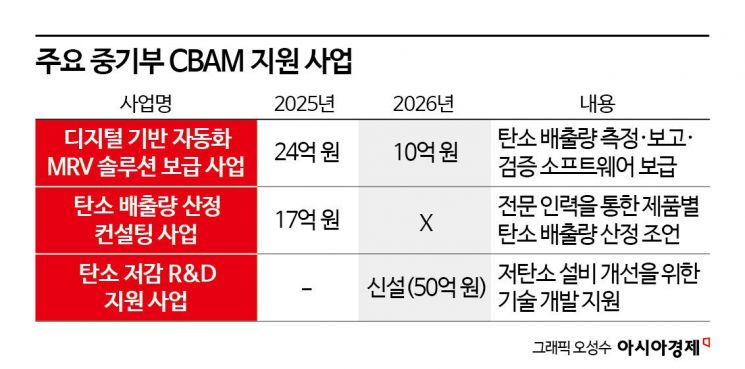
Given that “carbon emissions calculation” is the most urgent task for SMEs now obligated to report their emissions under CBAM, the reduction of these programs is being criticized as untimely. The MRV solution distribution project provides digital automated measurement, reporting, and verification software, enabling SMEs to calculate their own carbon emissions. The consulting project, which dispatched experts to help SMEs calculate product-specific carbon emissions on-site, was also considered a core program for SME CBAM compliance.
Seok Byunghoon, Professor of Economics at Ewha Womans University, stated, “Even if SMEs do not export directly to the EU, subcontractors and suppliers will likely be required by large corporations to report carbon emissions generated during production.” He added, “The problem is that most SMEs cannot afford the administrative costs and manpower needed for carbon emissions calculation.” He further noted, “There is excessive demand for the CBAM consulting program currently operated by state-owned banks compared to the available budget and personnel, so related support must be expanded.”
The carbon reduction technology development support program newly established by the Ministry of SMEs and Startups this year is also being criticized as “incomplete.” Although the ministry has allocated 5 billion won this year to support the long-term development of low-carbon technologies by SMEs, the support is limited to only two of the ten carbon-intensive items: steel and aluminum. If the actual impact of CBAM spreads across the entire supply chain, including all subcontractors and partner companies supplying large corporations, this measure will be insufficient to mitigate the shock throughout the supply network.
© The Asia Business Daily(www.asiae.co.kr). All rights reserved.


















