Range of Doctor Shortage Widens in Policy Committee Report
Jung Eunkyung: "Policy Decisions Will Prioritize Public Health Rights"
The estimated results of the Medical Workforce Supply and Demand Estimation Committee, which is responsible for decisions such as expanding medical school enrollment, changed in just one week. Initially, the committee projected that there would be a shortage of at least 5,704 physicians in 2040. However, the number reported at the Health and Medical Policy Deliberation Committee meeting dropped to 5,015, a decrease of nearly 700.
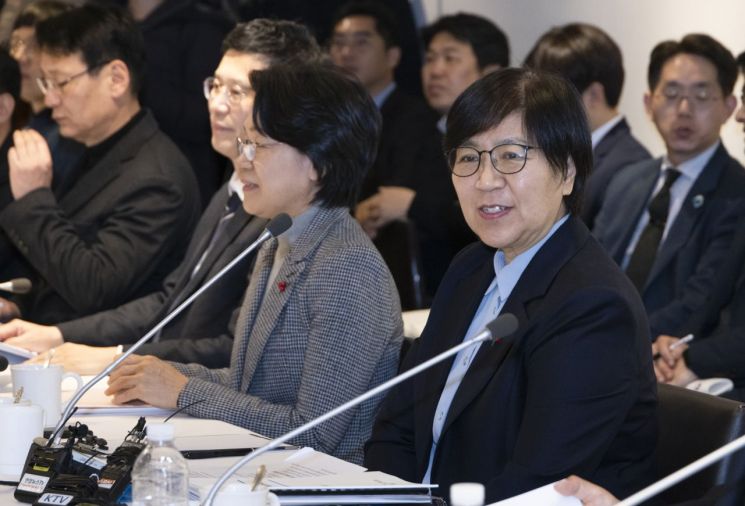 Jung Eun-kyung, Minister of Health and Welfare, is speaking at the 2nd Health and Medical Policy Deliberation Committee held on the 6th at Conference House Dalgabbi in Jung-gu, Seoul. Ministry of Health and Welfare
On January 6, the Ministry of Health and Welfare received a report on the estimation committee's supply and demand model, assumptions, and results at the second meeting of the Health and Medical Policy Deliberation Committee, and began discussions to finalize medical school enrollment quotas for the 2027 academic year and beyond. The committee, which deliberates and makes decisions on major health and medical policies, was reconstituted last December with 24 new members and has since resumed its meetings.
Previously, the estimation committee predicted, based on the number of outpatient and inpatient visits by Korean citizens and changes in population structure, that there would be a shortage of 1,535 to 4,923 physicians in 2035 (ten years later), and a shortage of 5,704 to 11,136 physicians in 2040 (fifteen years later).
However, the physician shortage numbers reported at the meeting that day were 1,055 to 4,923 in 2035 and 5,015 to 11,136 in 2040, indicating a wider range. The minimum shortage figures decreased by 689 and 480, respectively.
An official from the estimation committee explained, "As we updated the latest figures for the proportion of medical school graduates who actually practice clinical medicine, the rate was adjusted upward from 95% to 96.01%. The numbers changed due to the data update, not because of any errors."
Based on the estimation results reported at the meeting, the committee plans to hold weekly meetings throughout this month to discuss the scale of the enrollment increase, aiming to reach a conclusion before the Lunar New Year holiday next month, taking into account the university admissions schedule. In particular, the committee is expected to review the scale of the increase while considering the introduction of a regional physician system and the establishment of a public medical school.
The Ministry of Health and Welfare has previously presented the following as criteria for deliberating the scale of physician training: the estimation committee's results; the goal of resolving regional medical disparities and shortages of essential and public healthcare personnel; consideration of changes in the future medical environment and policy shifts; ensuring the quality of medical education; and securing the stability and predictability of training scale.
Jung Eun-kyung, Minister of Health and Welfare and chair of the committee, emphasized, "The scale of the physician workforce is a critical policy decision that affects people's lives and health rights through regional, essential, and public healthcare services. Based on the fundamental premise of respecting the estimation committee's results, we will now begin full-scale discussions on the physician training scale for the 2027 academic year and beyond."
© The Asia Business Daily(www.asiae.co.kr). All rights reserved.
![Clutching a Stolen Dior Bag, Saying "I Hate Being Poor but Real"... The Grotesque Con of a "Human Knockoff" [Slate]](https://cwcontent.asiae.co.kr/asiaresize/183/2026021902243444107_1771435474.jpg)











