Tokyo and Osaka Most Searched... Kagoshima Sees 160% Surge
Season-Switching Travel Demand Expands Despite Peak-Season Rates
Despite rising accommodation costs ahead of the Lunar New Year holiday, Korean travelers continue to flock to major Japanese cities such as Tokyo and Osaka. At the same time, interest is expanding to smaller Japanese cities like Kagoshima and Kobe, as well as to destinations in Australia and the Middle East, broadening the range of travel options.
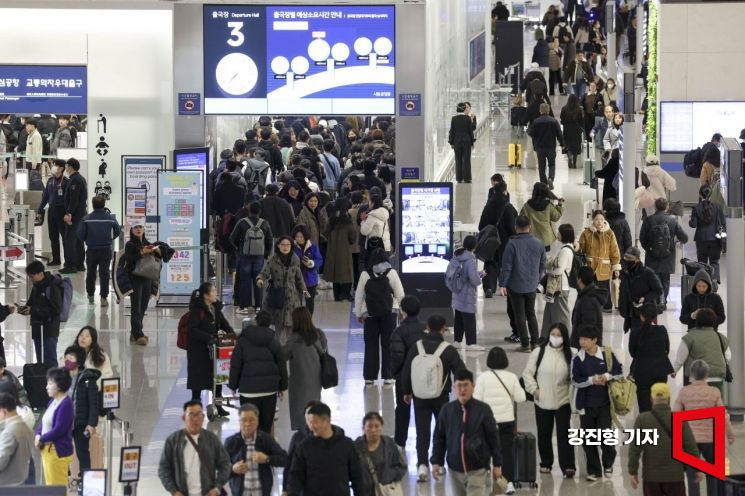 The scene at Incheon International Airport bustling with travelers on the 31st, ahead of the New Year's bridge holiday. The Asia Business Daily DB
Strong Demand for Travel to Japan Despite Peak Season Rates... Growing Interest in Smaller Cities
According to an analysis of Hotels.com reservation data on January 6, Tokyo, Osaka, Fukuoka, and Sapporo remain the most searched Japanese destinations among Korean travelers. As more people plan trips for the Lunar New Year holiday, searches for Kagoshima increased by 160% year-on-year, and Kobe saw a 95% rise, emerging as new popular destinations.
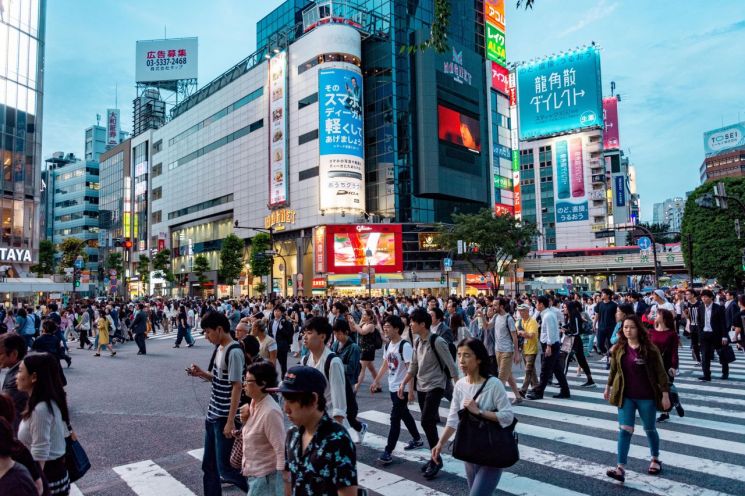
During the Lunar New Year holiday, accommodation rates in major Japanese cities reflected peak season pricing trends. According to Hotels.com, the average daily rate (ADR) in Tokyo was about 371,000 won, while Osaka recorded around 267,000 won. These figures are higher than the 2023 Hotel Price Index averages previously released by Hotels.com, which were 255,000 won for Tokyo and 199,000 won for Osaka.
Rising Interest in Long-Haul and Season-Switching Destinations
In contrast, some long-haul destinations maintained relatively stable accommodation rates during the holiday period. For example, the ADR in London during the Lunar New Year was about 344,000 won, lower than its annual average of approximately 370,000 won, while Rome's ADR was about 340,000 won, similar to its yearly average.
Interest is also growing in so-called "season-switching" travel, where people visit regions experiencing the opposite season. According to Hotels.com, searches for Melbourne, Sydney, and Dubai increased by 60%, 30%, and 85%, respectively, compared to the previous year. This indicates that Korean travelers are diversifying their travel choices during the Lunar New Year holiday.
A Hotels.com representative explained, "This data shows Korean travelers' planning and booking patterns for the Lunar New Year, as well as travel demand and pricing trends during the peak season."
Meanwhile, in response to the surge in tourists, the Japanese government plans to address the issue of overtourism by raising the international tourist departure tax from the current 1,000 yen (about 9,000 won) per person to 3,000 yen (about 27,000 won) starting in July this year.
© The Asia Business Daily(www.asiae.co.kr). All rights reserved.


















