Bank of Korea Releases Minutes of Extraordinary Monetary Policy Committee Meeting Held on December 19, 2023
Prior to the implementation of the Bank of Korea's temporary interest payment on excess reserve requirements for foreign currency deposits held by financial institutions (foreign currency reserve remuneration), an extraordinary meeting of the Monetary Policy Committee was convened. During this meeting, committee members closely examined whether the initiative would have a tangible effect on stabilizing the foreign exchange market and improving supply and demand conditions.
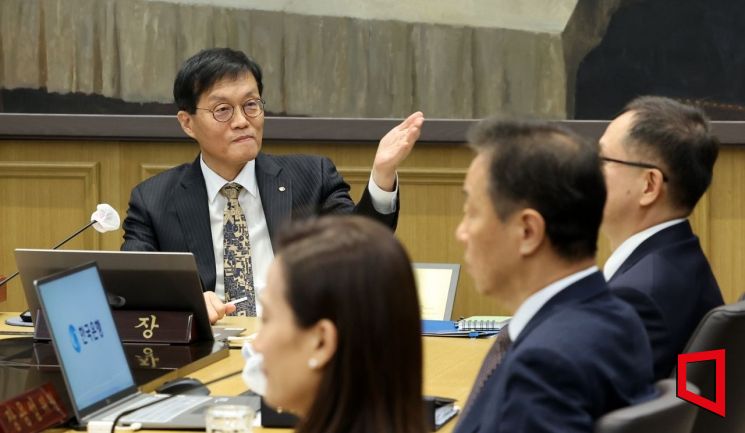 Lee Changyong, Governor of the Bank of Korea, is presiding over the Monetary Policy Committee plenary meeting at the Bank of Korea headquarters in Jung-gu, Seoul, on October 23 last year. Photo by Joint Press Corps
According to the minutes of the extraordinary Monetary Policy Committee meeting held on December 19 of last year, released by the Bank of Korea on January 6, the committee members approved the proposal to pay interest on financial institutions' foreign currency reserve requirements, after revising some of the wording.
Before the decision, some members inquired whether this measure would genuinely stabilize the foreign exchange market, whether there had been previous instances of foreign currency reserve remuneration, and why such a system had not been introduced during past crises such as the foreign exchange crisis or financial crisis. The relevant department responded, "Unlike recent measures related to the foreign exchange market, the foreign currency reserve remuneration is a system designed in anticipation of the National Pension Service's strategic currency hedging. If currency hedging volumes are introduced in the future, it will help stabilize the market." The department further explained, "During the 2008 global financial crisis, a temporary reserve remuneration system was introduced for the Korean won, but this is the first time such a system is being implemented for foreign currencies."
Another member stated, "In past financial and economic crises, this tool was viewed as the last policy option for foreign exchange authorities, and there were concerns about negative side effects such as signaling to the outside world that the situation was severe, so it was not introduced. However, the current situation, while there is some concentration in the foreign exchange market, is not a crisis like in the past, so the likelihood of negative side effects is low." Another member pointed out, "The reserve remuneration for Korean won implemented by the Bank of Korea during previous financial crises was a post-event measure to compensate financial institutions, whereas the current foreign currency reserve remuneration is a pre-emptive measure, and thus has a different nature." The member also requested that it be clearly communicated that this is a "temporary measure" and that future utilization plans be specified.
In response to a committee member's question about the expectation that this measure would lead to non-financial institutions such as corporations depositing their overseas-held US dollars in domestic banks as short-term foreign currency fund management by financial institutions expands, it was explained that "this is expected as one of the incidental effects of the system." It was also noted that the interest rate paid by domestic banks on foreign currency deposits is higher than the rate offered by US financial institutions. Furthermore, considering the profit generated by the Bank of Korea from managing the deposited foreign currency reserves, it is projected that the Bank of Korea's net cost from the reserve remuneration will not be significant.
Some members emphasized, "The main tools for stabilizing the foreign exchange market by policy authorities are structural improvements in foreign exchange supply and demand conditions and stabilization measures to respond to volatility, and it is important to communicate this clearly." Another member requested a detailed explanation of the recent high exchange rate situation, noting that at the end of 2024, political uncertainty contributed to the high exchange rate, while at the beginning of 2025, uncertainty over tariff negotiations played a role. It was also mentioned that recently, in addition to the annual burden of $20 billion in cash investments in the US, factors such as increased overseas direct investment and growing demand for overseas securities investment by individuals have also contributed to the situation.
Other members stressed, "Following recent measures such as the exemption from the foreign exchange soundness levy and the meeting with securities firms, it is essential to ensure that the introduction of the foreign currency reserve remuneration is not perceived as a series of sporadic stabilization actions. A well-established system of cooperation between institutions and policies is necessary to maximize policy effectiveness."
In accordance with the resolution of the extraordinary Monetary Policy Committee meeting, the Bank of Korea will implement temporary interest payments on foreign currency reserves deposited by financial institutions. The interest payment period will be from January to June of this year, with payments made monthly for deposits from December of last year through May of this year. The interest will be paid at a level corresponding to the current US policy rate target range (currently 3.5% to 3.75%), so that financial institutions can earn higher returns by keeping their foreign currency funds domestically rather than investing them overseas. The expectation is that, if financial institutions are able to attract more foreign currency deposits under better conditions, corporations and individuals will also have a greater incentive to keep their foreign currency funds in the country. This measure is also designed to prepare for the possibility that the National Pension Service, which has declared a "flexible currency hedge," may engage in large-scale foreign exchange swaps, thereby improving supply and demand conditions. However, if the policy results in not only the intended inflow of funds from overseas investments but also an increase in short-term foreign currency funds being deposited as reserves in the domestic market, the Bank of Korea plans to operate the system flexibly, including lowering the applicable interest rate as needed.
© The Asia Business Daily(www.asiae.co.kr). All rights reserved.

















