Investing 3.78 Billion Won and Mobilizing Field-Tested Technologies
Transforming Omija from a Local Specialty to a Strategic Industry
Mungyeong City has officially launched an initiative to fundamentally restructure the industrial framework surrounding omija, the region’s signature specialty crop.
The strategy is to overcome the structural limitations of agriculture-such as the climate crisis and production instability-through technology and policy measures.
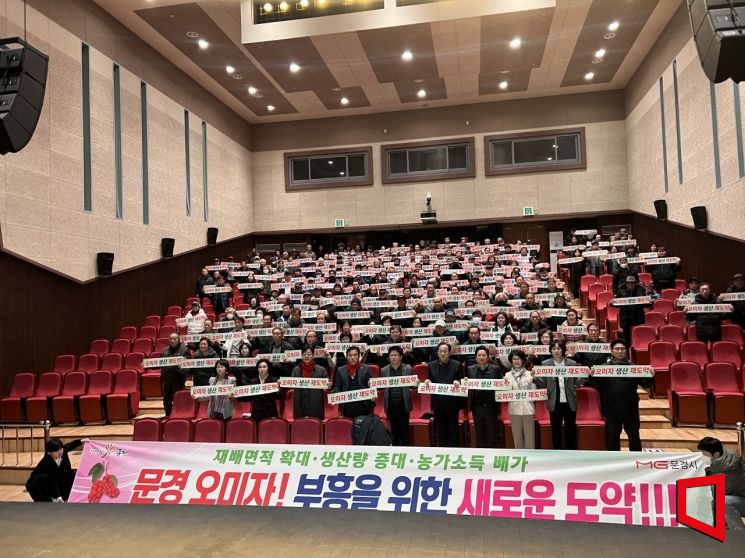
On January 6, Mungyeong City held the “Mungyeong Omija Production Reboot Project Comprehensive Evaluation Meeting” at Munhui Art Hall, attended by Mayor Shin Hyunkook, City Council Chair Lee Jeonggeol, provincial and city council members, omija farmers, and over 200 participants. The event provided a thorough review of the research achievements and field-oriented project outcomes implemented throughout 2025.
This meeting is seen not as a routine annual report, but as a turning point that connects evidence-based agricultural technology with industrial policy. Mungyeong City has redefined omija not merely as a cultivated crop, but as a core industry supporting the sustainability of local agriculture, and has shifted its approach accordingly.
Last year, Mungyeong City focused on redesigning the entire production base by establishing demonstration fields for omija utilizing farmland, piloting a specialized crop zone for agricultural transformation, and developing mass-production technology for high-quality omija seedlings. Building on these efforts, the city plans to invest a total budget of 3,782 million won this year to simultaneously expand cultivation areas and enhance production stability.
In particular, with abnormal weather conditions emerging as a key challenge, the Agricultural Technology Center will gradually distribute field-tested technologies for open-field environment control to cope with heat waves, as well as pilot projects using low-temperature films to promote plant growth. Alongside this, the city will establish a stable supply system for high-quality seedlings and conduct research to improve pest and disease control, aiming to minimize fluctuations in both quality and yield.
At the end of the meeting, all participants joined in a “New Leap for the Revival of Mungyeong Omija! Wishing for Success” performance, symbolizing the commitment of both the field and the administration to leading the industrial transformation together.
Kim Mija, Director of the Mungyeong Agricultural Technology Center, emphasized, “Mungyeong Omija represents the identity of our region and is a future growth asset. By combining field-validated technologies and policies, we will ensure industrial changes that farmers can truly experience.”
Immediately after the meeting, Mungyeong City continued its efforts by operating the “2026 New Year Practical Education Omija Course for Farmers,” sharing the need to expand cultivation areas and increase production, and thus connecting education and policy with practical field implementation.
In an era where the climate crisis has become a daily reality for agriculture, Mungyeong City has chosen not mere adaptation, but structural transformation. Attention is focused on whether this experiment centered on omija can become a future model for regional agriculture.
© The Asia Business Daily(www.asiae.co.kr). All rights reserved.
![Clutching a Stolen Dior Bag, Saying "I Hate Being Poor but Real"... The Grotesque Con of a "Human Knockoff" [Slate]](https://cwcontent.asiae.co.kr/asiaresize/183/2026021902243444107_1771435474.jpg)
















