Hwang Hee: "Personally, I Do Not Understand the Jaechohwan"
Amid ongoing discussions within the Democratic Party of Korea regarding the abolition or relaxation of the Reconstruction Excess Profit Recapture System (commonly known as "Jaechohwan"), criticism has emerged from within the party, arguing that the system excessively regulates the market.
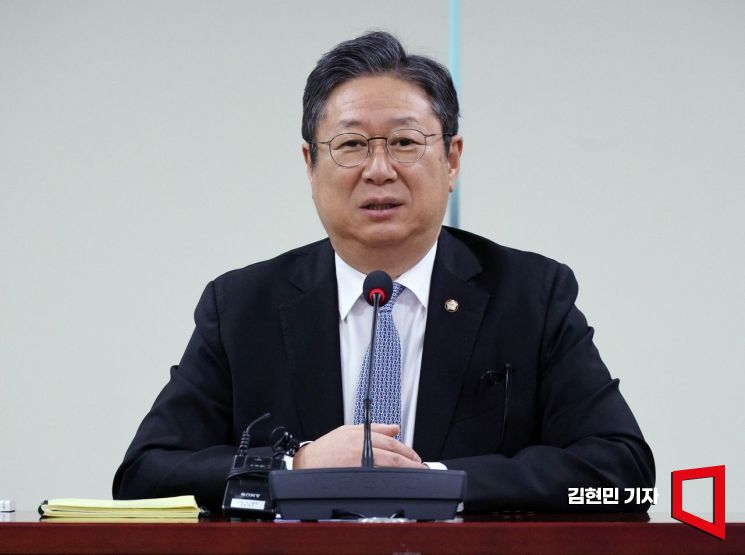 Hwang Hee, a member of the Democratic Party of Korea and head of the Seoul Metropolitan Party's Local Election Planning Team, is holding a press briefing on real estate policy directions at the National Assembly Members' Office Building on January 6, 2026. Photo by Kim Hyunmin
On January 6 at the National Assembly in Yeouido, Assemblyman Hwang Hee of the Democratic Party of Korea, who serves as the head of the Seoul Metropolitan Party's Local Election Planning Team, held a press briefing on real estate policy directions. He stated, "The Jaechohwan or land permit system is implemented right before the announcement of new city developments," adding, "It is excessive to recapture surplus profits from people who are already living in existing cities, as this constitutes overregulation of the market." However, Hwang emphasized, "This is strictly my personal opinion."
Regarding the Jaechohwan, Hwang stressed, "Personally, I do not understand it." He explained, "If a company grows from 1 billion won to 10 billion won through its business, we do not recapture the excess profit. There is a logic that, since roads and infrastructure are provided and the government contributes, the profit should be recaptured from real estate assets. However, I do not think it is logical to recapture even the excess profit after public contributions have already been made."
Although the Democratic Party of Korea had initially expressed a negative stance on abolishing the Jaechohwan, voices calling for its relaxation or abolition have emerged since the October 15 real estate measures. Nevertheless, the party leadership has maintained a cautious approach, stressing that these are individual opinions.
Hwang stated, "Real estate policy is the result of long-accumulated adverse factors, so resolving these issues must also be approached in a multi-layered and mid- to long-term manner. If we keep trying to eliminate problems as they arise without comprehensive, long-term measures, the balloon effect is inevitable."
He further argued that real estate policy should be based on three principles: "Land must be public, buildings must be market-driven, and housing must be premised on residential stability."
Emphasizing the public nature of land, Hwang highlighted the need to expand public land. He said, "The government itself may be the fundamental cause of real estate speculation. When the government sells land, only large construction companies benefit. Interior materials have a lifespan of 30 years, while exterior materials in reinforced concrete apartments last 100 years. Although the exterior may last a century, the interior's 30-year lifespan necessitates reconstruction." He added, "Even if the expansion of public land improves our neighborhoods, measures must be taken to ensure that communities can remain intact without gentrification."
Addressing the market-driven nature of buildings, Hwang pointed out the irrationality of the Jaechohwan and stressed the need to ease conditional property tax rules for owners of two homes. He said, "We should encourage 'second homes' in metropolitan areas. For cases such as two homes in the capital region, two homes in metropolitan areas, or two homes outside metropolitan areas-which are practically equivalent to single-home ownership-taxes should be eased and the focus should shift to transaction taxes." Regarding residential stability, he argued that the right to housing should be explicitly stated in the Constitution to strengthen government financial support.
Meanwhile, Hwang, who holds a doctorate in urban engineering, has been vocal on housing policy issues. Ahead of the 21st general election, he emphasized the need to reduce the comprehensive real estate holding tax for single-home owners.
© The Asia Business Daily(www.asiae.co.kr). All rights reserved.
![Clutching a Stolen Dior Bag, Saying "I Hate Being Poor but Real"... The Grotesque Con of a "Human Knockoff" [Slate]](https://cwcontent.asiae.co.kr/asiaresize/183/2026021902243444107_1771435474.jpg)
















