On January 6, the KOSPI, which had started the day lower, succeeded in rebounding and set a new all-time high for the third consecutive session.
On this day, the KOSPI closed at 4,525.48, up 67.96 points (1.52%) from the previous session. After surpassing the 4,300 mark for the first time on January 2, the KOSPI climbed past 4,400 the previous day and then broke through the 4,500 barrier just one day later.
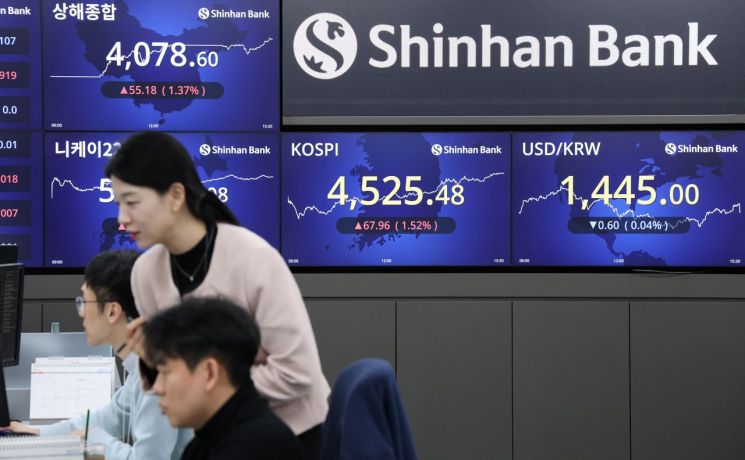
The index initially opened at 4,446.08, down 11.44 points (0.26%), and widened its losses to fall below the 4,400 level at one point. However, a wave of individual investor buying reversed the trend and pushed the index higher. While foreign investors and institutions sold off 630.5 billion won and 68.9 billion won worth of shares, respectively, individuals purchased 597.5 billion won, supporting the index. In the KOSPI200 futures market, institutions were net buyers of 509.1 billion won, while individuals and foreign investors sold off 49.5 billion won and 512 billion won, respectively.
Among large-cap KOSPI stocks, all major names rallied. After drawing attention for its meeting with Nvidia at 'CES 2026,' SK Hynix surged over 4% to hit a record high. Samsung Electronics, which had dropped more than 3% at one point, also rebounded to close at its highest-ever price. Other notable gainers included HD Hyundai Heavy Industries (up 7.21%), SK Square (up 3.85%), Doosan Enerbility (up 3.25%), LG Energy Solution (up 1.75%), Celltrion (up 1.67%), Hyundai Motor (up 1.15%), Hanwha Aerospace (up 0.99%), and Samsung Biologics (up 0.47%).
Lim Jeongeun, a researcher at KB Securities, commented, "Despite profit-taking in semiconductor stocks-evidenced by foreign investors' net selling of over 1.4 trillion won in the electrical and electronics sector-expectations of further gains led to a reversal in the leading semiconductor stocks." She added, "With accelerating innovation in artificial intelligence (AI) and expanding demand, investor sentiment is expected to remain favorable for the time being." Previously, Jensen Huang, CEO of Nvidia, captured market attention at CES 2026 by announcing the mass production of the next-generation AI chip 'Vera Rubin,' which will succeed Blackwell, alongside the autonomous driving model 'Alphamayo.'
On the same day, the KOSDAQ closed at 955.97, down 1.53 points (0.16%) from the previous session, ending a three-day winning streak. The index had opened at 959.38, up 1.88 points (0.20%), and fluctuated within a narrow range before finishing slightly lower. Individual investors were net buyers of 382.1 billion won, while foreign investors and institutions were net sellers of 344.9 billion won and 31 billion won, respectively.
Among major KOSDAQ stocks, results were mixed. ABL Bio (-5.19%), Kolon TissueGene (-3.62%), Rainbow Robotics (-3.46%), Samchundang Pharm (-2.56%), Peptron (-1.55%), and LIG ChemBio (-0.45%) declined, while Ecopro (up 3.67%), Ecopro BM (up 1.78%), HLB (up 1.30%), and Alteogen (up 1.17%) advanced.
By sector, securities (+4.93%), shipbuilding (+4.01%), and transportation & logistics (+3.98%) showed strong performances. Non-ferrous metals (-5.33%), cosmetics (-3.54%), and healthcare (-3.48%) experienced corrections.
© The Asia Business Daily(www.asiae.co.kr). All rights reserved.

















