Strategies Focused on Country-Specific Issues Such as Health and Eco-Friendliness
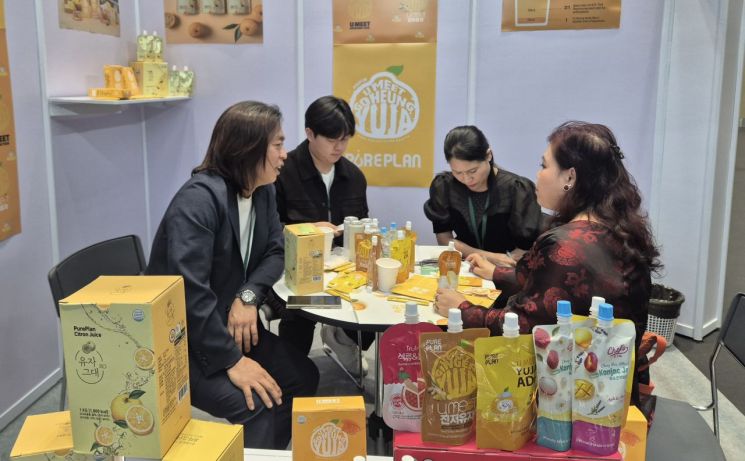 Seoul Food in Bangkok Jeonnam Agricultural and Marine Products Promotion Center. Provided by Jeonnam Province
Jeollanam-do announced that it will share the 2026 global agri-food market trends and key issues with cities, counties, agri-food export companies, and related export organizations and associations. The province also stated that it will provide support to help them proactively respond to the changing international market environment.
According to the presentation at the ‘2026 Global Agri-Food Market Trends and Outlook’ webinar (a seminar held online) by the Korea Agro-Fisheries & Food Trade Corporation (aT), the size of the global food market in 2025 is expected to reach approximately $9.2 trillion, a 7.0% increase from the previous year. By 2026, the market is projected to grow to $9.9 trillion.
The leading consumer countries in the global food market are China, India, the United States, and Japan, with Russia, Indonesia, Germany, Mexico, Nigeria, and France also included. As of 2025, the market share by product category is projected as follows: meat (16.9%), bread and grains (16.0%), dairy products and eggs (13.8%), vegetables (12.6%), fruits and nuts (10.0%), and confectionery and snacks (9.7%). This indicates a structure in which demand for essential foods is expanding alongside high value-added and emerging growth categories.
By country, the United States is characterized by health and regulatory issues, China by strengthened labeling requirements, Japan by changes in small-portion and labeling systems, and ASEAN by halal certification. In the United States, the market structure is centered on confectionery and snacks, dairy products and eggs, and meat, with consumption of high-protein and low-sugar foods expected to increase. In terms of regulations, the use of artificial food color FD&C Red No.3 will be banned from January 2027, and six types of colorants, including Green No.3 and Red No.40, will be gradually banned by the end of 2026. Therefore, pre-checking the ingredients and labeling of export products has become increasingly important.
In China, both consumer price sensitivity and demands for ingredient transparency are rising. According to the revision of the national standard for prepackaged food labeling, starting in March 2027, all prepackaged foods distributed and sold in China must comply with the new standards. In addition, the overseas food producer registration system will be partially eased from June 2026, with extensions to renewal application periods and the introduction of automatic renewals, which is expected to reduce administrative burdens.
In Japan, there is a growing trend toward new forms of food consumption, such as personalized recipe recommendations and nutrition management services using AI technology, as well as increased demand for small portions and ready-to-eat meals. Interest in foods using eco-friendly packaging materials is also on the rise.
In Europe, the transition to eco-friendly packaging for food products to reduce food waste is expected to accelerate. The competitiveness of products using eco-friendly food packaging materials, such as minimal packaging, small packaging, and biodegradable packaging, is expected to increase. In particular, with the Packaging and Packaging Waste Regulation (PPWR) set to take effect in 2026, the trend toward simplifying packaging and increasing recycling rates is expected to strengthen.
ASEAN is a rapidly growing market driven by population growth and an expanding middle class, with food purchases increasingly led by social media, mobile-based consumption, and food delivery services. Demand for low-sugar and zero-sugar foods, premium ready-to-eat meals, and localized K-food is expanding. Responding to regulatory changes, such as the mandatory halal certification in Indonesia starting in October 2026, has been identified as a key challenge.
In response, Jeollanam-do will invest 4.3 billion won in direct payments for regionally specialized export items, 2.4 billion won in projects to strengthen the export competitiveness of agricultural and marine products (including support for obtaining overseas food standard certifications such as halal certification), and a total of 10.5 billion won in 12 projects, including overseas promotions, export consultation meetings, international food exhibitions, and consulting support through trade doctors.
Through these efforts, the province plans to enhance the export competitiveness of local companies in 2026 by strengthening consulting on country-specific regulations and labeling, upgrading products and marketing based on local trends, and supporting both online and offline sales channels.
Shin Hyungon, Director of International Cooperation at Jeollanam-do, emphasized, "As the global food market continues to grow, proactively identifying and responding to changing consumer trends and regulatory issues will determine export success. We will ensure that export companies are not shaken by changes in the 2026 market environment by providing thorough information and on-site support."
© The Asia Business Daily(www.asiae.co.kr). All rights reserved.

















