Refuting the 'Semiconductor Southern Boundary Line' Argument, Criticizing the Seoul-Centric Structure
Calling for a Decentralized Location Strategy Considering Power and Renewable Energy Conditions
Emphasizing, "Decentralization Is Both Industry Normalization and a Matter of National Survival"
President Lee Jaemyung Mentions Southern Semiconductor Belt Initiative in New Year's Address
Lee Byunghun, Senior Vice Chairman of the Honam Development Special Committee, emphasized the importance of distributing the semiconductor industry across regions, stating, "Dispersing semiconductor clusters to the Honam region is a matter of national survival." He refuted the so-called 'semiconductor southern boundary line' argument and urged the adoption of a decentralized semiconductor cluster strategy.
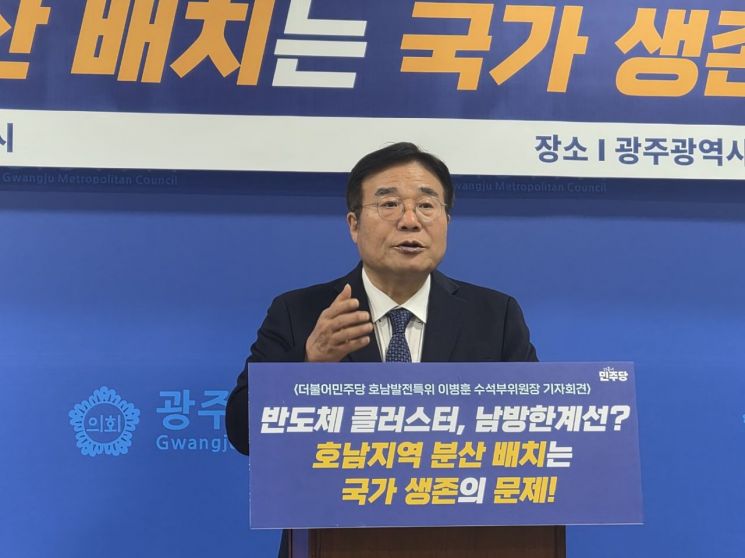 At a press conference held at Gwangju City Council on the morning of the 6th, Lee Byunghun, Senior Vice Chairman of the Honam Development Special Committee, advocated for the necessity of distributed placement of the semiconductor cluster. Photo by Song Bohyun
At a press conference held at Gwangju City Council on the morning of the 6th, Lee stated, "Reconsidering the location of semiconductor facilities is not a source of confusion, but rather a path toward normalizing Korea's semiconductor industry." He added, "The existing discussions, which are based on concentration in the Seoul metropolitan area, fail to fully reflect issues such as power saturation, the transition to new energy sources, and changes in the global industrial environment."
Lee pointed out that expanding transmission networks is inevitable to supply the large amounts of electricity required by the semiconductor industry. However, he noted that constructing ultra-high-voltage transmission lines can lead to issues with public acceptance, social conflict, and the potential for lengthy project delays. He explained that in many major domestic transmission network projects, the process of obtaining permits and resolving conflicts has taken more than 10 years.
Regarding the recent argument about the 'southern boundary line for semiconductor workforce,' Lee said, "This perception is not based on industrial reality but on the assumption of a Seoul-centric structure." He explained, "The reason talent is concentrated in the metropolitan area is because industries and jobs are clustered there." Citing examples from the United States and Taiwan, he emphasized that "division of labor and decentralization are already global standards."
Lee defined the semiconductor industry as a national strategic asset, stating, "An excessively concentrated structure in a specific region can turn into a nationwide risk in the event of a power outage, climate crisis, or geopolitical variables." He also pointed out that the United States and Taiwan are securing supply chain stability by distributing semiconductor production bases both domestically and internationally.
He further stated, "The use of renewable energy is not a choice but a standard," and explained that Minister of Climate, Energy, and Environment Kim Seonghwan's remarks about reconsidering semiconductor facility locations were not political intervention but a reflection of policy realities. He noted that this aligns with the national strategy of restructuring the industrial ecosystem around regions abundant in renewable energy.
Lee argued that the Honam region possesses objective conditions for the decentralized placement of semiconductor facilities. He cited the base power from Yeonggwang Hanbit Nuclear Power Plant, renewable energy resources such as solar and wind power, the hydrogen energy industry in Yeosu National Industrial Complex, the artificial sun research base in Naju, the water resource system in the southern region, and the location of national data centers. He also mentioned the conditions for nurturing semiconductor talent through local universities such as Chonnam National University, Chosun University, Gwangju Institute of Science and Technology, and Korea Energy Engineering University.
Lee stated, "While the Yongin semiconductor cluster should proceed on the premise of a smooth landing, the newly established fabs and material, component, and equipment industrial complexes should be distributed to the Honam region, which has abundant renewable energy potential." He added, "The 4.5 trillion won system semiconductor mutual growth foundry announced by the Ministry of Trade, Industry and Energy on December 10 last year should be attracted to Gwangju and Jeonnam."
He further remarked, "If a southern semiconductor innovation cluster is established by linking the mutual growth foundry and advanced packaging, it will provide a stable and sustainable growth foundation for the semiconductor industry, which is directly tied to national competitiveness."
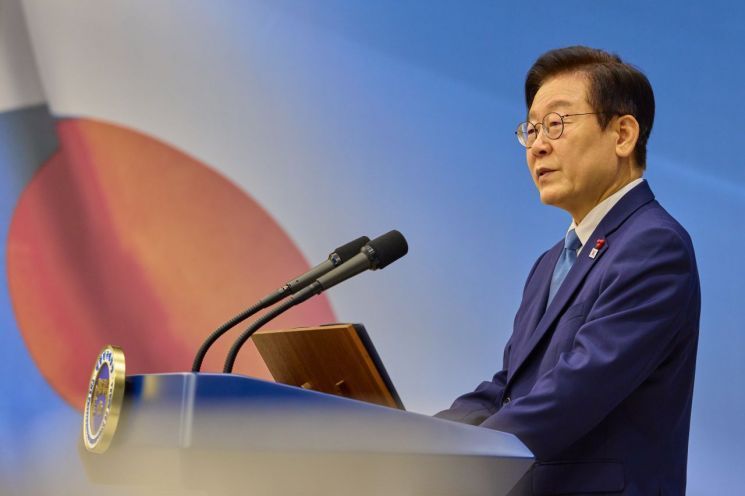
Meanwhile, discussions surrounding the location of semiconductor facilities have recently resurfaced, mainly among the government and political circles. In his New Year's address, President Lee Jae-myung stated, "From the semiconductor belt in the energy-rich southern region to AI demonstration cities and renewable energy clusters, we will design a structure in which advanced industrial development leads to regional development," mentioning plans for a semiconductor belt centered on the southern regions such as Honam and Yeongnam. However, he did not clarify whether this statement implies relocating the SK Hynix and Samsung Electronics semiconductor plants currently planned and under construction in Yongin, or whether it refers to the creation of new industrial complexes. SK Hynix and Samsung Electronics plan to invest a total of 480 trillion won by 2050 to build 10 semiconductor plants in Yongin.
In this context, on December 10 last year, President Lee mentioned at the 'Strategy Briefing for Fostering the Semiconductor Industry in the AI Era,' "Please pay attention to building a new industrial ecosystem by turning our eyes to the southern regions rich in renewable energy." Subsequently, on December 26, Minister of Climate, Energy, and Environment Kim Seonghwan stated in a broadcast interview, "We are considering whether it is necessary to be in Yongin or whether we should move to a region with more electricity," which sparked further controversy.
Following Minister Kim's remarks, National Assembly members from the Democratic Party representing the Yongin area and Lee Sangil, the mayor of Yongin from the People Power Party, expressed opposition to relocating the Yongin semiconductor industrial complex to other regions. On the other hand, local governments and environmental groups have renewed calls to halt the construction of energy highways and to promote the decentralized placement of the semiconductor industry in the provinces.
© The Asia Business Daily(www.asiae.co.kr). All rights reserved.


















