Automatic Payment System for Childbirth Congratulatory Grants Implemented from First to Fourth Birthday
On January 6, the city of Gwangyang in South Jeolla Province announced that it has significantly improved the application and payment procedures for its childbirth congratulatory grant (birth encouragement grant). Starting this year, the city will implement the "Automatic Payment System for Childbirth Congratulatory Grants," under which the grant will be automatically paid each year from a child's first to fourth birthday.
The childbirth congratulatory grant is a system designed to celebrate the birth of a child and alleviate the financial burden faced by families in the early stages of childbirth. However, until now, the requirement to apply in order to receive the grant has placed an administrative burden on families with newborns.
To address this gap, Gwangyang City has switched to an automatic payment method. In other words, this is a welfare program in which the administration proactively takes care of families: the "Gwangyang City Automatic Payment System for Childbirth Congratulatory Grants."
■ How the Childbirth Congratulatory Grant System Operates
The childbirth congratulatory grant, the flagship project of Gwangyang City's pregnancy and childbirth support initiatives, began in 2004 as a program to support childcare expenses for newborns in agricultural households. Since 2008, the program has expanded its eligibility to all families residing in the city for more than one year, and it has continued for 23 years as of this year.
The grant is intended to celebrate and support a child's growth for a certain period after birth, and to help ease the initial financial burden of childbirth and childrearing, thereby fostering a birth-friendly environment.
Eligible recipients are newborns or adopted children under 12 months who are registered in Gwangyang City, and whose parents have been registered residents of the city for at least six months prior to the date of birth.
The amount of support varies depending on the birth order: 5 million won for the first child, 10 million won for the second, 15 million won for the third, and 20 million won for the fourth child or beyond. The payments are made in five installments from birth until the child turns four years old.
■ Gwangyang City's Childbirth Grant Support Has Expanded by Over 260% in the Past Nine Years
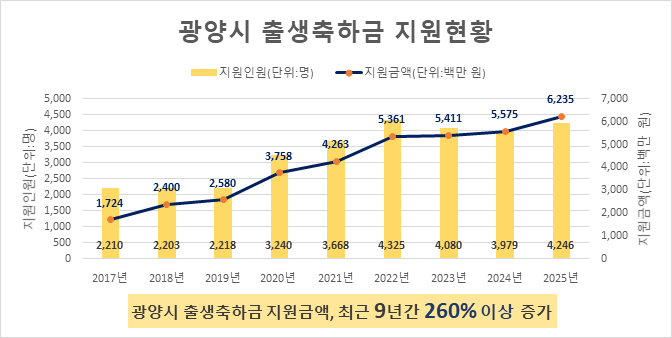
The budget for Gwangyang City's childbirth congratulatory grant has increased significantly over the past nine years. According to the city, in 2017, 1.724 billion won was allocated to support 2,210 recipients, while in 2025, 6.235 billion won will be allocated to support 4,246 recipients. This represents an increase of over 260% in budget terms.
Even as the number of births has declined, Gwangyang City has continued to expand the scale of childbirth grant support. This demonstrates the city's policy commitment to stably maintain and expand the scale and criteria of support for families with newborns over the medium and long term, regardless of fluctuations in the birth rate.
■ Some Eligible Families Missed Out on the Grant
Nevertheless, there have been cases each year in which eligible families did not receive the grant due to missed applications, resulting in ongoing complaints. In many cases, this was not due to a lack of awareness about the system, but rather because parents, busy with childbirth and parenting, missed the application period or procedures.
Such cases highlighted a gap between the intent of the system and its actual operation. The problem was not the scope of eligibility, but rather the application-based operation of the system.
■ How the Automatic Payment Procedure Works
To resolve this issue, the city has improved the system so that families can receive the childbirth congratulatory grant automatically, without a separate application.
The new system applies to families who meet the eligibility requirements for the grant from the child's first to fourth birthdays.
The procedure centers on prior verification between departments and administrative agencies. The Birth and Health Department first sends the list of eligible recipients for the month to each township and neighborhood office. These offices then pre-verify residency and eligibility requirements, and only request supporting documents from recipients if further verification is needed. The offices report the verification results to the Birth and Health Department, which then reviews the data and automatically pays the grant by the 15th of the following month.
Notably, for children born in 2026 or later, only one application and consent for personal information provision is required at birth, after which the grant will be automatically paid from the first to fourth birthdays without any further application.
■ The Deliberations and Choices Behind Automatic Payment
The decision to introduce the automatic payment system for the childbirth congratulatory grant was not an easy one from the outset. Within the department, there were concerns that switching to automatic payment could increase the risk of missing or incorrectly including recipients due to changes in residency, loss of eligibility, or address changes.
System improvements, computerized management, and the additional administrative burden of pre-verification were also expected to be significantly greater than before. However, the city also considered the fact that every time a family missed out on support due to a missed application, complaints would arise, and the process of verifying and addressing these cases placed a considerable burden on field work.
There was also a sense that it was inconsistent with the spirit of the system for support to be discontinued simply because parents, busy with childbirth and parenting, missed the application period.
The Birth and Health Department took all these realities into account and decided to fundamentally change the administrative approach. After internal discussions and reviews, the department actively pursued improvements to the payment system.
■ Concrete Efforts to Improve the System
Gwangyang City has been preparing for the introduction of the automatic payment system in stages. From 2022 to 2025, the city has been obtaining consent for the provision of personal information from approximately 3,500 childbirth grant recipients in preparation for automatic payment.
Additionally, the city has introduced a new computerized system to systematically manage eligible recipients, and has revised procedures such as recipient registration to lay the groundwork for automatic payment implementation.
The city explained that, even if the administrative burden increases somewhat, preparations have continued with the aim of reducing inconvenience for citizens.
Gwangyang City has not only changed the payment method but also revised the overall system. Through an ordinance amendment in February 2025, the residency requirement was relaxed from "one year or more" to "six months or more."
Furthermore, even if the residency requirement is not met at the time of birth, families can now apply after six months have passed, allowing more families to benefit from the system in accordance with its intent.
■ Voices from Families with Newborns
The response from families to the automatic payment system for the childbirth congratulatory grant has been clear. One working parent, Mr. A, said, "After my child's first birthday, life was so hectic that I only realized later there was an application deadline. Now that it's automatic, I feel relieved that I won't miss out."
Another parent of a large family, Mr. B, said, "I missed the application period for my second child and didn't receive the support. I was very upset when I found out later."
A first-time parent, Mr. C, commented, "The fact that after just one visit and application, the remaining childbirth grants will be paid automatically feels like a real act of consideration."
■ "Proactive Welfare": Gwangyang City's Choice
Hwang Youngsook, head of the Birth and Health Department, stated, "While it is important to expand childbirth support policies to overcome low birth rates, it is even more meaningful when the process is convenient for citizens. We will continue to review and improve policies from the citizens' perspective, even after childbirth."
The automatic payment system for the childbirth congratulatory grant is more than just a procedural improvement. The key is the shift from a structure in which support was missed due to missed applications, even by eligible families, to one in which the administration proactively verifies and provides support.
Gwangyang City has chosen not just to encourage childbirth, but to support families throughout the period after childbirth as well. This choice, though small, is clearly changing the daily lives of families with newborns and the lives of citizens in Gwangyang City.
© The Asia Business Daily(www.asiae.co.kr). All rights reserved.
![Clutching a Stolen Dior Bag, Saying "I Hate Being Poor but Real"... The Grotesque Con of a "Human Knockoff" [Slate]](https://cwcontent.asiae.co.kr/asiaresize/183/2026021902243444107_1771435474.jpg)
















