Establishment of Regular Ministerial Dialogue and Enhanced Industrial Complex Cooperation
A 'Relationship Management' Strategy Amid U.S.-China Tensions
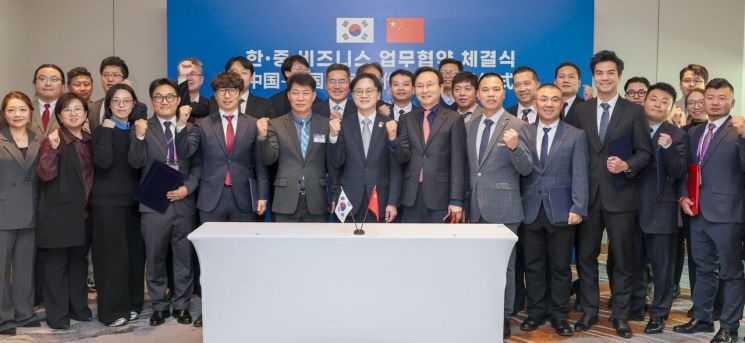
The Ministry of Trade, Industry and Energy and the Chinese Ministry of Commerce have agreed to establish a regular ministerial-level dialogue and strengthen cooperation on industrial complexes. While the move is formally aimed at expanding industrial cooperation, it is seen as significant for institutionalizing a permanent communication channel to manage industrial and supply chain risks between South Korea and China, especially as U.S.-China trade tensions become more entrenched.
According to the Ministry of Trade, Industry and Energy on January 6, Minister Kim Jeonggwan and Chinese Minister of Commerce Wang Wentao signed two memorandums of understanding (MOUs) in the presence of both countries' leaders following the Korea-China summit in Beijing: one on the establishment of a Korea-China commercial cooperation dialogue channel, and another on strengthening cooperation in industrial complexes.
Under the MOUs, the two countries will set up a regular ministerial-level dialogue and hold meetings at least once a year, alternating visits. The first meeting is scheduled to take place in the first half of this year. Until now, the Ministry of Trade, Industry and Energy and the Chinese Ministry of Commerce have held ministerial meetings on a bilateral or multilateral basis as needed, but the Korea-China Investment Cooperation Committee, a regular ministerial-level dialogue launched in 2002, has been suspended for 15 years since 2011.
The core of this new dialogue is its "regularization." By integrating and upgrading existing channels that cover not only trade, investment, and supply chains but also cooperation with third countries and multilateral partners, the two governments have restored a permanent and consistent communication structure. The government expects that this will allow for more systematic management of industrial issues between South Korea and China.
The MOU on industrial complex cooperation is interpreted in the same context. In 2015, following the conclusion of the Korea-China Free Trade Agreement (FTA), the two countries designated four locations-Saemangeum in Korea and Yancheng, Yantai, and Huizhou in China-as industrial cooperation hubs. However, Chinese investment in Saemangeum has been limited so far. With the signing of the industrial complex cooperation MOU during the latest summit and a planned visit to Saemangeum by a Chinese investment delegation led by the Ministry of Commerce, the possibility of expanded Chinese investment is once again being discussed.
The government plans to strengthen business-to-business connections in promising sectors such as parts and materials, green energy, and bio-pharmaceuticals, and to expand investment and trade cooperation to include joint research and collaboration with third countries. In particular, the government aims to attract investment from Chinese high-tech companies into Saemangeum to revitalize the regional economy and stabilize supply chains.
In the market, this agreement is viewed more as a move to strengthen management rather than merely expand cooperation. As U.S.-China tensions persist, South Korea faces pressure to cooperate with the United States on trade while simultaneously dealing with regulatory risks from China. It is not feasible to abruptly sever ties with either side. Therefore, the regular ministerial-level dialogue is seen as a "buffer mechanism" to mitigate unexpected variables in the event of disputes.
Within and outside the government, some assess that "rather than entering a new phase of expansion in Korea-China industrial cooperation, this should be seen as a signal that the relationship has entered a phase of management in a trade environment where uncertainty has become constant." In other words, beneath the appearance of cooperation lies the more pragmatic objective of risk management.
© The Asia Business Daily(www.asiae.co.kr). All rights reserved.
![Clutching a Stolen Dior Bag, Saying "I Hate Being Poor but Real"... The Grotesque Con of a "Human Knockoff" [Slate]](https://cwcontent.asiae.co.kr/asiaresize/183/2026021902243444107_1771435474.jpg)
















