Direct Hit from High Exchange Rates, Coffee and Dining Prices Rise in Succession
Premium Hotel Buffets Enter the '200,000 Won Era' on New Year's Day
Banapresso Americano Increases from 1,800 Won to 2,000 Won
Price Hikes Extend to Major Processed
From the very beginning of the new year, food prices have started to rise. The surge in international raw material prices due to last year's abnormal weather, combined with the strong US dollar, has triggered increases in major processed food prices. Recently, the ongoing cold wave has also pushed up prices of fresh produce such as vegetables, further increasing the burden on consumers.
According to the industry on January 6, Coffeebean Korea raised the prices of decaffeinated coffee and drip coffee starting the previous day. The price of drip coffee increased by 300 won per size, and the additional charge for switching to decaf also rose by 200 won. Low-cost coffee brands are no exception. Banapresso raised the take-out price of iced Americano from 1,800 won to 2,000 won, and HiO Coffee adjusted the prices of cappuccino and cafe latte from 2,800 won to 3,000 won starting December 17 last year.
Coffee Price Hikes Begin at the Start of the Year
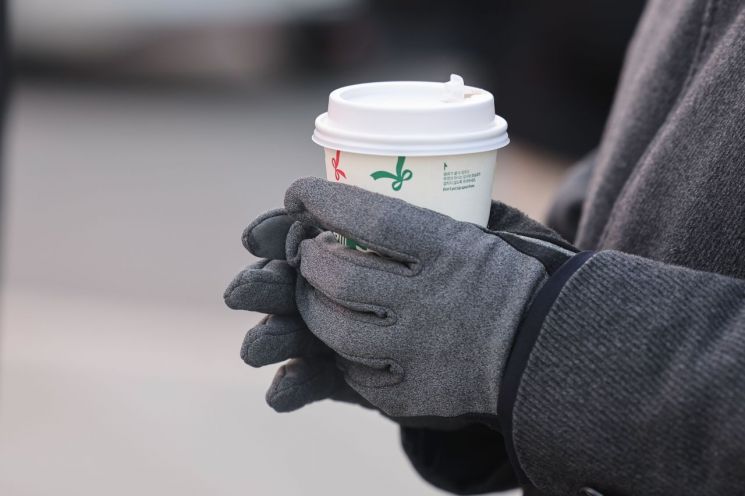 A citizen is holding a warm coffee in hand at Gwanghwamun Intersection, Jongno-gu, Seoul. Photo by Yonhap News Agency
At the beginning of last year, major coffee franchises such as Starbucks, Twosome Place, and Paul Bassett, as well as low-cost brands like MegaMGC Coffee and Compose Coffee, raised their prices one after another. This trend of price increases is continuing into the new year.
The main factors behind the rise in coffee prices are the sharp increase in international coffee bean prices and the burden of exchange rates. Droughts and heavy rains in major producing countries such as Vietnam and Brazil have worsened production conditions, leading to higher bean prices. In addition, the prolonged weakness of the Korean won has increased import costs. Last year, the international price of Arabica beans soared to $8,116.9 per ton, a jump of more than 57% compared to the 2024 average of $5,157.9. According to the Bank of Korea's Economic Statistics System, Korea's coffee import price index surged to 379.71 at the end of last year. With the import price index based on 100 in 2020, this means that coffee prices are now nearly four times higher than they were then.
Leafy Vegetable Prices Soar... Wholesale Lettuce Price Jumps 390% Month-on-Month
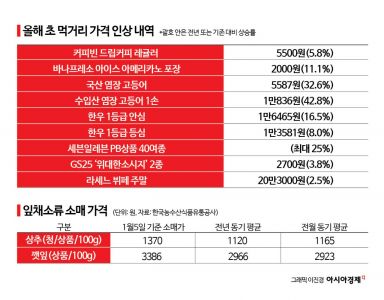
In addition, the prices of agricultural and livestock products are rising steeply. According to 'KAMIS', the agricultural and fishery distribution information service operated by Korea Agro-Fisheries & Food Trade Corporation (aT), the retail price of green lettuce-a major leafy vegetable-was surveyed at an average of 1,370 won per 100g (product) on January 5. This is 22.32% higher than the average retail price of 1,120 won during the same period last year, and 17.6% higher than the previous month's average of 1,165 won.
The retail price of green lettuce remained in the high 1,000 won range until just before Christmas last year, but has been rising daily since reaching 1,176 won on December 26. An industry official explained, "Since the end of last year, the cold wave has intensified. While there are no supply issues for leafy vegetables grown in greenhouses, the yield (ratio of marketable products) of those produced outdoors (on land not covered or protected by a roof) has dropped significantly, leading to an overall decrease in supply."
Large supermarkets are sourcing products from alternative southern regions with relatively higher temperatures, but further price increases cannot be ruled out. In fact, as of December 30 last year, the wholesale price for 4kg of green lettuce traded at major agricultural and fishery wholesale markets was 38,287 won, up 390% from the same period the previous month and 156% from the same period last year. During the same period, the wholesale price for 100 bundles of perilla leaves was 50,282 won, up 149.6% from the previous month and 35.3% from a year earlier. Wholesale prices are typically reflected in retail prices with about a one-week lag, so the increase may be passed on to consumers starting this week.
Among seafood, the price of mackerel-a staple fish in Korea-has risen sharply. Domestic salted mackerel (one set, two fish) is priced at 5,587 won, up 32.6% from the average year, while imported salted mackerel is 10,836 won, a 42.8% increase compared to the average year. Due to decreased catch volumes, the price of fresh domestic refrigerated mackerel is 4,686 won per fish, 4.8% higher than the average year. Livestock product prices are also on the rise. According to the Livestock Product Quality Evaluation Institute's distribution information, as of January 5, the average consumer price for first-grade Korean beef tenderloin was 16,465 won per 100g, up 16.5% from a year earlier. The price of sirloin also rose 8.0% year-on-year to 13,581 won per 100g.
Convenience Store Private Brands Join Price Hikes... Hotel Buffet Prices Enter the 200,000 Won Era
Even convenience store private brand (PB) products, once symbols of value-for-money in processed foods, have joined the wave of price increases. Seven-Eleven, operated by Korea Seven, raised the prices of around 40 PB products-including snacks and desserts-by up to 25% starting January 1. For example, 'Seven Select Nunettine' increased from 1,200 won to 1,500 won, and both 'Charcoal Spicy Barbecue Chicken' and 'Charcoal Soy Sauce Barbecue Chicken' rose by 300 won each, from 5,900 won to 6,200 won.
GS25, operated by GS Retail, also raised the prices of its PB products, such as two types of 'Great Sausage', cinema popcorn, and butter garlic popcorn, by 1,000 won each from the start of the new year. An industry official explained, "We tried to maintain existing prices as much as possible in the new year, but due to increased labor and raw material costs, the burden on our partners has grown, making price increases unavoidable."
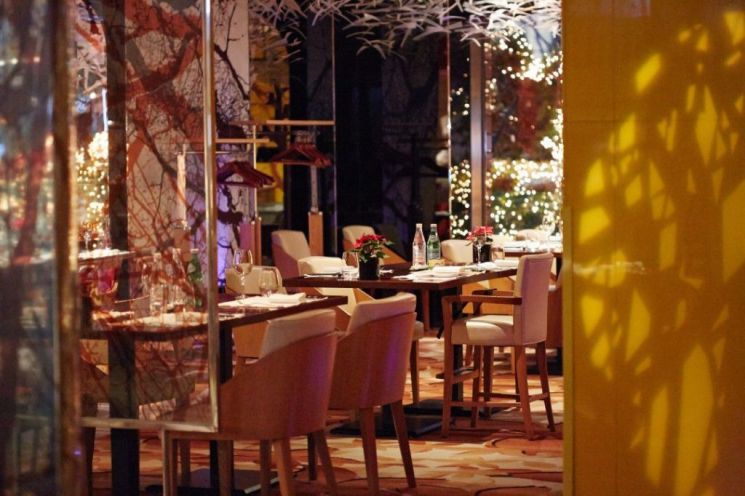
Restaurant prices are also climbing. On the first day of the new year, luxury hotel buffets ushered in the '200,000 won era.' Lotte Hotel Seoul's 'La Seine' raised its weekend price from 198,000 won to 203,000 won starting January 2, while The Parkview at The Shilla Seoul will increase its weekend dinner price by 5% to 208,000 won starting March 1. The main factors are rising costs and labor expenses.
The cost pressure on franchise businesses is also intensifying. Dining Brands Group, which operates BHC Chicken, raised the price of sunflower oil supplied to franchisees by 20% at the end of December last year-the first increase in three and a half years. There is growing interest in whether this will be passed on to chicken prices. A high-ranking official in the food industry commented, "Right now, both raising and freezing prices are burdensome. Cost structures are changing rapidly, but consumer purchasing power is not keeping up, making pricing strategies much more difficult for companies than before."
© The Asia Business Daily(www.asiae.co.kr). All rights reserved.



















