US, UK, and France: "Legitimate Law Enforcement"
China and Russia: "Violation of Sovereignty, Illegal Invasion"
An emergency meeting of the United Nations Security Council (UNSC) to discuss the United States' military operation against Venezuela was held on the 5th (local time) at the United Nations Headquarters in New York.
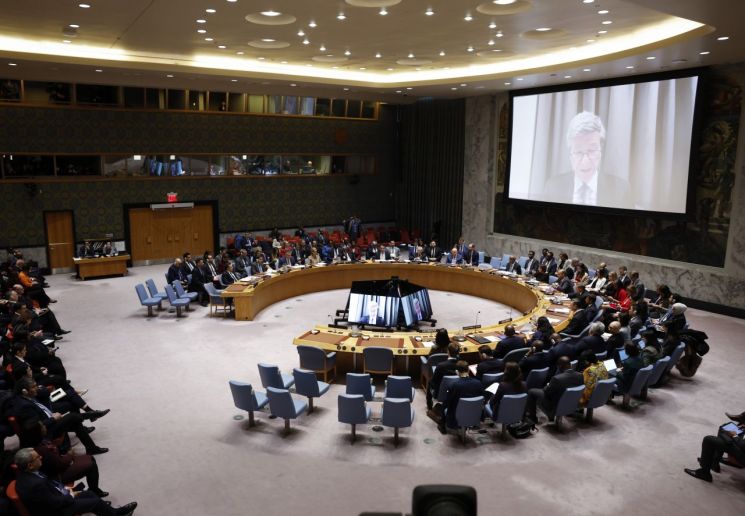 A United Nations Security Council meeting regarding the United States' military operation in Venezuela was held on the 6th (local time) at the United Nations Headquarters in New York, USA. Photo by UPI Yonhap News
This UNSC meeting was convened just a few hours before President Nicolas Maduro was scheduled to appear at the U.S. District Court in Manhattan, New York, on charges including conspiracy to commit narcoterrorism, cocaine smuggling, and arms trafficking. President Maduro has consistently denied these allegations.
At the meeting, the five permanent members of the Security Council-the United States, the United Kingdom, France, China, and Russia-expressed opposing views regarding the arrest and detention of President Nicolas Maduro and his spouse by the U.S. military.
Michael Waltz, the U.S. Ambassador to the United Nations, emphasized that President Maduro had been indicted by a U.S. court on charges of "narcoterrorism," arguing that his arrest and detention constituted a "law enforcement operation to execute a legitimate indictment" against the head of the notorious foreign terrorist organization "Cartel of the Suns" (Cartel de los Soles).
He also referred to the controversy over alleged vote rigging in Venezuela's 2024 presidential election, stating, "He (Maduro) was an illegitimate president. He has not been a (legitimate) head of state for years." This was interpreted as an attempt to justify the operation against accusations of violating international law by emphasizing that Maduro was not the legitimate leader of a sovereign state.
James Kariuki, the United Kingdom's Deputy Permanent Representative to the United Nations, echoed the U.S. stance, saying, "Maduro's rule was a fraud," and added, "The United Kingdom hopes for a safe and peaceful transition to a legitimate government that reflects the will of the Venezuelan people."
Jerome Bonnafont, France's Ambassador to the United Nations, also stated that the 2024 election, which brought Maduro to power, was "marred by numerous irregularities," expressing support for a peaceful and democratic transition of power in Venezuela. However, he pointed out that the U.S. military operation "contradicts the principle of peaceful resolution of disputes."
Russia and China took a hardline stance. Fu Cong, China's Ambassador to the United Nations, declared that the United States had "trampled on Venezuela's sovereignty, security, and legitimate rights and interests," adding, "We are deeply shocked by the United States' unilateral, illegal, and hegemonic actions and strongly condemn them." He further emphasized, "No country can act as the world's police, and no country can appoint itself as an international judge. (China) is ready to jointly safeguard peace and stability in Latin America and the Caribbean."
Vassily Nebenzia, Russia's Ambassador to the United Nations, stated, "We firmly condemn the United States' armed aggression against Venezuela, which violates all international legal norms," and called for the "immediate release" of the Maduro couple, who appeared in a New York courtroom not far from the meeting venue.
Samuel Moncada, Venezuela's Ambassador to the United Nations and a party to the dispute, described the situation as "the kidnapping of the Republic's president by the U.S. government" and "a bombing of a sovereign nation." He appealed that if the international community tolerates this, "it sends the devastating message that law is optional and that force is the true arbiter of international relations."
Responses from Latin American countries regarding Venezuela were also divided according to their diplomatic alignment with the United States or Venezuela. Argentina, Chile, Paraguay, and Trinidad and Tobago generally sided with the United States, while Brazil, Colombia, Mexico, and Cuba opposed the operation.
Argentina stated, "We highly appreciate the decisions and determination shown by the U.S. President and government, which resulted in the arrest of the dictator Maduro," while Paraguay said, "The removal of the leader of a terrorist organization must immediately lead to the restoration of democracy and the rule of law in Venezuela."
In contrast, Brazil criticized the operation, saying, "The bombing of Venezuelan territory and the arrest of the president are actions that cross an unacceptable line," and Colombia stated, "We are ready to offer good-faith mediation for a diplomatic solution to the crisis facing our brother nation (Venezuela)."
Experts pointed out that the operation was carried out without UNSC approval or Venezuela's consent, and that it lacked a clear basis for self-defense, making its legitimacy under international law weak. However, due to disagreements among the permanent members at this meeting, no joint response was reached. According to The Guardian, it is widely expected that if a resolution criticizing the United States is proposed, it will be difficult to adopt due to the U.S. veto.
© The Asia Business Daily(www.asiae.co.kr). All rights reserved.

















