Investor Sentiment Remains Firm Despite Arrest of President Maduro and His Wife
Energy Stocks Surge on Hopes for Venezuela Oil Infrastructure Rebuilding
Oil Prices Up 1% with Limited Volatility
Focus Shifts from Geopolitical Risks to This W
The three major U.S. stock indexes on the New York Stock Exchange are all showing gains on January 5 (local time). Despite heightened geopolitical tensions following the U.S. surprise attack on Venezuela and the arrest of anti-American President Nicolas Maduro over the weekend, investors are viewing these as limited risks. Expectations for the reconstruction of Venezuela's oil infrastructure are rising, leading energy-related stocks to outperform.
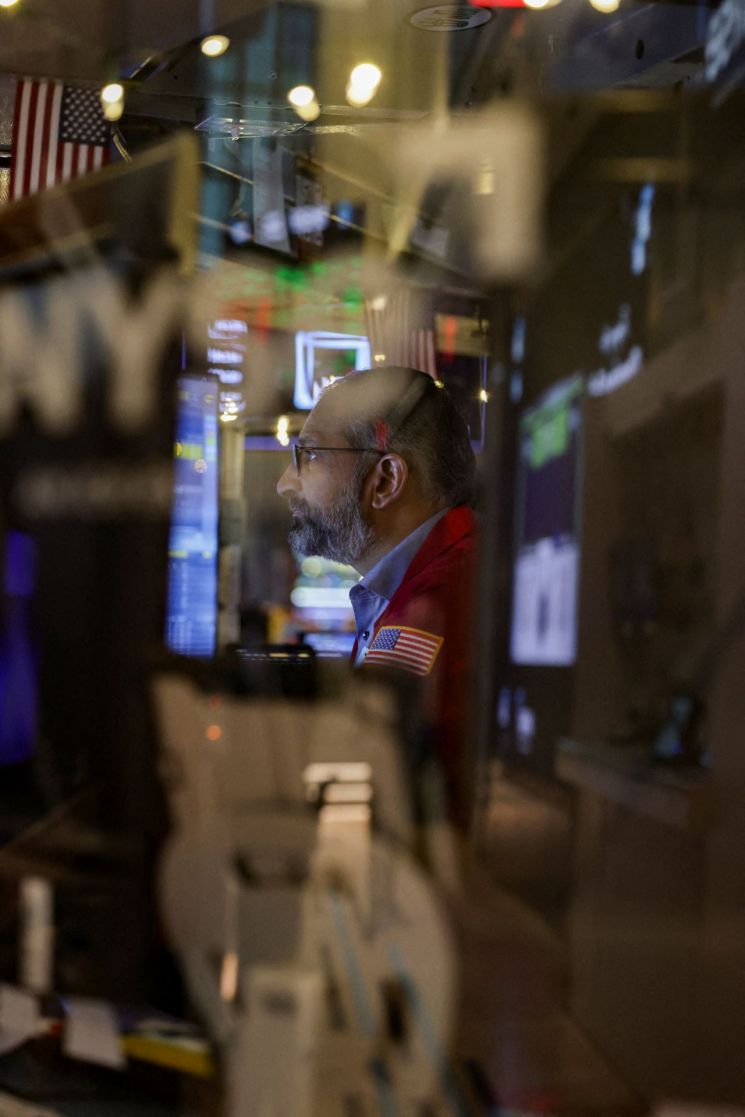 A trader is working on the floor of the New York Stock Exchange (NYSE) in the United States. Photo by Reuters Yonhap News Agency
As of 10:40 a.m. on the New York Stock Exchange, the blue-chip Dow Jones Industrial Average is up 635.34 points (1.31%) from the previous trading day, standing at 49,017.73. The Dow has reached an all-time intraday high. The large-cap S&P 500 Index is up 49.84 points (0.73%) at 6,908.31, while the tech-heavy Nasdaq Composite Index is trading at 23,442.433, up 206.804 points (0.89%).
By sector, energy stocks are showing particularly strong gains. Chevron, which operates in Venezuela, home to the world’s largest oil reserves, is up 5.04%. ExxonMobil is up 2.05%. Halliburton and Schlumberger, both expected to participate in Venezuela’s energy reconstruction, are soaring 11.15% and 11.69%, respectively. Defense stocks are also strong, with General Dynamics up 3.07% and Lockheed Martin up 1.84%.
Previously, on January 3, President Maduro and his wife Cilia Flores were arrested in a U.S. military operation, transferred to New York, and indicted on charges including narco-terrorism. According to the indictment, they are accused of conspiring with drug cartels to smuggle thousands of tons of cocaine into the United States. At a press conference on January 3, U.S. President Donald Trump stated, "We will run Venezuela until a safe, appropriate, and wise transition of power is possible."
Thomas Mathews, Head of Asia-Pacific Markets at Capital Economics, commented, "Although the U.S. military’s arrest of President Maduro made headlines, the financial markets have remained largely unaffected. However, the geopolitical impact could be significant and may increase the risk premium for some regional assets."
Matthew Axe, policy analyst at Evercore ISI, said, "This incident is an important geopolitical issue, but is unlikely to have a major short-term impact on the markets. However, considering President Trump's remarks about running Venezuela, it cannot be ruled out that this situation may not end as a one-off event, similar to last year’s attack on Iran’s nuclear facilities."
Investors are closely monitoring developments in Venezuela while also focusing on employment data to be released this week. The U.S. Bureau of Labor Statistics (BLS) will release the December employment report on January 9. The market expects nonfarm payrolls to have increased by 57,000 last month, down from 64,000 in November. The unemployment rate is projected to decline by 0.1 percentage point to 4.5% over the same period. Prior to that, on January 7, the U.S. Department of Labor’s November Job Openings and Labor Turnover Survey (JOLTs) and the December employment report from private labor market research firm ADP will be released. On January 8, weekly initial jobless claims will be announced.
In addition, remarks from Federal Reserve officials will continue. Minneapolis Fed President Neel Kashkari said in a CNBC interview that the current federal funds rate of 3.5-3.75% is "very close to neutral" and assessed that "monetary policy is not putting excessive downward pressure on the economy." He added that any further rate cuts would depend on future economic data. Other statements from Federal Open Market Committee (FOMC) members, including Richmond Fed President Thomas Barkin and Federal Reserve Vice Chair Michelle Bowman, are also scheduled.
International oil prices have risen slightly following the U.S. attack on Venezuela, but overall volatility remains limited. West Texas Intermediate (WTI) crude is up 0.98% from the previous session at $57.88 per barrel, while Brent crude, the global oil price benchmark, is up 1.2% at $61.48 per barrel.
Although Venezuela holds the world’s largest crude oil reserves, its share of global oil supply is only 1%, so the market impact is considered limited. Sam Stovall, Chief Investment Strategist at CFRA Research, said that while oil prices may rise in the short term due to supply and transportation instability, the long-term impact on global oil prices is expected to be minimal.
U.S. Treasury yields are showing relatively stable movements. The yield on the benchmark 10-year Treasury note is down 2 basis points (1 bp = 0.01 percentage point) from the previous session at 4.16%, while the yield on the 2-year Treasury note, which is sensitive to monetary policy, is down 1 basis point at 3.46%.
© The Asia Business Daily(www.asiae.co.kr). All rights reserved.
![Clutching a Stolen Dior Bag, Saying "I Hate Being Poor but Real"... The Grotesque Con of a "Human Knockoff" [Slate]](https://cwcontent.asiae.co.kr/asiaresize/183/2026021902243444107_1771435474.jpg)
















