Korean Peninsula Peace Recognized as "Shared Interest" of Korea and China
Economic Cooperation Expands to 'Manufacturing, Services, Content'...15 MOUs Signed
Vice-Ministerial Talks Discussed for West Sea Boundary Delimitation
Expansion of Private
President Lee Jaemyung, who is on a state visit to China, held a summit meeting with Chinese President Xi Jinping at the Great Hall of the People in Beijing on the 5th (local time), where both leaders reaffirmed the importance of resuming dialogue with North Korea for the stability of the Korean Peninsula. In addition, by signing memorandums of understanding (MOUs) to expand cooperation in various sectors such as manufacturing, consumer goods, services, and content, centered on practical cooperation for people's livelihoods, the momentum for a "full restoration of Korea-China relations" was further strengthened.
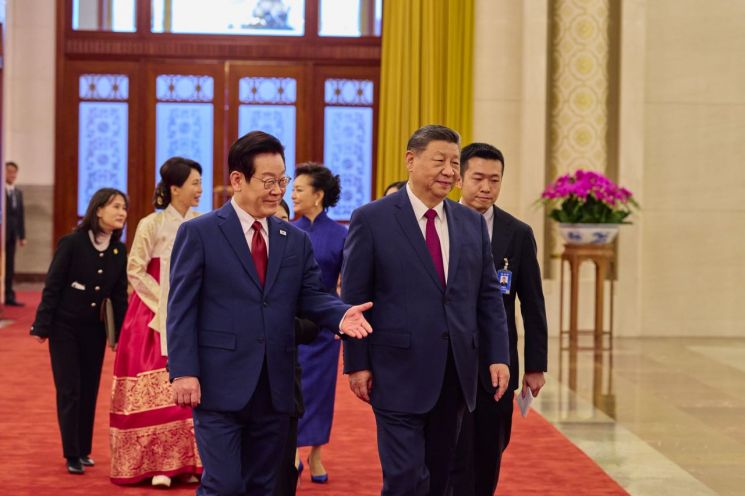
President Lee arrived at the Great Hall of the People at around 4:30 p.m. and began his official schedule with a welcoming ceremony that included a 21-gun salute and an honor guard inspection. President Xi and his wife greeted President Lee and his wife inside the entrance of the Great Hall, and the two leaders moved to the meeting room while exchanging pleasantries. The summit, which was scheduled to begin at 4:47 p.m., lasted about 90 minutes, exceeding the planned time by 30 minutes.
Korean Peninsula Peace Recognized as "Shared Interest of Korea and China"... Seeking Conditions to Resume Dialogue
Wi Sungrak, Director of the National Security Office, explained at a briefing held at the press center in Beijing that "the two sides engaged in in-depth discussions on a wide range of issues, from creating tangible and practical outcomes that the peoples of both countries can feel, to realistic approaches to improving the situation on the Korean Peninsula." In particular, regarding the Korean Peninsula issue, he stated, "Both sides reaffirmed that peace on the Korean Peninsula is a shared interest of Korea and China, and agreed to continue seeking creative ways to create conditions for North Korea to resume dialogue."
It was reported that President Lee mainly raised the agenda regarding inter-Korean relations. Director Wi said, "We mainly spoke about inter-Korean relations and explained the current situation," adding, "We expressed our intention to make efforts to improve the situation and hoped that other major neighboring countries would also move together." Regarding the Chinese side's response, he explained, "China evaluated the efforts made so far to ease tensions and expressed its intention to continue playing a constructive role going forward."
Sensitive issues such as nuclear-powered submarines, structures in the West Sea, and the Taiwan issue were also discussed. Regarding the West Sea, Director Wi said, "Both Korea and China share the recognition that the West Sea should be managed as a sea of peace, and, given that the boundaries are not yet finalized, both sides agreed on the importance of restraint and responsible behavior. They also agreed to continue constructive consultations on the issue of structures in the West Sea." Starting this year, both sides will work together to hold vice-ministerial-level talks to delineate the West Sea boundary. He added, "Given the series of developments leading up to this summit, progress can be expected."
Regarding the cross-strait (China-Taiwan) issue, he stated, "There was no additional discussion on Taiwan, and we explained that our position remains unchanged in respecting the 'One China' policy." When asked whether there were any demands from China that went beyond respect for its long-standing "One China" stance, he replied, "The discussion did not expand beyond that."
On cultural exchanges, including the easing of the "Korean Wave Ban"-one of the most anticipated issues-the two leaders agreed to gradually expand exchanges in areas such as Go and soccer, and to seek progress in dramas and films through working-level consultations, according to Director Wi. However, he added, "China still does not acknowledge the existence of the Korean Wave Ban itself, and the conversation was more along the lines of joking that 'there's no need to argue about whether the ban exists or not.' It is difficult to predict how things will develop going forward," showing a cautious stance.
Economic Cooperation Expands to 'Manufacturing, Services, Content'... Supply Chains and FTA Also on the Agenda
 President Lee Jae-myung and his wife, along with President Xi Jinping and his wife, are taking a commemorative photo with a Xiaomi phone after a state banquet at the Great Hall of the People in Beijing on the 5th (local time). This Xiaomi phone was gifted to President Lee by President Xi during the Gyeongju summit. Photo by Yonhap News Agency
Regarding the economic sector, Director Wi stated, "We have established a foundation to actively promote cooperation aimed at bringing about real changes in people's livelihoods, based on a mutually beneficial and horizontal relationship." He added, "Both sides agreed to work toward meaningful progress in the Korea-China Free Trade Agreement (FTA) in the services and industrial sectors, and to create mutually beneficial supply chain expansion cases based on the cooperation needs of individual companies. China also agreed to actively cooperate in the universal licensing system and other areas to ensure stable supplies of key minerals."
Kim Yongbeom, Policy Director, who joined Director Wi at the briefing, predicted that business exchanges would become much more active through the Korea-China Business Forum held that day. Kim stated, "China is our largest trading partner for both exports and imports, but the trade volume, which peaked at 310.4 billion dollars in 2022, has remained below 300 billion dollars. On the occasion of this visit, we agreed to expand the scope of cooperation to include consumer goods and services such as food, fashion, tourism, entertainment, and games." He also explained, "Despite a preparation period of less than three weeks, a large delegation was formed due to high expectations for restoring the previously strained Korea-China relationship."
At a pre-forum meeting attended by leading companies from both countries, President Lee also presented new directions for cooperation in manufacturing innovation, supply chain collaboration, entry into new consumer goods markets, and cooperation in services and content. Kim added, "Financial professionals from both countries participated in this forum, and there was discussion about expanding the scope of cooperation through private financial networks, including currency swaps."
Immediately after the summit, a signing ceremony was held for 14 memorandums of understanding (MOUs) between government ministries of both countries and one "Certificate of Donation for a Pair of Qing Dynasty Stone Lions." Director Wi explained regarding the donation certificate, "The National Museum of Korea donated a Chinese artifact purchased in Japan by the late Jeong Hyeongpil, who contributed to the protection of our cultural heritage, to China," adding, "We hope this donation will contribute to enhancing friendly sentiments between Korea and China."
That evening, a state banquet was held at the Great Hall of the People. At the banquet, six Korean and six Chinese musical pieces were performed. For Korea, songs such as "Hanobaeknyeon," "Spring in My Hometown," and "Doraji Arirang" were played. On the Chinese side, a hit song sung by President Xi's wife, Peng Liyuan, titled "Who Wouldn't Say Our Hometown Is Good," was performed.
Director Wi, summarizing the overall achievements of the summit, stated, "The foundation for diplomacy in the national interest through summit diplomacy has been firmly established, and the basis for political trust and friendly sentiment between Korea and China has been solidified. The two leaders reached a consensus to continue annual meetings, and also agreed to restore strategic dialogue channels and expand communication and exchanges between defense authorities." Kim also commented, "This state visit, the first in nine years, has laid a future-oriented foundation for expanding cooperation not only in manufacturing but also in consumer goods, services, and content," adding, "It marks a new chapter in Korea-China economic relations."
© The Asia Business Daily(www.asiae.co.kr). All rights reserved.


















