"85% of Days Had Good Air Quality... Surpassing 80% for the First Time"
Highest Level Since Monitoring Began in 2013
Still Five Times Higher Than WHO PM2.5 Guidelines
The notoriously poor air quality in Beijing, China, has improved rapidly over the past few years, with more than 80% of days last year classified as having "good" air quality.
According to local media outlets such as China News Service on January 5, Liu Baoxian, Deputy Director and Spokesperson of the Beijing Municipal Ecology and Environment Bureau, announced that Beijing recorded 311 days last year when the Air Quality Index (AQI) was rated as "excellent" or "good." This means that 85.2% of the days in 2025 had good air quality.
The Chinese AQI is divided into six levels: excellent (0-50), good (51-100), lightly polluted (101-150), moderately polluted (151-200), heavily polluted (201-300), and severely polluted (301-500). Last year was the first time since monitoring began in 2013 that the proportion of days with "excellent" or "good" air quality in Beijing exceeded 80%.
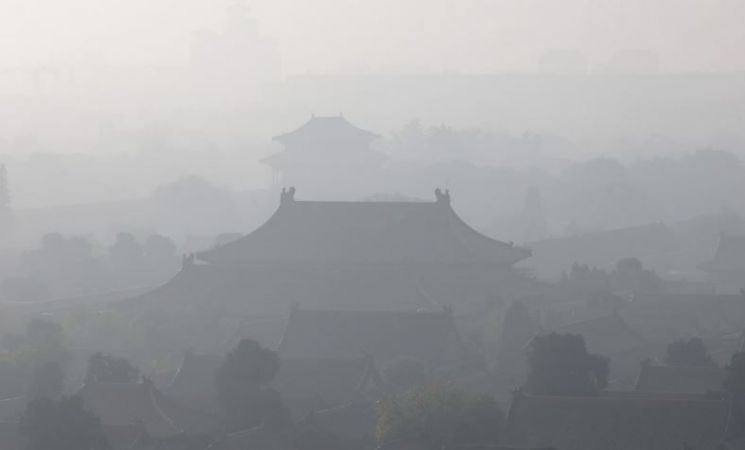 The Forbidden City in Beijing, China, is shrouded in thick smog, appearing hazy. Photo by Yonhap News
Spokesperson Liu explained, "Last year, Beijing prioritized the protection of 'blue skies' and achieved these results through continuous improvement in air quality. Multiple indicators have reached their highest levels since monitoring began." He also added that China's annual average concentration of fine particulate matter (PM2.5) fell below 30 micrograms per cubic meter for the first time last year, reaching 27.0 micrograms per cubic meter.
Given that the World Health Organization (WHO) recommends a PM2.5 standard of 5 micrograms per cubic meter, there are calls for stricter standards for "good air." However, compared to 2013, when the worst smog in history blanketed downtown Beijing, air quality has clearly improved.
China News Service cited the shift to "new energy" as a key factor in dramatically reducing air pollution. The government implemented subsidy policies to scrap or replace old, polluting freight trucks and buses. Efforts to clean up the transportation sector continued by expanding the supply of new energy vehicles, such as electric, hydrogen, and hybrid cars.
As a result, the proportion of new energy vehicles among newly registered cars in China has surpassed 60%. The media also analyzed that meticulous management in various sectors, such as greening of factories, enhanced road dust control, and expansion of urban green spaces, contributed to the improvement.
© The Asia Business Daily(www.asiae.co.kr). All rights reserved.

















