At the January 5 Briefing, Governor Lee Again Criticizes Reappointment Practices of Financial Holding Group Chairmen
"Six-Year Terms Lead to Aging Leadership, Becoming Antiques"
"Currently Checking for Customer Data Leaks at Coupang's Payment Affiliate 'Pay'"
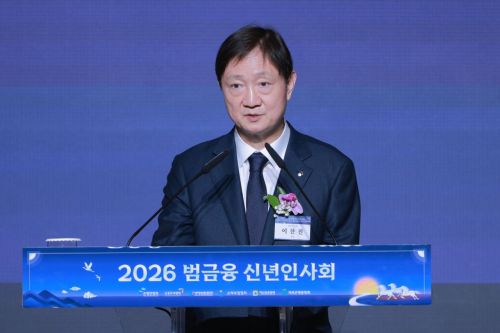 Lee Chanjin, Governor of the Financial Supervisory Service, is delivering a New Year's address at the '2026 Pan-Financial New Year's Meeting' held at Lotte Hotel in Jung-gu, Seoul on the afternoon of the 5th. 2026.1.5 Photo by Kang Jinhyung
Lee Chanjin, Governor of the Financial Supervisory Service, reiterated his criticism on January 5 regarding the long-term reappointment of financial holding group chairmen, stating, "Even the next-generation pool of candidates has aged and become antiques." He also emphasized that Coupang Financial, a subsidiary of Coupang, has been reaping excessive profits by arbitrarily applying its own criteria for interest rate calculation.
Continued Strong Criticism of the Practice of Reappointing Financial Holding Group Chairmen
On this day, during a meeting with reporters at the Financial Supervisory Service headquarters in Yeouido, Seoul, Governor Lee strongly criticized the practice of reappointing financial holding group chairmen. He pointed out, "Instead of fostering next-generation leadership, the so-called 'trench-building' practice has become entrenched, resulting in a management structure where the CEO faces virtually no checks and balances."
He added, "When board members engage in the so-called 'trench-building' practice and share the same mindset as the CEO, the board ends up making uniform decisions. Looking at the succession process, if a holding group chairman is reappointed for as long as six years, they too will eventually age and become antiques."
Governor Lee stated that he will decide whether to expand the scope of inspections to all financial holding groups after reviewing the results of the inspection of BNK Financial Group. He said, "We plan to review the ad hoc inspection results of BNK to see if there are additional areas that need to be examined. Whether to expand inspections to all financial holding groups will be determined after reviewing the results of the BNK inspection."
He also argued that boards should include representative shareholders to enhance board independence, noting that the current professor-centered board structure makes it difficult to properly check the power of financial holding group chairmen and CEOs.
He stated, "To strengthen board independence, representative shareholder groups should join the board to objectively and fairly represent the interests of all shareholders. Considering that financial companies operate as service businesses for the entire public without so-called 'ownership,' I believe shareholder-centered board composition is far from the debate over 'pension socialism.'"
Regarding the financial holding group governance improvement task force (TF) set to begin this month, he said, "We are reviewing three aspects: the director appointment process, the fairness and transparency of CEO appointment procedures, and the terms of directors and CEOs. We will produce an amendment to the governance law as soon as possible."
He further emphasized, "A culture must take root where those who can truly serve shareholder interests are the ones shaping governance. If the CEO holds the same views as the board, the board will make uniform decisions and lose its ability to provide oversight."
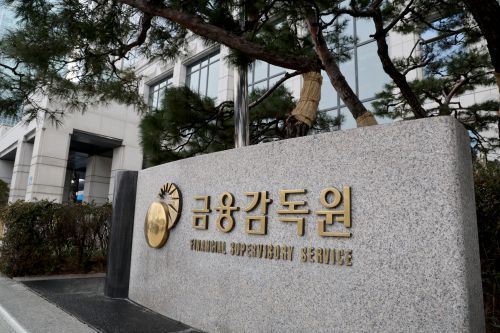
Continued Strong Inspections Expected Regarding Coupang
Governor Lee also continued his strong criticism regarding Coupang. He commented on Coupang Financial's high-interest loans, saying, "From an ethical business perspective, this seems akin to so-called 'gapjil' (abuse of power)."
He explained, "Other retail platforms settle payments the next day, but Coupang has an unusually long settlement cycle of over a month, which is puzzling. It appears that they are arbitrarily applying incomprehensible interest calculation criteria, resulting in excessive profits."
Regarding Coupang Pay, he said, "Coupang Pay is structured as a 'one ID, one click' system with Coupang headquarters. We are currently checking whether, as the company claims, there have been any leaks of payment information. We are cross-checking information flowing from Coupang to Coupang Pay and vice versa."
He added, "The joint investigation with Coupang headquarters has not yet produced concrete results."
Governor Lee raised concerns about the dual regulatory structure between Coupang's financial affiliates and its e-commerce business. He stated, "If the regulatory framework is dualized, it becomes difficult to regulate higher-level platforms or predators beyond the financial industry. Since the entire population suffers repeatedly from the difficulty of withdrawing from Coupang, I believe the regulatory standards should be equivalent to those for the financial sector. We will work to improve related systems accordingly."
Emphasizing the Need to Introduce Investigative Authority for Special Judicial Police
He also pointed out the structural limitations of the current system for responding to unfair trading in the capital market and reiterated the need to introduce investigative authority for special judicial police. Governor Lee said, "Even when investigations are urgent, the process of going through the Sanctions Review Committee and the Securities and Futures Commission takes about 11 weeks. If three months are wasted, all the evidence can be destroyed."
According to financial authorities, discussions are underway, led by the Office for Government Policy Coordination, to strengthen the role of special judicial police. This includes considering whether to grant investigative authority to the Financial Supervisory Service's special judicial police.
However, even if investigative authority is granted, the plan is to limit its scope to unfair trading under the Capital Markets Act. He emphasized, "We are not targeting all crimes. The Financial Supervisory Service will limit its investigations to cases of unfair trading under the Capital Markets Act that it has planned and investigated."
He also explained the proposed investigation procedures: "Our proposal is for the Financial Supervisory Service and the Financial Services Commission to jointly form an investigation review committee. The committee will decide whether to proceed with an investigation and report that information to the Securities and Futures Commission." He added, "We are discussing with the Financial Services Commission ways to maintain checks and balances and ensure transparency by immediately reporting the process and results to the Securities and Futures Commission."
© The Asia Business Daily(www.asiae.co.kr). All rights reserved.

![Clutching a Stolen Dior Bag, Saying "I Hate Being Poor but Real"... The Grotesque Con of a "Human Knockoff" [Slate]](https://cwcontent.asiae.co.kr/asiaresize/183/2026021902243444107_1771435474.jpg)
















