A Record 17.81 Million Visitors Last Year
Four Out of Ten Visitors to Gyeongbokgung Palace Were Foreigners
Jongmyo Shrine Doubles Attendance After Main Hall Restoration
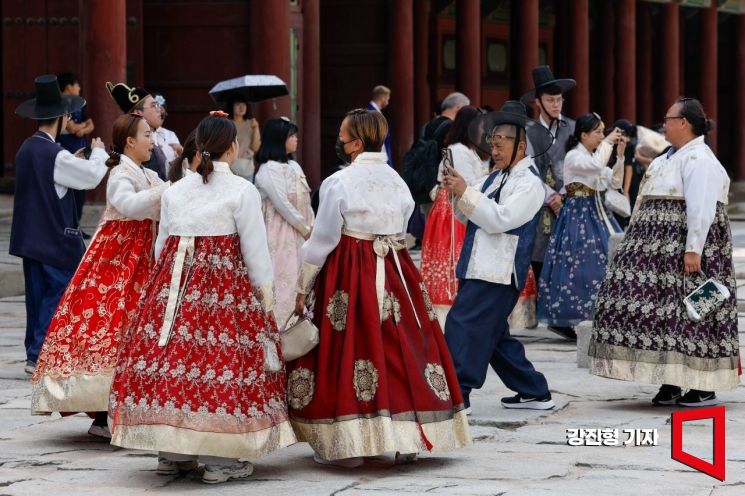 On the 29th, when visa-free entry for Chinese group tourists was implemented, Chinese tourists visiting Gyeongbokgung Palace in Jongno-gu, Seoul, are enjoying their time. 2025.9.29 Photo by Kang Jinhyung
Driven by the global interest in Korean traditional culture, the number of visitors to the Four Grand Palaces, Jongmyo Shrine, and the Royal Tombs of the Joseon Dynasty has surpassed 17 million for the first time ever. Not only has the sector recovered from the pandemic, but it is now ushering in a new era with over 4 million foreign tourists, firmly establishing itself as a landmark of 'K-Tourism.'
The Palaces and Royal Tombs Center of the Cultural Heritage Administration announced on January 5 that the total number of visitors to Gyeongbokgung Palace, Changdeokgung Palace, Changgyeonggung Palace, Deoksugung Palace, Jongmyo Shrine, and the Royal Tombs of the Joseon Dynasty reached 17,814,848 last year. This figure represents a 12.9% increase from the previous year's 15.78 million, setting a new all-time high. The number of visitors to the palaces and royal tombs had dropped to the 6 million range in 2021 during the COVID-19 pandemic, but has rebounded sharply since 2022, surpassing 10 million for four consecutive years through this year.
Foreign tourists were undoubtedly the main contributors to this record-breaking performance. Last year, the number of foreign visitors to the palaces and Jongmyo Shrine reached approximately 4,269,000, a remarkable 34.4% surge compared to the previous year. One in four visitors (24.0%) was a foreigner. In particular, at Gyeongbokgung Palace, the main palace of the Joseon Dynasty, foreigners accounted for as much as 40.4% of all visitors, proving that it has become a global destination as popular among foreigners as it is among locals. The Palaces and Royal Tombs Center analyzed that "the popularity of K-content and the spread of experiential programs such as Hanbok experiences have led to actual visits."
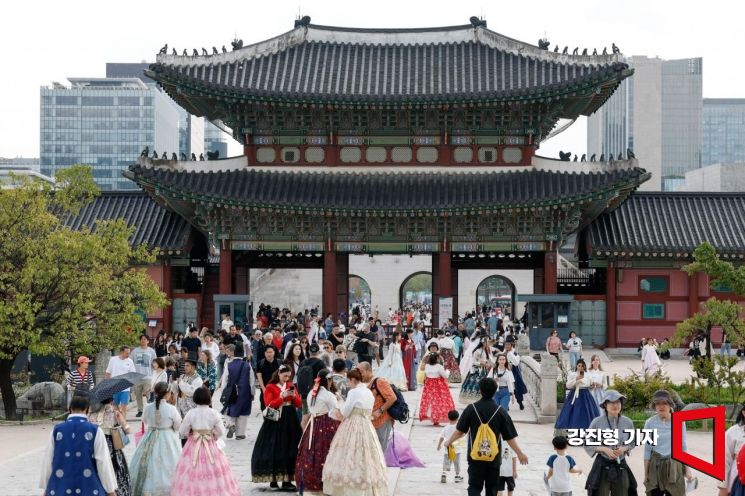 On September 29, when visa-free entry for Chinese group tourists was implemented, Gyeongbokgung Palace in Jongno-gu, Seoul, was crowded with foreign tourists, including Chinese visitors. 2025.9.29 Photo by Kang Jinhyung
By location, the results were mixed. Gyeongbokgung Palace maintained its unchallenged lead with 6.88 million visitors, while Jongmyo Shrine showed the most notable growth. The number of visitors to Jongmyo Shrine nearly doubled year-on-year to about 761,000 last year. This was attributed to the full reopening in April after long-term repairs of the main hall, as well as major events such as the Hwanan ceremony, where ancestral tablets were re-enshrined, which attracted more visitors. In contrast, the number of foreign visitors to the Royal Tombs of the Joseon Dynasty was only around 40,000, highlighting the challenge of dispersing the heavy concentration of foreign tourist demand at the palaces.
With the explosive increase in visitors, discussions on raising admission fees, which have been frozen for 20 years since 2005, are expected to gain momentum. There is a growing consensus that adjusting admission fees is inevitable to cover rising management costs and to enhance the value of cultural heritage. President Lee Jaemyung also mentioned at last month's Cultural Heritage Administration work report that "it is necessary to adjust admission fees through a process of persuasion." Accordingly, the Cultural Heritage Administration plans to coordinate the specific scale and timing of the increase through consultations with relevant ministries and public opinion gathering.
© The Asia Business Daily(www.asiae.co.kr). All rights reserved.
![Clutching a Stolen Dior Bag, Saying "I Hate Being Poor but Real"... The Grotesque Con of a "Human Knockoff" [Slate]](https://cwcontent.asiae.co.kr/asiaresize/183/2026021902243444107_1771435474.jpg)

















