All Students to Learn Fundamental AI Literacy,
Academic System Centered on Problem Definition
Tech Bridge Strategy in Action,
AX Transformation for Southeastern Manufacturing Industry
"Let's begin where we have disrupted."
On January 5, Chong Rae Park, president of UNIST, emphasized during the opening ceremony that the university's operational direction for 2026 will be centered on "Creative Destruction," vowing to boldly change familiar methods and inefficiencies in order to accelerate innovation.
President Park began by stating that UNIST, as a university specializing in science and technology, has continued to nurture future talent, conduct cutting-edge research, and collaborate with local industries. He announced that starting this year, these strategies will be expanded across education, research, industry-academia cooperation, and administration, moving to a phase where accumulated achievements are translated into tangible changes on the ground.
In the field of education, the university will completely overhaul its system to align with the era of AI transformation. The curriculum and academic structure will shift to a competency-based model, with the aim that all students acquire fundamental AI literacy.
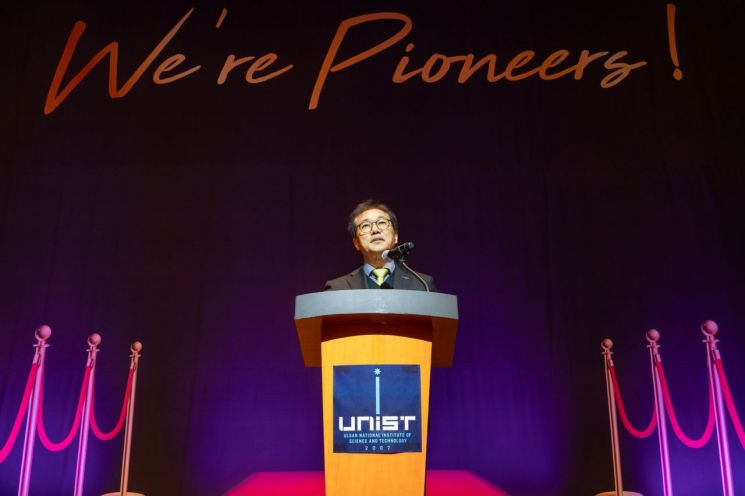
President Park stated, "The most important ability is not the speed of finding the right answer, but the power to define the problem," adding that education will cover not only technical principles but also ethics and social impact.
In the areas of research and industry-academia cooperation, the connection speed with industry will be increased. UNIST will implement the "Tech Bridge" strategy to ensure research outcomes are rapidly transferred to the field, aiming to reduce the time between research and industry. He also mentioned the "Pentagon" manufacturing innovation zone, which connects Ulsan, Gyeongju, Pohang, Gyeongnam, and Busan. As the AI transformation (AX) of manufacturing is urgent, the plan is to strengthen industrial competitiveness by expanding "on-site AI" that can be immediately applied in the field and demonstration-based collaboration.
To achieve this, the university will increase the number of joint projects based on corporate demand and expand open labs and field demonstration projects. The goal is to create a structure where research is validated in the field, and those results are fed back into research. The university also plans to strengthen technology transfer and startups originating from the university, so that research outcomes can lead to business ventures.
Changes have also been signaled in organizational management and administration. The university will lower barriers between departments, create a structure where collaboration is routine, and reduce imbalances in work burdens based on job analysis and organizational diagnosis results.
The use of AI will also be expanded across the entire campus. UNIST plans to establish the use of AI agents in research, academics, and administration, centered around its own generative AI, "UNIAI."
President Park said, "Based on the research capabilities and execution power that UNIST has accumulated, we will lead regional industrial innovation and strengthen the nation's science and technology competitiveness."
At the opening ceremony, nine faculty members who were selected as "Highly Cited Researchers (HCR)" for 2025 were also awarded. UNIST continues to demonstrate global research competitiveness, having ranked first in Korea for nine consecutive years in the Leiden Ranking, which evaluates the quality of academic papers.
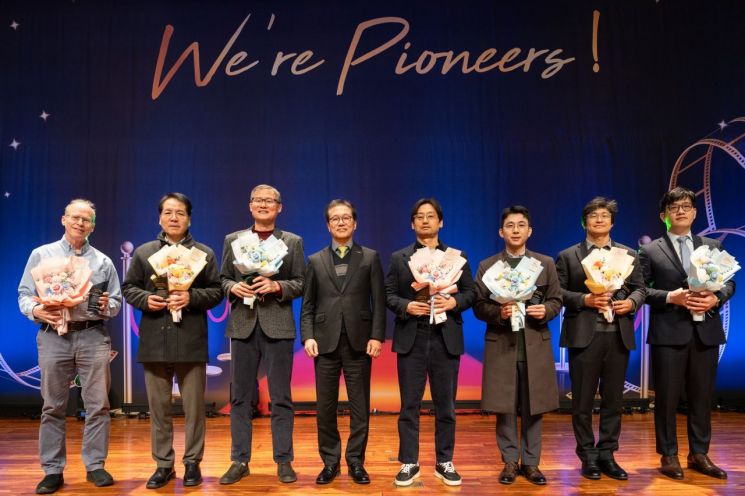 UNIST faculty members selected as 'Highly Cited Researchers (HCR)' last year stood in front of the camera with Chong Rae Park, president of UNIST (fourth from the left).
© The Asia Business Daily(www.asiae.co.kr). All rights reserved.
![Clutching a Stolen Dior Bag, Saying "I Hate Being Poor but Real"... The Grotesque Con of a "Human Knockoff" [Slate]](https://cwcontent.asiae.co.kr/asiaresize/183/2026021902243444107_1771435474.jpg)

















