Push for Original Special Act on Administrative Integration and Draft System for Second Phase of Public Institution Relocations
Three Major Issues Raised Head-On: Differentiated Electricity Pricing and Reconsideration of Transmission Lines Included
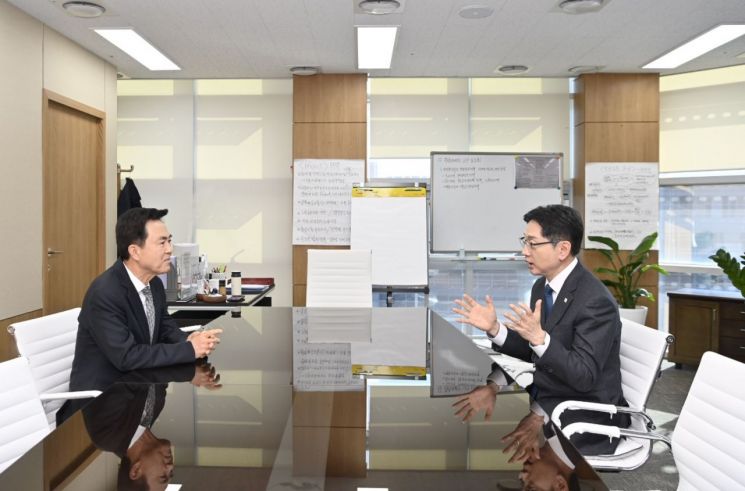
Kim Tae-heum, Governor of South Chungcheong Province, visited the Local Era Committee as his first external schedule of the new Byeongo year. He simultaneously raised key issues for South Chungcheong-such as the Daejeon-South Chungcheong administrative integration, the second phase of public institution relocations, and the restructuring of power policy-initiating a full-scale push against the central government.
On January 5, Governor Kim visited the Local Era Committee in Sejong City to meet with Chairman Kim Kyung-soo. He officially proposed three major issues: ▲establishing a super-regional national development model through the administrative integration of Daejeon and South Chungcheong, ▲prompt implementation of the second phase of public institution relocations and introduction of a draft system, and ▲reconsideration of new transmission line construction and early implementation of a differentiated electricity pricing system.
Regarding the Daejeon-South Chungcheong administrative integration, Governor Kim emphasized, "For administrative integration to become a truly successful case, bold delegation of authority and financial incentives are absolutely necessary."
He also argued, "The ratio of national to local taxes should be raised to the levels of advanced countries such as Germany (45:55) and Switzerland (48:52)."
He pointed out, "Due to various central government controls such as preliminary feasibility studies, investment reviews, and environmental impact assessments, it is structurally difficult for local governments to even begin key projects within their term."
As a solution, Governor Kim stressed the need to retain the original 257 special provisions contained in the 'Special Act on the Establishment of Daejeon-South Chungcheong Special City and the Creation of an Economic and Science Capital.'
The special provisions include: ▲financial exceptions to secure additional national and local taxes such as transfer income tax, corporate tax, value-added tax, and local consumption tax; ▲comprehensive transfer of personnel and financial resources from central agencies in the fields of environment, small and medium-sized enterprises, employment, and labor; ▲exemptions from various feasibility studies; ▲expansion of development project approval by assumption; and ▲balanced development measures tailored to regional characteristics, such as designation of smart agriculture promotion zones and expansion of pension systems for retired farmers.
Governor Kim requested, "As discussions on administrative integration are progressing rapidly, government-level support is needed to ensure that the foundation of the special act is not undermined and that it passes through the National Assembly intact."
Regarding the second phase of public institution relocations, he stated, "South Chungcheong was excluded from the first phase of public institution relocations due to the construction of Sejong City, and has had to endure structural discrimination such as population outflow and reduced tax revenue."
He then proposed, "In line with the government's roadmap, the relocations should proceed swiftly, and as a latecomer to the innovation city program, South Chungcheong should be given priority placement of five to six, up to thirteen, medium and large public institutions-similar to a sports draft system."
He also requested, "While the remaining institutions should be distributed evenly according to regional characteristics, South Chungcheong should be prioritized for institutions related to carbon neutrality, culture and sports, and economic and industrial functions."
Regarding power policy, Governor Kim pointed out the problem with the plan to build large-scale transmission lines connecting to the Seoul metropolitan area, which is included in the 11th power grid construction plan.
This is based on the judgment that further concentration of power supply in the metropolitan area could actually hinder the relocation and dispersion of companies to local regions.
Governor Kim stated, "A structure in which electricity produced in the region is consumed in the region must be established for companies to relocate to local areas," and requested "the active role of the Local Era Committee in reconsidering the plan to build new transmission lines connecting to the metropolitan area, and in the prompt design and implementation of a differentiated electricity pricing system in line with the intent of the Distributed Energy Act."
© The Asia Business Daily(www.asiae.co.kr). All rights reserved.
!["The Woman Who Threw Herself into the Water Clutching a Stolen Dior Bag"...A Grotesque Success Story That Shakes the Korean Psyche [Slate]](https://cwcontent.asiae.co.kr/asiaresize/183/2026021902243444107_1771435474.jpg)
















