Boosting Economic Vitality with Early Commissioning of 70% of SOC Budget in the First Half
Emphasizing Tangible Changes for Citizens through Cultural Heritage Restoration and Expanded Welfare Services
On the morning of January 5, Mayor Jun Nakyoung of Gyeongju presided over a meeting of the local headquarters chiefs in the city hall’s video conference room, where he conducted a comprehensive review of the 2026 city administration direction and the main work plans for each department.
This meeting, the first local headquarters chiefs meeting of the new year, was attended by directors and heads of headquarters and departments. It was convened to share and discuss major projects and key issues across all areas of city administration, including culture and tourism, economy and industry, urban development, agriculture, livestock and marine affairs, and welfare and safety, as well as to develop implementation strategies.
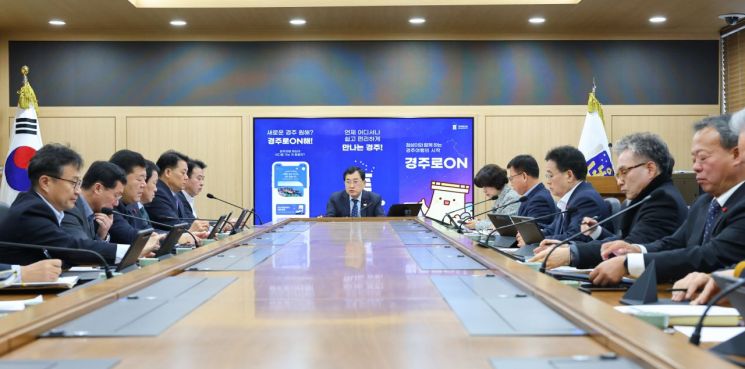 Mayor Jun Nakyoung is presiding over the local headquarters chiefs meeting on the morning of the 5th at the video conference room inside the government office, speaking about the direction of city administration for the new year and key issues. Provided by Gyeongju City
In the meeting, the focus in the culture and tourism sector was on cultural infrastructure projects such as the restoration of the birthplace of Haewol Choi Si-hyung and the construction of an arts creation center. Plans to expand content utilizing Gyeongju’s historical and cultural assets, such as the Munmu the Great Royal Tomb sanctification project and national heritage utilization and promotion projects, were also reviewed.
In particular, it was emphasized that, as 19 national heritage agency projects have been selected and will receive large-scale funding from the national, provincial, and city budgets, managing project timelines and ensuring high quality are of utmost importance.
In the economy and industry sector, progress on improvements to the public market usage permit system and plans to revitalize traditional markets were reported. The city aims to establish open recruitment and fair contract systems in compliance with the law, while simultaneously implementing measures to protect existing merchants and modernize facilities, thereby enhancing both public interest and the competitiveness of local commercial districts.
In the agriculture, livestock, and marine sector, the confirmed purchase price for public stockpiled rice and measures for stabilizing farmers’ incomes were discussed, along with the operational performance of major tourism and leisure facilities such as the Jusangjeolli Observatory, Songdaemal Lighthouse Experience Exhibition Hall, and Oryu Camping Site. The city plans to strengthen stay-type tourism by ensuring stable facility operations and enhancing content.
In the urban development sector, plans for early commissioning of social infrastructure projects such as roads, flood control, and water and sewage systems were reviewed. Gyeongju City aims to commission more than 70% of its budget in the first half of the year by operating an early commissioning planning team, and to improve project quality through designs reflecting residents’ opinions and expedited administrative procedures.
In the welfare sector, reports were made on changes to welfare systems, including the completion of Hwangseong Senior Welfare Housing, reforms to the basic livelihood security system, and the issuance of mobile disability registration cards. The city will work to strengthen housing and living stability for seniors and vulnerable groups, and to enhance citizens’ satisfaction by expanding digital-based welfare services.
Mayor Jun Nakyoung stated, “This year marks an important turning point for Gyeongju as we enter a new phase following the APEC Summit. Now is not the time to simply list plans, but to create changes that citizens can feel through execution and ongoing review.”
Meanwhile, starting with this meeting, Gyeongju City plans to systematically monitor the progress of major policies and large-scale projects from the beginning of the year, and to fully implement city administration and mid- to long-term strategic tasks in preparation for the post-APEC era.
© The Asia Business Daily(www.asiae.co.kr). All rights reserved.
![Clutching a Stolen Dior Bag, Saying "I Hate Being Poor but Real"... The Grotesque Con of a "Human Knockoff" [Slate]](https://cwcontent.asiae.co.kr/asiaresize/183/2026021902243444107_1771435474.jpg)
















