Gwangju-Jeonnam Administrative Integration Moves Beyond Declaration to Implementation Stage
The administrative integration of Gwangju and Jeonnam has moved beyond a declaration and entered the implementation phase. Gwangju City has officially launched a dedicated organization for administrative integration, accelerating the push for unification.
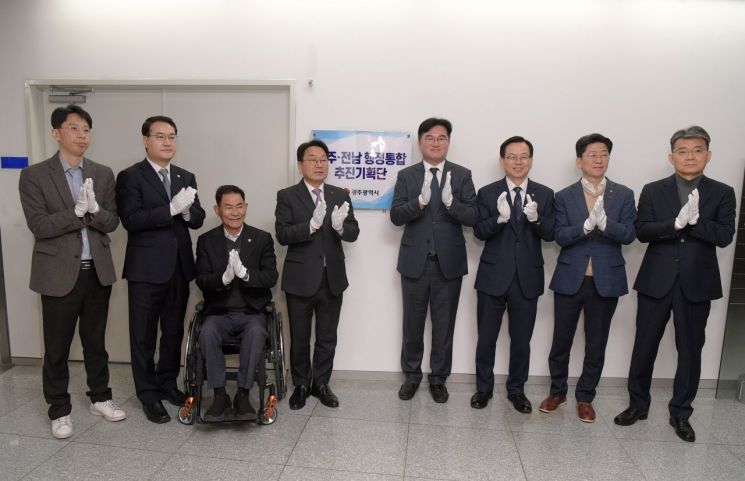 On the morning of the 5th, at Gwangju City Hall, participants including Gwangju Mayor Kang Gijeong and National Assembly member Jung Junho are taking a commemorative photo at the plaque ceremony for the Gwangju-Jeonnam Administrative Integration Promotion Planning Group. Photo by Gwangju City
On the morning of the 5th, Gwangju Metropolitan City announced that it held a plaque ceremony for the "Gwangju-Jeonnam Administrative Integration Promotion Planning Group" on the second floor of City Hall and activated an organization dedicated to preparing for administrative integration. The launch of the planning group is a follow-up measure to the "Gwangju-Jeonnam Administrative Integration Joint Declaration" announced on January 2 by Gwangju Mayor Kang Gijeong and Jeonnam Governor Kim Youngrok.
Attendees at the plaque ceremony included Mayor Kang Gijeong, Seo Yongkyu, Vice Chairman of the Gwangju City Council, Ko Kwangwan, Vice Mayor for Administrative Affairs, Kim Youngmoon, Vice Mayor for Culture and Economy, and Lee Byungcheol, Director of Planning and Coordination.
The planning group consists of one team, two divisions, and 16 members. Kim Youngmoon, Vice Mayor for Culture and Economy, will serve as the head. The planning group will oversee all aspects of preparation for integration, including implementing administrative procedures related to integration, forming and operating public-private consultative bodies, and supporting citizen communication and public discussion.
The Gwangju-Jeonnam administrative integration is being promoted in conjunction with the "Five Axes, Three Special Zones" system, a national balanced growth strategy of the Lee Jaemyung administration. Both the city and province plan to enhance industrial competitiveness and establish a super-regional administrative foundation through integration.
If the integration is achieved, Gwangju City expects that key projects such as the artificial intelligence (AI) and semiconductor industries, the creation of RE100 industrial complexes, and the establishment of a joint civil-military airport will gain momentum. The city also anticipates positive effects such as attracting national strategic industries and expanding regional growth engines.
On the same day, Jeonnam Province also formed an administrative integration promotion planning group of the same scale as Gwangju City. The two local governments plan to jointly promote integration discussions by establishing a cooperative system between the planning groups.
Gwangju Mayor Kang Gijeong stated, "Administrative integration, which we have not achieved for 30 years, has entered the promotion phase thanks to the support of President Lee Jaemyung, the proposal of Governor Kim Youngrok, and the determination of both the city and province. With the launch of the planning group, we will realize the aspirations of the people of Gwangju and Jeonnam for a prosperous future."
Mayor Kang also said, "The administrative integration of Gwangju and Jeonnam will become the first case of region-led growth and national balanced development. If integration is achieved, we will secure a status equivalent to Seoul Metropolitan City and autonomy and decentralization powers at the level of a federal system."
© The Asia Business Daily(www.asiae.co.kr). All rights reserved.
![Clutching a Stolen Dior Bag, Saying "I Hate Being Poor but Real"... The Grotesque Con of a "Human Knockoff" [Slate]](https://cwcontent.asiae.co.kr/asiaresize/183/2026021902243444107_1771435474.jpg)
















