Attempts to Seize Control of Natural Resources Raise Strong Concerns in Latin America
Ambiguous Stance from Europe, Including France and Germany
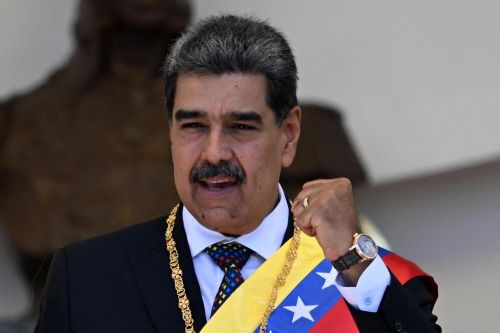 Nicolas Maduro, President of Venezuela, is greeting after taking the oath at the inauguration ceremony in January last year. Photo by AFP Yonhap News
Latin American countries have formed an anti-American alliance and have issued public criticism over the arrest of Venezuelan President Nicolas Maduro by the United States. Tensions have also heightened in Denmark after U.S. President Donald Trump demonstrated renewed territorial ambitions regarding Danish-controlled Greenland, following the U.S. military intervention in Venezuela.
On January 4 (local time), five Latin American countries-Brazil, Chile, Colombia, Mexico, and Uruguay-along with Spain, issued a joint statement expressing "deep concern and strong rejection of the unilateral military actions carried out on Venezuelan territory," and stated, "This is a violation of the fundamental principles of international law." These countries also warned that "such actions set a very dangerous precedent for the international order" and called for a peaceful resolution without external intervention.
In particular, Latin American nations have voiced concerns about attempts to seize control over Venezuela's key natural resources. According to the Washington Post, Marco Rubio, the U.S. Secretary of State of Latin American descent, is expected to become a "key man" overseeing overall policy, including the allocation of oil resources, during the transitional period before the new government is inaugurated.
The fear among the Danish public has also intensified as they have watched the Trump administration, which has declared an "isolationist" stance, resort to military force when national interests are at stake. From the beginning of his term in January last year, President Trump has repeatedly made threatening remarks about incorporating resource-rich, strategically located Greenland as U.S. territory, stating that he would use physical force if necessary.
Amid these developments, President Trump reiterated on January 4, immediately after the attack on Venezuela, that Greenland is necessary for U.S. defense. Following Trump's remarks, Danish Prime Minister Mette Frederiksen issued a statement saying, "We must make it absolutely clear to the United States that the idea of taking control of Greenland is completely absurd," and called for an immediate halt to acts that threaten allied nations.
Russia and China, which are among the fundamental causes behind the U.S. attack on Venezuela, also immediately condemned the United States. The Russian Foreign Ministry stated, "The United States has committed an act of armed aggression against Venezuela," adding, "This deserves strong condemnation." The Chinese Foreign Ministry said, "We are deeply shocked by the U.S. use of force against a sovereign nation and the use of force against the president of a country, and we strongly condemn it." Belarus, a Russian ally, also joined this wave of criticism.
What stands out is the ambiguous stance of Europe, a traditional U.S. ally. French President Emmanuel Macron and German Chancellor Friedrich Merz emphasized the need to abide by international law and advocated for a peaceful transition as a principle. Ursula von der Leyen, President of the European Commission, also stated, "We stand with the people of Venezuela and support a peaceful and democratic transition," adding, "All solutions must respect international law and the United Nations Charter."
Politico Europe noted, "Europe is buying time rather than producing results," pointing out that these countries are maintaining an ambiguous stance that borders on 'strategic silence.' The Guardian interpreted this as "insurance diplomacy rather than pacifism," suggesting that it is an effort to avoid open confrontation with the United States while also preventing diplomatic rupture with leftist governments in South America.
Meanwhile, Trump's allies-Argentine President Javier Milei and Israeli Prime Minister Benjamin Netanyahu-competed to make sycophantic remarks such as, "Today's news is very good news for the free world," and "Congratulations to President Trump for his bold and historic leadership for freedom and justice." Nigel Farage, leader of the Reform UK party and often called the "British Trump," also praised the U.S. action, saying, "If this makes China and Russia hesitate, it may be a good thing."
© The Asia Business Daily(www.asiae.co.kr). All rights reserved.
![Clutching a Stolen Dior Bag, Saying "I Hate Being Poor but Real"... The Grotesque Con of a "Human Knockoff" [Slate]](https://cwcontent.asiae.co.kr/asiaresize/183/2026021902243444107_1771435474.jpg)











