U.S. Engages in Talks with Rodriguez... Backlash Expected over "Maduro 2.0"
Risk of Civil War if Negotiations Fail... "Iraq Scenario Should Be a Warning"
For the Opposition: "Machado Unlikely to Become Leader"
As U.S. President Donald Trump has ousted Venezuelan President Nicolas Maduro, global attention is now focused on how the political situation in Venezuela will unfold. On January 4 (local time), the Trump administration stated that its policy objective for Venezuela is "to bring about changes beneficial to the United States." While there are rising expectations both domestically and internationally for a rapid return to normalcy, it is difficult to rule out the possibility of major turmoil.
Currently, the Trump administration is continuing dialogue with Maduro's associates, led by Vice President Delsy Rodriguez, who has been appointed as acting president by the Venezuelan Supreme Court. President Trump said the previous day, "She [Rodriguez] is essentially willing to do whatever we think is necessary to make Venezuela great again." U.S. Secretary of State Marco Rubio also stated on the same day that Vice President Rodriguez told him, "I will do whatever is necessary."
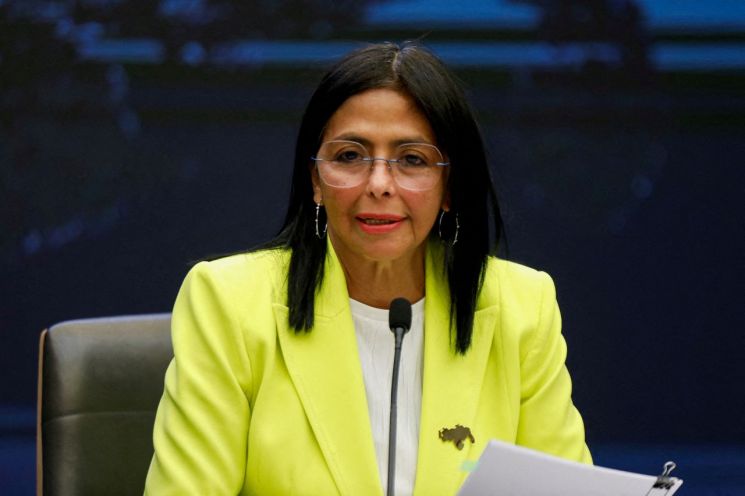
However, Vice President Rodriguez expressed a defiant stance against the United States at an emergency cabinet meeting on January 3, stating, "There is only one president in Venezuela, and that is Maduro." In response, Secretary Rubio pressured Rodriguez, saying, "I hope she chooses a different path than the one Maduro has chosen."
Vice President Rodriguez is the daughter of Jorge Antonio Rodriguez, a leader of Venezuela's leftist guerrilla movement, and entered politics during the Hugo Chavez administration. Along with her brother, National Assembly Speaker Jorge Rodriguez, she is considered one of the key figures in the Maduro regime.
Even if Vice President Rodriguez successfully negotiates with the United States, the future remains uncertain. She will inevitably have to align herself with key Maduro regime figures such as Interior Minister Diosdado Cabello and Defense Minister Vladimir Padrino. Both of these individuals have bounties of $25 million and $15 million, respectively, placed on them by the United States. As this would essentially be a continuation of the Maduro regime, widespread public backlash is also expected.
Secretary Rubio said in an NBC interview that, at this point, it is premature to discuss elections in Venezuela.
Nicholas Watson, Managing Director at consulting firm Teneo, told Bloomberg that the United States appears to be considering a hybrid arrangement in which some Chavez loyalists remain in senior government positions on the condition that they shift to a pro-American stance. He noted, "While this could help avoid a dangerous power vacuum, a highly pragmatic agreement centered on figures with limited legitimacy may be difficult for Venezuelans to accept."
The Nihon Keizai Shimbun (Nikkei) also pointed out that, during the first Trump administration in 2019, the United States attempted to topple the Maduro regime by supporting Juan Guaido's interim government, but the perception that the interim government was acting according to U.S. interests led to a loss of national cohesion.
There is also a scenario in which negotiations between the United States and Venezuela break down. If this happens, Venezuela, having lost its political center, could face the worst-case scenario of civil war.
The movements of Venezuela's military, which is strongly anti-American, are a key variable. Led by Minister Padrino, the military has maintained the Maduro regime for over a decade by thwarting numerous coup attempts by the opposition and has served as the regime's backbone. In a video address that day, Minister Padrino described President Maduro's arrest as "imperialist aggression." It is known that there are figures within the Maduro regime and the military linked to the major drug cartel "Cartel de los Soles" (Cartel of the Suns), and if these criminal groups become involved, massive chaos could ensue.
David FitzGerald, former head of Latin American operations at the CIA, told Bloomberg, referring to the aftermath of Saddam Hussein's removal in Iraq, "We're not at that stage yet. But I think it's something we need to be vigilant about."
The Wall Street Journal (WSJ) reported that, for President Trump to successfully implement his plan to run Venezuela in line with U.S. interests, securing the cooperation of the military leadership is crucial.
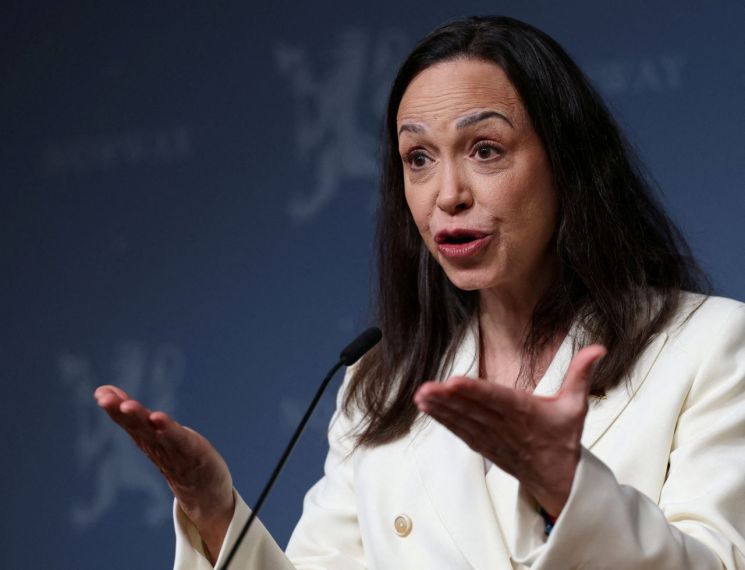 Maria Corina Machado, Venezuelan opposition leader and recipient of the 2025 Nobel Peace Prize. Photo by Reuters Yonhap News
There is also the possibility that the Venezuelan opposition could take over the government. However, at present, this does not seem highly likely.
Maria Corina Machado, the opposition leader who won the Nobel Peace Prize last year, has emphasized that Edmundo Gonzalez, who was elected in the 2024 presidential election, is the legitimate president and has expressed her intention to assume power.
However, President Trump stated, "For now, it is very difficult for her to become the leader," adding, "She is a very good woman, but she is not respected." Secretary Rubio also said that most opposition figures are not in Venezuela, and for now, the United States intends to continue dialogue with the current Venezuelan government rather than with Machado or Gonzalez.
Nikkei noted that while Machado enjoys strong public support, her relationship with the Trump administration could provoke backlash.
© The Asia Business Daily(www.asiae.co.kr). All rights reserved.


















