Eight New Institutions Join This Year
Advancing the Full-Cycle Support System for Semiconductor R&D
The government is expanding the number of participating organizations in "MoaFab," an integrated platform that unifies domestic public nanofabs, and is also strengthening user-centric services. The plan is to connect previously scattered nanoprocessing infrastructure to enhance the competitiveness of semiconductor research and development (R&D).
The Ministry of Science and ICT announced that it will expand the number of participating organizations in the national nanofab integrated information system, MoaFab, from the current six to 14 institutions starting in January 2026. The eight new participants include the Jeonbuk Nano Technology Integration Center of the Korea Electronics Technology Institute, the Gwangju Nano Technology Integration Center of the Korea Institute of Industrial Technology, the Nano Process Technology Center of Daegu Technopark, the Research Equipment Education and Support Division of Ulsan National Institute of Science and Technology, the Semiconductor Physics Research Institute at Jeonbuk National University, the Research Convergence Support Division of the Korea Institute of Science and Technology, the Cheorwon Plasma Industry Technology Institute, and the Nano Convergence Center of Gyeongnam Technopark.
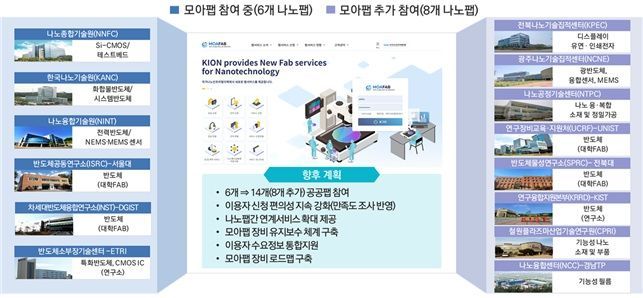
MoaFab is an integrated platform that connects public nanofabs across Korea, enabling researchers and companies to utilize advanced equipment more efficiently. It is designed to support the entire R&D cycle, from basic and original technology research to prototype production and technology commercialization. From the user perspective, it offers convenience features such as unified service application and management, real-time progress monitoring, reservation time recommendations, institution-specific equipment and expert information, and applications for nanofab support programs.
In terms of operations, the platform has improved fab service efficiency by establishing a process management system, expanding mobile-based service processing capabilities, and supporting process integration between institutions. This has laid the foundation for organically connecting the equipment, personnel, and data held by each organization.
MoaFab has been expanded in phases. Phase 1 began in January 2024 with three participating institutions: the National NanoFab Center, the Korea Nanotechnology Research Society, and the Nano Convergence Technology Institute. In September of the same year, three more institutions joined: the Semiconductor Joint Research Center at Seoul National University, the Next-Generation Semiconductor Convergence Research Center at Daegu Gyeongbuk Institute of Science and Technology (DGIST), and the Semiconductor Materials, Parts, and Equipment Technology Center at the Electronics and Telecommunications Research Institute, bringing the total to six. With the third phase of expansion in January 2026, the system will include 14 organizations.
The government is also pursuing public-private collaboration. The Ministry of Science and ICT signed a memorandum of understanding (MOU) in March 2025 with Samsung Electronics, SK hynix, and DB HiTek to advance the functions of MoaFab. The goal is to strengthen public support functions based on public nanofabs in areas such as R&D, performance evaluation, prototype production, and workforce development. The three semiconductor companies are also supporting the operation of public nanofabs by providing advanced process equipment, offering operational consulting, and utilizing highly experienced professionals, thereby enhancing operational expertise and helping to prevent talent outflow.
Lee Kangwoo, Director of Basic Technology at the Ministry of Science and ICT, stated, "Expanding the number of MoaFab participating organizations will improve researchers' access to public nanofabs and increase equipment utilization rates. Based on public-private collaboration, we will continue to advance customized support services for users to further strengthen Korea's competitiveness in nanotechnology and semiconductor research."
© The Asia Business Daily(www.asiae.co.kr). All rights reserved.

















