Debuted at Age Five, Starred in 170 Films: The Face of Korean Cinema
A Leading Figure in 1980s Realism and Blockbusters
Ultimately Lost His Battle with Blood Cancer
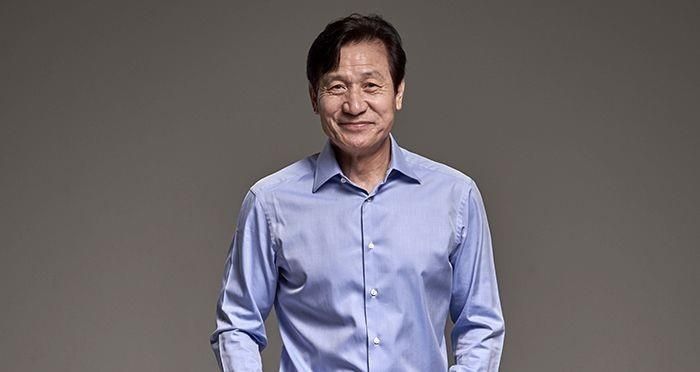
Ahn Sungki, widely regarded as the "national actor" representing Korean cinema, passed away on January 5. He was 74 years old.
The Korean Actors Association announced that Ahn died that morning in the intensive care unit at Soonchunhyang University Hospital in Seoul, surrounded by his family. The cause of death was brain death due to airway obstruction. On December 30, he collapsed at home after food blocked his airway and was taken to the hospital, but he never regained consciousness during the six days that followed. The sense of loss is even greater because, despite being diagnosed with blood cancer in 2019 and undergoing treatment, he continued to make public appearances and expressed a strong will to return to acting until recently.
His 69-year acting career paralleled the trajectory of modern Korean history. Born in 1952, Ahn made his debut at the age of five in director Kim Ki-young's film "Twilight Train" in 1957. He went on to appear in more than 70 films, including "The Housemaid" (1960) and "Pig Dream" (1961), earning a reputation as a "child prodigy." Notably, in 1959, he won the Special Acting Award for Boys at the San Francisco International Film Festival for "Teenage Rebellion." This was the first time a Korean actor had received an acting award at an overseas film festival.
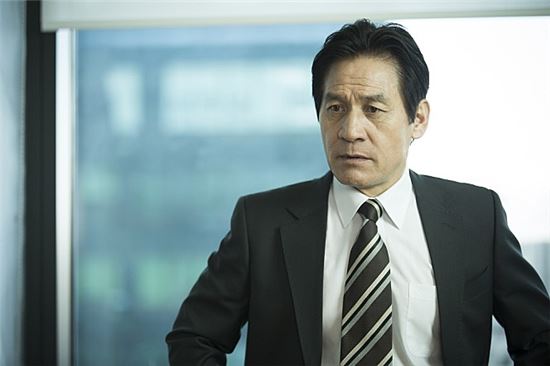 Ahn Sungki
After starring in "The Young Zelkova Tree" in 1968, he briefly stepped away from the screen. He entered the Department of Vietnamese at Hankuk University of Foreign Studies, completed his studies, and fulfilled his military service as an ROTC officer. After being discharged, he worked for a trading company, living the life of an ordinary office worker for a time.
It was director Lee Jangho's "The Windy But Pleasant Day" in 1980 that called him back to the film industry. Playing Deok-bae, a deliveryman at a Chinese restaurant, Ahn naturally portrayed the awkward yet pure-hearted face of the everyday citizen. This marked the beginning of his role as a leading figure in the "New Wave" of Korean cinema in the 1980s.
His heyday was dazzling. Teaming up with director Bae Changho, he delivered a string of hits, including "People of Kkobang Neighborhood" (1982), "Flower on the Equator" (1983), "Whale Hunting" (1984), and "Deep Blue Night" (1985). With director Im Kwon-taek, he deepened his acting through "Mandala" (1981). The Korean Film Archive described Ahn Sungki during this period as "the most realistic persona representing the suppressed youth and the joys and sorrows of ordinary citizens under the dictatorship." Works with strong social criticism, such as "Chilsu and Mansu" (1988) and "Age of Success" (1988), also reached the public through his performances.
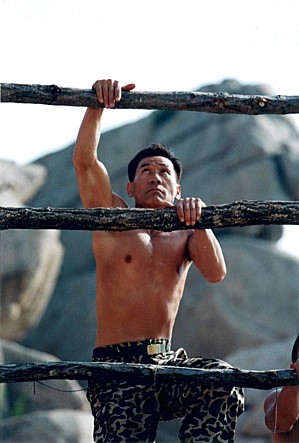 Movie Still Cut of "Silmido"
He continued to reinvent himself throughout the 1990s and 2000s. In director Chung Ji-young's "North Korean Partisan in South Korea" (1990) and "White Badge" (1992), he portrayed the anguish of intellectuals. In Kang Woo-suk's "Two Cops" (1993), he took on the role of a sly, corrupt detective, even mastering the art of comedy. In 2003, he reunited with director Kang Woo-suk to drive the box office success of "Silmido," the first Korean film to attract 10 million viewers. In 2012, he played a strict mathematics professor in "Unbowed," sparking social debate. Over his lifetime, he appeared in more than 170 films, sweeping major Best Actor awards at the Baeksang Arts Awards, Grand Bell Awards, Blue Dragon Film Awards, and other leading domestic film festivals dozens of times.
Off-screen, he was a true "adult." Known for his thorough self-discipline and upright character, he was one of the rare actors in the entertainment industry without any "antis." He also took the lead in protecting the rights and interests of the film industry. In the early 2000s, he spearheaded the movement against the reduction of the screen quota system, led the Good Downloader Campaign, served as chairman of the Shin Young-kyun Arts & Culture Foundation, and acted as a UNICEF Goodwill Ambassador, fulfilling his social responsibilities.
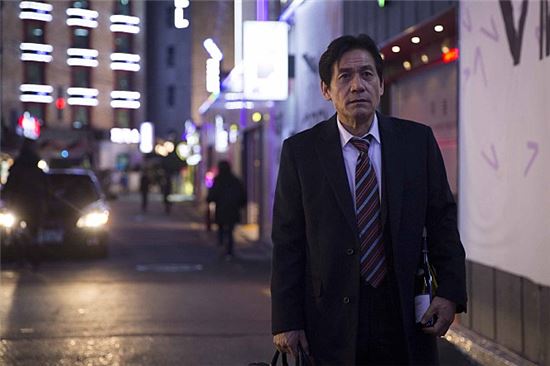 Ahn Sungki
The memorial altar will be set up at the funeral hall of Seoul St. Mary's Hospital. The funeral will take place on January 8, with the burial site yet to be determined.
© The Asia Business Daily(www.asiae.co.kr). All rights reserved.
![Clutching a Stolen Dior Bag, Saying "I Hate Being Poor but Real"... The Grotesque Con of a "Human Knockoff" [Slate]](https://cwcontent.asiae.co.kr/asiaresize/183/2026021902243444107_1771435474.jpg)
















